


MHT CET · Physics · Mechanical Properties of Fluids
A liquid drop of density ' \(\rho\) ' is floating half immersed in a liquid of density ' \(d\) '. If ' \(T\) ' is the surface tension then the diameter of the liquid drop is ( \(\mathrm{g}=\) acceleration due to gravity)
- A \(\left[\frac{6 \mathrm{~T}}{\mathrm{~g}(2 \rho-\mathrm{d})}\right]^{\frac{1}{2}}\)
- B \(\left[\frac{8 \mathrm{~T}}{3 \mathrm{~g}(2 \rho-\mathrm{d})}\right]^{\frac{1}{2}}\)
- C \(\left[\frac{12 \mathrm{~T}}{\mathrm{~g}(2 \rho-\mathrm{d})}\right]^{\frac{1}{2}}\)
- D \(\left[\frac{3 \mathrm{~T}}{\mathrm{~g}(2 \rho-\mathrm{d})}\right]^{\frac{\mathrm{t}}{2}}\)
Answer & Solution
Correct Answer
(C) \(\left[\frac{12 \mathrm{~T}}{\mathrm{~g}(2 \rho-\mathrm{d})}\right]^{\frac{1}{2}}\)
Step-by-step Solution
Detailed explanation
\(\begin{aligned} & \text { Surface Tension }=\mathrm{T} \times 2 \pi \mathrm{r} \\ & \frac{4}{3} \pi \mathrm{r}^3 \rho \mathrm{~g}=2 \pi \mathrm{rT}+\frac{1}{2} \times \frac{4}{3} \pi \mathrm{r}^3 \mathrm{dg}\end{aligned}\)
\(\begin{array}{ll}\therefore \quad & 2 \pi r T=\frac{4}{3} \pi r^3 \rho g-\left(\frac{4}{3} \pi r^3 d g\right) \times \frac{1}{2} \\ & 2 \pi T=\frac{4}{3} \pi r^2 g\left(\rho-\frac{d}{2}\right) \\ \therefore & r^2=\frac{2 \pi T}{\frac{4}{3} \pi g\left(\rho-\frac{d}{2}\right)} \\ \therefore & r^2=\frac{3 T}{g(2 \rho-d)} \Rightarrow r=\sqrt{\frac{3 T}{g(2 \rho-d)}} \\ & \text { Diameter }=2 r=\sqrt{\frac{12 T}{g(2 \rho-d)}}\end{array}\)
\(\begin{array}{ll}\therefore \quad & 2 \pi r T=\frac{4}{3} \pi r^3 \rho g-\left(\frac{4}{3} \pi r^3 d g\right) \times \frac{1}{2} \\ & 2 \pi T=\frac{4}{3} \pi r^2 g\left(\rho-\frac{d}{2}\right) \\ \therefore & r^2=\frac{2 \pi T}{\frac{4}{3} \pi g\left(\rho-\frac{d}{2}\right)} \\ \therefore & r^2=\frac{3 T}{g(2 \rho-d)} \Rightarrow r=\sqrt{\frac{3 T}{g(2 \rho-d)}} \\ & \text { Diameter }=2 r=\sqrt{\frac{12 T}{g(2 \rho-d)}}\end{array}\)
See the Complete Solution
Get step-by-step explanations for this and 2.5 Lakh+ more JEE, NEET & CET questions.
- Unlock all solutions
- Practice the full chapter
- Track accuracy across PYQs
4.8 rated on Google Play · 14,000+ reviews
More questions from Physics
- A glass slab of thickness 4.8 cm is placed on the piece of paper on which an ink dot is marked. By how much distance would an ink dot appear to be raised?
\((\) The refractive index of glass \(=1.5)\)MHT CET 2024 Easy - In a hydrogen atom in its ground state, the first Bohr orbit has radius \(r_1\). The electron's orbital speed becomes one-third when the atom is raised to one of its excited states. The radius of the orbit in that excited state isMHT CET 2024 Medium
- If you set up the seven overtone on a string fixed at both ends, how many nodes and antinodes are set up in it?MHT CET 2009 Easy
- Which of the following graphs between pressure and volume correctly show isochoric process?
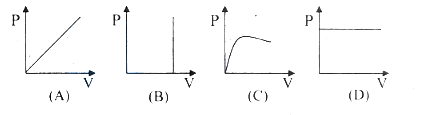 MHT CET 2024 Easy
 - In which layer of the atmosphere, the water vapour is present?MHT CET 2020 Easy
- When a current of \(2 \mathrm{~A}\) is passed through a coil of 100 turns, flux associated with it is \(5 \times 10^{-5} \mathrm{~Wb}\). Find the self inductance of the coil.MHT CET 2010 Medium
More PYQs from MHT CET
- What reagent is used in Etard reaction?MHT CET 2016 Easy
- A parallel beam of light is incident normally on a plane surface absorbing 50\% of the light and reflecting the rest. If the incident beam carries 90 W of power, the force exerted by it on the surface is \(\left(\mathrm{C}=\right.\) velocity of light in air \(\left.=3 \times 10^8 \mathrm{~m} / \mathrm{s}\right)\)MHT CET 2025 Medium
- A carnot engine operates with source at \(227^{\circ} \mathrm{C}\) and sink at \(27{ }^{\circ} \mathrm{C}\). If the source supplies \(50 \mathrm{~kJ}\) of heat energy, the work done by the engine isMHT CET 2023 Medium
- Two strings \(A\) and \(B\) of same material are stretched by same tension. The radius of the string \(A\) is double the radius of string \(B\). Transverse wave travels on string \(A\) with speed \(V_A\) and on string B with speed \(V_B\). The ratio \(\frac{V_A}{V_B}\) isMHT CET 2016 Easy
- Susceptibility of a paramagnetic substance isMHT CET 2025 Easy
- The solution of the differential equation \(\mathrm{e}^{-x}(y+1) \mathrm{d} y+\left(\cos ^2 x-\sin 2 x\right) y \mathrm{~d} x=0\) at \(x=0\), \(y=1\) isMHT CET 2023 Medium