


MHT CET · Physics · Electrostatics
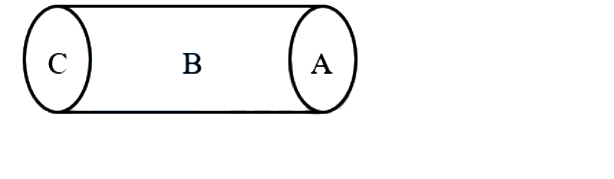
A hollow cylinder has a charge \(q\) coulomb within it. If \(\phi\) is the electric flux associated with the surface \(B\), the flux linked with the plane surface A will be
- A \(\frac{\phi}{2}\)
- B \(\frac{\phi}{\epsilon_0}-\phi\)
- C \(\frac{1}{2}\left(\frac{\mathrm{q}}{\epsilon_0}-\phi\right)\)
- D \(\frac{q}{2 \epsilon_0}\)
Answer & Solution
Correct Answer
(C) \(\frac{1}{2}\left(\frac{\mathrm{q}}{\epsilon_0}-\phi\right)\)
Step-by-step Solution
Detailed explanation
The correct option is (C).
Concept: Gauss Law: Net flux through an enclosing surface is proportional to the charge inside, or \(\phi_{\mathrm{T}}=\frac{\mathrm{q}}{\varepsilon_0}\), where \(\mathrm{q}\) is the charge inside, \(\varepsilon_0\) the free permitivity of the space and \(\phi_{\mathrm{T}}\) is the total flux
The flux associated with the lateral surface B is \(\phi\). Due to symmetry of the system, the flux associated with surface A should be the same as surface \(\mathrm{C}\). Let the flux associated with the surface A be \(\phi_0\).
Therefore, the total flux is \(\phi_0+\phi+\phi_0=\frac{q}{\varepsilon_0}\)
So, the flux associated with the surface \(A\) is \(\phi_0=\frac{1}{2}\left(\frac{q}{\epsilon_0}-\phi\right)\)
Concept: Gauss Law: Net flux through an enclosing surface is proportional to the charge inside, or \(\phi_{\mathrm{T}}=\frac{\mathrm{q}}{\varepsilon_0}\), where \(\mathrm{q}\) is the charge inside, \(\varepsilon_0\) the free permitivity of the space and \(\phi_{\mathrm{T}}\) is the total flux
The flux associated with the lateral surface B is \(\phi\). Due to symmetry of the system, the flux associated with surface A should be the same as surface \(\mathrm{C}\). Let the flux associated with the surface A be \(\phi_0\).
Therefore, the total flux is \(\phi_0+\phi+\phi_0=\frac{q}{\varepsilon_0}\)
So, the flux associated with the surface \(A\) is \(\phi_0=\frac{1}{2}\left(\frac{q}{\epsilon_0}-\phi\right)\)
See the Complete Solution
Get step-by-step explanations for this and 2.5 Lakh+ more JEE, NEET & CET questions.
- Unlock all solutions
- Practice the full chapter
- Track accuracy across PYQs
4.8 rated on Google Play · 14,000+ reviews
More questions from Physics
- If \(L\) is the inductance and \(R\) is the resistance then the SI unit of \(\frac{L}{R}\) isMHT CET 2025 Easy
- A unit vector in the direction of resultant vector of \(\vec{A}=-2 \hat{i}+3 \hat{j}+\hat{k}\) and \(\vec{B}=\hat{i}+2 \hat{j}-4 \hat{k}\) isMHT CET 2025 Easy
- In hydrogen spectrum, the wavelengths of light emitted in a series of spectral lines
is given by the equation,
\(\frac{1}{\lambda}=\mathrm{R}\left(\frac{1}{4^{2}}-\frac{1}{\mathrm{n}^{2}}\right)\), where \(\mathrm{n}=5,6,7 \ldots \ldots \ldots . .\) and \({ }^{\prime} \mathrm{R}^{\prime}\) is Rydberg's constant. Identify the
series and wavelength region.MHT CET 2020 Easy - Which of the following combinations of identical capacitors each of gives a resultant capacitance ofMHT CET 2019 Medium
- Two planar concentric rings of metal wire having radii \(r_1\) and \(r_2\) ( \(r_1>r_2\) ) are placed in air. The current I is flowing through the coil of larger radius. The mutual inductance between the coils is given by ( \(\mu_0=\) permeability of free space)MHT CET 2025 Medium
- If \(\vec{A}=\hat{i}+\hat{j}+3 \hat{k}, \vec{B}=-\hat{i}+\hat{j}+4 \hat{k}\) and \(\vec{C}=2 \hat{i}-2 \hat{j}-8 \hat{k}\), then the angle between the vectors \(\vec{P}=\vec{A}+\vec{B}+\vec{C}\) and \(\vec{Q}=(\vec{A} \times \vec{B})\) is (in degree)MHT CET 2025 Medium
More PYQs from MHT CET
- The electron in hydrogen atom is initially in the third excited state. When it finally moves to ground state, the maximum number of spectral lines emitted areMHT CET 2021 Easy
- The combined equation of the lines passing through the origin making an acute angle \(\propto\) with the line \(y=x\) isMHT CET 2022 Easy
- In a triangle \(A B C\) with usual notations, If \(a: b: c=7: 8: 9\) : then \(\cos A: \cos B: \cos C=\)MHT CET 2022 Easy
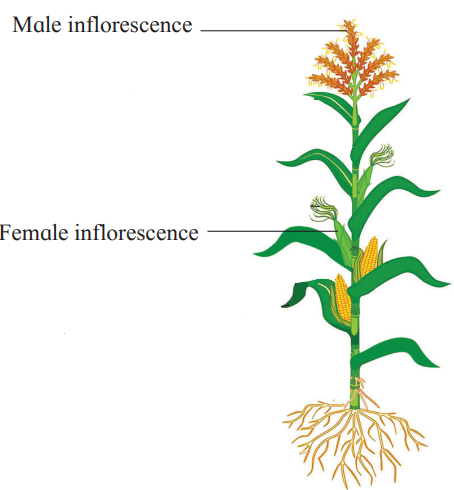
- Arrangement of flowers in the given plant favours which type of pollination?
 MHT CET 2019 Medium
 - The radius of planet is twice the radius of the earth. Both have almost equal average mass densities. If ' \(V_P\) ' and ' \(V_E\) ' are escape velocities of the planet and the earth respectively, thenMHT CET 2021 Medium
- Identify Swartz reaction from the following.MHT CET 2022 Easy