


MHT CET · Physics · Ray Optics
A glass prism ' \(A\) ' deviates the red and blue rays through \(10^{\circ}\) and \(12^{\circ}\) respectively. A second prism ' B ' deviates them through \(8^{\circ}\) and \(10^{\circ}\) respectively. The ratio of their dispersive powers is (A to B)
- A 9:13
- B \(4: 5\)
- C \(9: 11\)
- D \(8: 9\)
Answer & Solution
Correct Answer
(C) \(9: 11\)
Step-by-step Solution
Detailed explanation
Dispersive power
\(\omega=\frac{\delta_v-\delta_R}{\delta_y}, \delta_y=\frac{\delta_v+\delta_R}{2}...(i)\)
For prism A: \(\delta_y=\frac{12+10}{2}=11\)
\(\omega_{\mathrm{A}}=\frac{12-10}{11}=\frac{2}{11}\)
For prism B: \(\delta_y=\frac{8+10}{2}=9\)
\(\begin{aligned}
& \omega_{\mathrm{B}}=\frac{10-8}{9}=\frac{2}{9} \\
\therefore \quad & \frac{\omega_{\mathrm{A}}}{\omega_{\mathrm{B}}}=\frac{9}{11}
\end{aligned}\)
\(\omega=\frac{\delta_v-\delta_R}{\delta_y}, \delta_y=\frac{\delta_v+\delta_R}{2}...(i)\)
For prism A: \(\delta_y=\frac{12+10}{2}=11\)
\(\omega_{\mathrm{A}}=\frac{12-10}{11}=\frac{2}{11}\)
For prism B: \(\delta_y=\frac{8+10}{2}=9\)
\(\begin{aligned}
& \omega_{\mathrm{B}}=\frac{10-8}{9}=\frac{2}{9} \\
\therefore \quad & \frac{\omega_{\mathrm{A}}}{\omega_{\mathrm{B}}}=\frac{9}{11}
\end{aligned}\)
See the Complete Solution
Get step-by-step explanations for this and 2.5 Lakh+ more JEE, NEET & CET questions.
- Unlock all solutions
- Practice the full chapter
- Track accuracy across PYQs
4.8 rated on Google Play · 14,000+ reviews
More questions from Physics
- Two inductors of \(60 \mathrm{mH}\) each are joined in parallel. The current passing through this combination is \(2.2 \mathrm{~A}\). The energy stored in this combination of inductors in joule isMHT CET 2023 Medium
- If only \(5 \%\) of the total current is to be passed through galvanometer of resistance G, then the resistance of the shunt will beMHT CET 2025 Easy
- In a resonance pipe the first and second resonances are obtained at depths \(22.7 \mathrm{~cm}\) and \(70.2 \mathrm{~cm}\) respectively. What will be the end correction ?MHT CET 2009 Medium
- An object of mass 0.2 kg executes simple harmonic oscillations along the \(X\) - axis with frequency of \(\left(\frac{25}{\pi}\right) \mathrm{Hz}\). At the position \(x=0.04 \mathrm{~m}\), the object has kinetic energy 1 J and potential energy 0.6 J . The amplitude of oscillation isMHT CET 2025 Medium
- An inductance of \(\frac{300}{\pi} \mathrm{mH}\), a capacitance of \(\frac{1}{\pi} \mathrm{mF}\) and a resistance of \(20 \Omega\) are connected in series with an a.c. source of \(240 \mathrm{~V}, 50 \mathrm{~Hz}\). The phase angle of the circuit isMHT CET 2024 Medium
- A sphere of mass 25 gram is placed on a vertical spring. Spring is compressed by \(0.2 \mathrm{~m}\) using a force \(5 \mathrm{~N}\). When the spring is relaxed, mass is reaching a height of \(\left(\mathrm{g}=10 \mathrm{~m} / \mathrm{s}^2\right)\)MHT CET 2021 Easy
More PYQs from MHT CET
- Identify the major product formed when 2-Methylhexan-3-ol is heated with concentrated sulphuric acid.
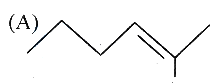
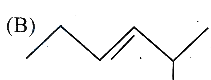
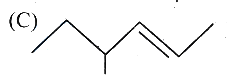
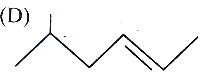 MHT CET 2024 Medium
 - For the reaction \(2 \mathrm{~A}+2 \mathrm{~B} \rightarrow 2 \mathrm{C}+\mathrm{D}\), the rate law is expressed as rate \(=k[A]^2[B]\). Calculate the rate constant if rate of reaction is \(0.24 \mathrm{~mol} \mathrm{dm}^{-3} \mathrm{~s}^{-1}\).
\(([\mathrm{A}]=0.5 \mathrm{M}\) and \([\mathrm{B}]=0.2 \mathrm{M}\) )MHT CET 2023 Medium - If \(x^{2}+y^{2}=t+\frac{1}{t}, x^{4}+y^{4}=t^{2}+\frac{1}{t^{2}}\) then \(\frac{d y}{d x}=\)MHT CET 2020 Medium
- What is the oxidation number of gold in the complex \([AuCl_{4}]^{1-}?\)MHT CET 2018 Easy
- If \(\mathrm{AX}=\mathrm{B}\), where \(\mathrm{A}=\left[\begin{array}{ccc}1 & -1 & 1 \\ 2 & -1 & 0 \\ 3 & 3 & -4\end{array}\right], \mathrm{B}=\left[\begin{array}{l}1 \\ 1 \\ 2\end{array}\right]\) and \(\mathrm{X}=\left[\begin{array}{l}x \\ y \\ z\end{array}\right]\), then \(x+y+z=\)MHT CET 2020 Medium
- The line joining the points \(6 \overrightarrow{\mathbf{a}}-4 \overrightarrow{\mathbf{b}}+4 \overrightarrow{\mathbf{c}},-4 \overrightarrow{\mathbf{c}}\) and the line joining the
points \(-\overrightarrow{\mathbf{a}}-2 \overrightarrow{\mathbf{b}}-3 \overrightarrow{\mathbf{c}}, \overrightarrow{\mathbf{a}}+2 \overrightarrow{\mathbf{b}}-5 \overrightarrow{\mathbf{c}}\) intersect
atMHT CET 2008 Easy