


MHT CET · Physics · Thermal Properties of Matter
A cylindrical rod is having temperatures \(\theta_1\) and \(\theta_2\) at its ends. The rate of heat flow is ' \(\mathrm{Q}\) ' \(\mathrm{J} \mathrm{s}{ }^{-1}\). All the linear dimensions of the rod are doubled by keeping the temperatures constant. What is the new rate of flow of heat?
- A \(\frac{Q}{2}\)
- B \(\frac{Q}{4}\)
- C \(2 Q\)
- D \(\frac{3 Q}{2}\)
Answer & Solution
Correct Answer
(C) \(2 Q\)
Step-by-step Solution
Detailed explanation
\(\mathrm{Q}=\frac{\mathrm{kA} \Delta \theta}{\ell}\)
If the radius of the cylindrical rod is doubled, then its area of cross-section will become four times.
\(
\begin{aligned}
& \therefore \mathrm{A}_2=4 \mathrm{~A}_1 \\
& \text { Also, } \ell_2=2 \ell_1 \\
& \therefore \frac{\mathrm{Q}^{\prime}}{\mathrm{Q}}=\frac{\mathrm{A}_2}{\mathrm{~A}_1} \cdot \frac{\mathrm{d}_1}{\mathrm{~d}_2}=4 \times \frac{1}{2}=2 \\
& \therefore \mathrm{Q}^{\prime}=2 \mathrm{Q}
\end{aligned}
\)
If the radius of the cylindrical rod is doubled, then its area of cross-section will become four times.
\(
\begin{aligned}
& \therefore \mathrm{A}_2=4 \mathrm{~A}_1 \\
& \text { Also, } \ell_2=2 \ell_1 \\
& \therefore \frac{\mathrm{Q}^{\prime}}{\mathrm{Q}}=\frac{\mathrm{A}_2}{\mathrm{~A}_1} \cdot \frac{\mathrm{d}_1}{\mathrm{~d}_2}=4 \times \frac{1}{2}=2 \\
& \therefore \mathrm{Q}^{\prime}=2 \mathrm{Q}
\end{aligned}
\)
See the Complete Solution
Get step-by-step explanations for this and 2.5 Lakh+ more JEE, NEET & CET questions.
- Unlock all solutions
- Practice the full chapter
- Track accuracy across PYQs
4.8 rated on Google Play · 14,000+ reviews
More questions from Physics
- Which of the following graphs between pressure and volume correctly show isochoric process?
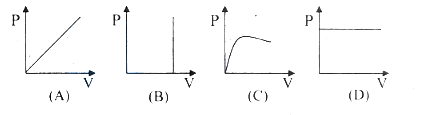 MHT CET 2024 Easy
 - In potentiometer experiment, cells of e.m.f. E and E 2 are connected in series (E \(_{1}>\mathrm{E}_{2}\) ), the balancing length is \(64 \mathrm{~cm}\) of the wire. If the polarity of \(\mathrm{E}_{2}\) is reversed, the balancing length becomes \(32 \mathrm{~cm}\). The ratio \(\frac{\mathrm{E}_{1}}{\mathrm{E}_{2}}\) isMHT CET 2020 Medium
- Assume that an electric field \(E=20 x^2 \hat{i}\) exists in space. If \(V_0\) is the potential at the origin and \(V_A\) is the potential at \(x=3 \mathrm{~m}\) then, the potential difference \(V_A-V_0\) in volts isMHT CET 2022 Hard
- Two identical progressive waves moving in opposite direction superimpose to
produce a stationary wave. The wavelength of each progressive wave is \(\lambda^{\prime}\). The
wavelength of the stationary wave isMHT CET 2020 Easy - A transverse wave given by \(\mathrm{y}=2 \sin (0.01 \mathrm{x}+30 \mathrm{t})\) moves on a stretched string from one end to another end in 0.5 second. If ' \(x\) ' and ' \(y\) ' are in \(\mathrm{cm}\) and ' \(\mathrm{t}\) ' is in second, then the length of the string isMHT CET 2021 Easy
- Select the correct statement.MHT CET 2025 Easy
More PYQs from MHT CET
- The projection of \(\overline{\mathrm{AB}}\) on \(\overline{\mathrm{CD}}\), where \(\mathrm{A} \equiv(2,-3,0), \mathrm{B} \equiv(1,-4,-2), \mathrm{C} \equiv(4,6,8)\) and \(\mathrm{D} \equiv(7,0,10)\) isMHT CET 2024 Easy
- The p.m.f of random variate \(\mathrm{X}\) is
\(\mathrm{P}(\mathrm{X})=\frac{2 x}{\mathrm{n}(\mathrm{n}+1)},x=1,2,3, \ldots \ldots, \mathrm{n} \ 0, \text { otherwise }\)
Then \(E(X)=\)MHT CET 2023 Medium - When \(6 \cdot 0 \mathrm{~g}\) of graphite reacts with dihydrogen to give methane gas, \(37 \cdot 4 \mathrm{~kJ}\) of heat is liberated. What is standard enthalpy of formation of \(\mathrm{CH}_{4_{(g)}}\) ?MHT CET 2020 Easy
- Which of the following have the same value
(a) \(\sin 120^{\circ}\)
(b) \(\cos 930^{\circ}\)
(c) \(\tan 840^{\circ}\)
(d) \(\cot \left(-1110^{\circ}\right)\)MHT CET 2020 Easy - In a class of 300 students, every student reads 5 news papers and every news paper is read by 60 students. Then the number of newspapers isMHT CET 2024 Easy
- Two charges \(\mathrm{q}_1=+6 \mathrm{q}\) and \(\mathrm{q}_2=-3 \mathrm{q}\) are placed as shown in figure. A proton is placed on x -axis away from \(\mathrm{q}_2\). To remain proton in equilibrium, the distance between \(\mathrm{q}_1\) and proton is
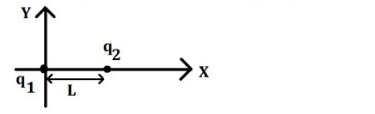 MHT CET 2025 Medium