


MHT CET · Physics · Waves and Sound
A closed organ pipe of length ' \(L_c\) ' and an open organ pipe of length ' \(L_0\) ' contain different gases of densities ' \(\rho_1\) ' and ' \(\rho_2\) ' respectively. The compressibility of the gases is the same in both the pipes. The gases are vibrating in their first overtone with the same frequency. What is the length of open organ pipe?
- A \(\frac{4 L_c}{3} \sqrt{\frac{\rho_1}{\rho_2}}\)
- B \(\frac{3 L_c}{4} \sqrt{\frac{\rho_2}{\rho_1}}\)
- C \(\frac{4 L_c}{3} \sqrt{\frac{\rho_2}{\rho_1}}\)
- D \(\frac{2 L_c}{3} \sqrt{\frac{\rho_2}{\rho_1}}\)
Answer & Solution
Correct Answer
(A) \(\frac{4 L_c}{3} \sqrt{\frac{\rho_1}{\rho_2}}\)
Step-by-step Solution
Detailed explanation
For open organ pipe:
Fundamental frequency \(\mathrm{n}=\frac{\mathrm{V}}{2 \mathrm{~L}_{\text {o }}}\)
First overtone \(\mathrm{n}_1=2 \mathrm{n}=\frac{\mathrm{V}}{\mathrm{L}_{\text {。 }}}\)
For closed organ pipe
Fundamental frequency \(n^{\prime}=\frac{V^{\prime}}{4 L_c}\)
First overtone \(n_1{ }^{\prime}=3 n^{\prime}=\frac{3 \mathrm{~V}^{\prime}}{4 \mathrm{~L}_{\mathrm{c}}}\)
\(
\begin{aligned}
& \because \mathrm{n}_1=\mathrm{n}_1^{\prime} \\
& \therefore \frac{\mathrm{V}}{\mathrm{L}_{\mathrm{o}}}=\frac{3 \mathrm{~V}^{\prime}}{4 \mathrm{~L}_{\mathrm{c}}} \\
& \therefore \frac{\mathrm{L}_{\mathrm{o}}}{\mathrm{L}_{\mathrm{c}}}=\frac{4}{3} \frac{\mathrm{V}}{\mathrm{V}^{\prime}} \\
& \mathrm{V}=\sqrt{\frac{\mathrm{k}}{\rho_2}}, \mathrm{~V}^{\prime}=\sqrt{\frac{\mathrm{k}}{\rho_1}}
\end{aligned}
\)
where \(\mathrm{k}\) is the adiabatic bulk modulus, which is reciprocal of compressibility.
\(
\frac{L_0}{L_c}=\frac{4}{3} \sqrt{\frac{\rho_1}{\rho_2}}
\)
Fundamental frequency \(\mathrm{n}=\frac{\mathrm{V}}{2 \mathrm{~L}_{\text {o }}}\)
First overtone \(\mathrm{n}_1=2 \mathrm{n}=\frac{\mathrm{V}}{\mathrm{L}_{\text {。 }}}\)
For closed organ pipe
Fundamental frequency \(n^{\prime}=\frac{V^{\prime}}{4 L_c}\)
First overtone \(n_1{ }^{\prime}=3 n^{\prime}=\frac{3 \mathrm{~V}^{\prime}}{4 \mathrm{~L}_{\mathrm{c}}}\)
\(
\begin{aligned}
& \because \mathrm{n}_1=\mathrm{n}_1^{\prime} \\
& \therefore \frac{\mathrm{V}}{\mathrm{L}_{\mathrm{o}}}=\frac{3 \mathrm{~V}^{\prime}}{4 \mathrm{~L}_{\mathrm{c}}} \\
& \therefore \frac{\mathrm{L}_{\mathrm{o}}}{\mathrm{L}_{\mathrm{c}}}=\frac{4}{3} \frac{\mathrm{V}}{\mathrm{V}^{\prime}} \\
& \mathrm{V}=\sqrt{\frac{\mathrm{k}}{\rho_2}}, \mathrm{~V}^{\prime}=\sqrt{\frac{\mathrm{k}}{\rho_1}}
\end{aligned}
\)
where \(\mathrm{k}\) is the adiabatic bulk modulus, which is reciprocal of compressibility.
\(
\frac{L_0}{L_c}=\frac{4}{3} \sqrt{\frac{\rho_1}{\rho_2}}
\)
See the Complete Solution
Get step-by-step explanations for this and 2.5 Lakh+ more JEE, NEET & CET questions.
- Unlock all solutions
- Practice the full chapter
- Track accuracy across PYQs
4.8 rated on Google Play · 14,000+ reviews
More questions from Physics
- Two-point charges +2 C and +6 C separated by distance ' r ' repel each other with a force of 18 N . If negative charge of 4 C is added to each of these charges, then the force experienced by them isMHT CET 2025 Medium
- A body of mass' \(\mathrm{m}\) ' and radius of gyration ' \(\mathrm{K}\) ' has an angular momentum ' \(L\) '. Then its angular velocity isMHT CET 2021 Easy
- Ratio of centripetal acceleration for an electron revolving in \(3^{\text {rd }}\) and \(5^{\text {th }}\) Bohr orbit of hydrogen atom isMHT CET 2021 Easy
- For a particle performing linear S.H.M., its average speed over one oscillation is
( \(A=\) amplitude of S.H.M., \(n=\) frequency of oscillation)MHT CET 2022 Easy - A sound source is moving towards a stationary observer with \(\left(\frac{1}{10}\right)^{\text {th }}\) the speed of sound, The ratio of apparent to real frequency isMHT CET 2025 Medium
- A particle performing U.C.M. of radius \(\frac{\pi}{2} \mathrm{~m}\) makes ' \(\mathrm{x}\) ' revolutions in time ' \(\mathrm{t}^{\prime}\). Its tangential velocity isMHT CET 2020 Hard
More PYQs from MHT CET
- When an observer moves towards a stationary source with velocity ' \(\mathrm{V}_1\) ', the appearent frequency of emitted note is ' \(\mathrm{F}_1\) '. When observer moves away from stationary source with velocity ' \(\mathrm{V}_1\) ' the appearent frequency is ' \(F_2\) '. If ' \(v\) ' is velocity of sound in air and \(\frac{F_1}{F_2}=2\), then \(\frac{V}{V_1}\) is equal toMHT CET 2025 Medium
- What is the product formed when \(\mathrm{CH}_3-\mathrm{CH}=\mathrm{CH}_2\) is treated with \(\mathrm{B}_2 \mathrm{H}_6\) followed by the action of \(\mathrm{H}_2 \mathrm{O}_2\)MHT CET 2022 Hard
- The dimensions of Planck's constant are same as the product ofMHT CET 2020 Easy
- Figure shows three forces \(\overrightarrow{\mathrm{F}}_{1}, \overrightarrow{\mathrm{F}}_{2}\) and \(\overrightarrow{\mathrm{F}}_{3}\) acting along the sides of an equilateral
triangle. If the total torque acting at point ' 0 ' (centre of the triangle) is zero then the
magnitude of \(\overrightarrow{\mathrm{F}}_{3}\) is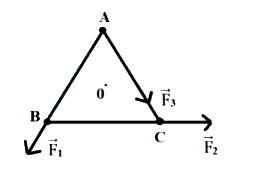 MHT CET 2020 Medium
 - Which polymer among the following does NOT contain ester linkage in it?MHT CET 2020 Medium
- In a purely inductive circuit, the current isMHT CET 2012 Easy