


MHT CET · Physics · Electrostatics
A charge \(Q \mathrm{C}\) is placed at the center of a cube. If \(\varepsilon_0\) is the permittivity of vacuum then the flux through one face and two opposite faces of the cube is respectively
- A \(\frac{Q}{6 \epsilon_0}, \frac{Q}{3 \epsilon_0}\)
- B \(\frac{Q}{3 \epsilon_0}, \frac{Q}{2 \epsilon_0}\)
- C \(\frac{Q}{12 \epsilon_0}, \frac{Q}{6 \epsilon_0}\)
- D \(\frac{Q}{\epsilon_0}, \frac{Q}{2 \epsilon_0}\)
Answer & Solution
Correct Answer
(A) \(\frac{Q}{6 \epsilon_0}, \frac{Q}{3 \epsilon_0}\)
Step-by-step Solution
Detailed explanation
A charge \(Q \mathrm{C}\) is placed at the center of a cube.
Total flux radiated \(=\frac{Q}{\varepsilon_0}\)
\(\therefore\) from one face would be \(\frac{Q}{6 \varepsilon_0}\) due to the six-fold symmetry of the cube.
And from two opposite faces, it would be \(\frac{Q}{3 \varepsilon_0}\) due to three-fold symmetry.
Total flux radiated \(=\frac{Q}{\varepsilon_0}\)
\(\therefore\) from one face would be \(\frac{Q}{6 \varepsilon_0}\) due to the six-fold symmetry of the cube.
And from two opposite faces, it would be \(\frac{Q}{3 \varepsilon_0}\) due to three-fold symmetry.
See the Complete Solution
Get step-by-step explanations for this and 2.5 Lakh+ more JEE, NEET & CET questions.
- Unlock all solutions
- Practice the full chapter
- Track accuracy across PYQs
4.8 rated on Google Play · 14,000+ reviews
More questions from Physics
- A particle executes a simple harmonic motion of time period \(T\). Find the time taken by the particle to go directly from its mean position to half the amplitudeMHT CET 2011 Medium
- A rope is wound around a solid cylinder of mass \(1 \mathrm{~kg}\) and radius \(0 \cdot 4 \mathrm{~m}\). What is the angular acceleration of cylinder, if the rope is pulled with a force of \(25 \mathrm{~N} ?\)
(cylinder is rotating about its own axis)MHT CET 2020 Easy - Four electric charges \(+q,+q,-q\) and \(-q\) are placed in order at the corners of a square of side 2 L . The electric potential at point midway between the two positive charges isMHT CET 2024 Medium
- Earth revolves round the sun in a circular orbit of radius 'R'. The angular momentum of the revolving earth is directly proportional toMHT CET 2020 Easy
- A rectangular black body of temperature \(127^{\circ} \mathrm{C}\) has surface area \(4 \mathrm{~cm} \times 2 \mathrm{~cm}\) and rate of radiation is E . If its temperature is increased by \(400^{\circ} \mathrm{C}\) and surface area is reduced to half of the initial value then the rate of radiation isMHT CET 2025 Medium
- A solid metallic sphere of radius ' \(R\) ' having moment of inertia ' I ' about diameter is melted and recast into a solid disc of radius ' \(r\) ' of a uniform thickness. The moment of inertia of a disc about an axis passing through its edge and perpendicular to its plane is also equal to ' I '. The ratio \(\frac{r}{R}\) isMHT CET 2024 Medium
More PYQs from MHT CET
- From a disc of radius \(R\), a concentric dircular portion of radius \(r\) is cut out so as to leave an annular disc of mass \(M\). The moment of inertia
of this annular disc about the axis perpendicular to its plane and passing through its centre of gravity isMHT CET 2009 Easy - The pressure and density of a diatomic gas \(\left(\gamma=\frac{7}{5}\right)\) changes adiabatically from \((\mathrm{P}, \rho)\) to \(\left(\mathrm{P}^{\prime}, \rho^{\prime}\right)\). If \(\frac{\rho^{\prime}}{\rho}=32\) then \(\frac{\mathrm{P}^{\prime}}{\mathrm{P}}\) should beMHT CET 2023 Hard
- An e.m.f. \(E=E_0 \cos \omega t\) is applied to the L-R circuit. The inductive reactance is equal to the resistance ' \(R\) ' of the 'circuit. The power consumed in the circuit isMHT CET 2024 Medium
- What is the highest oxidation state exhibited by any transition element among all ?MHT CET 2020 Easy
- Calculate the number of particles present per unit cell if mass of a particle is \(8.0 \times 10^{-23} \mathrm{~g}\left[\varrho \times a^3=3.2 \times 10^{-22} \mathrm{~g}\right]\)MHT CET 2025 Medium
- A long rectangular conducting loop of width ' \(\ell\) ', mass ' m ' and resistance ' R ' is placed partly in a perpendicular magnetic field ' B '. It is pushed downwards with velocity ' \(V\) ' so that it may continue to fall freely. The velocity ' \(V\) ' is
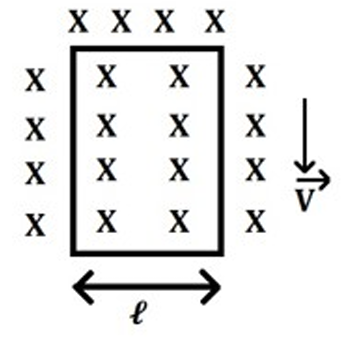 MHT CET 2025 Medium