


MHT CET · Physics · Oscillations
A body of mass ' \(m\) ' performs linear S.H.M. given by equation \(\mathrm{x}=\mathrm{P} \sin \omega \mathrm{t}+\mathrm{Q} \sin \left(\omega \mathrm{t}+\frac{\pi}{2}\right)\). The total energy of the particle at any instant is
- A \(\frac{1}{2} \mathrm{~m} \omega^2 \mathrm{PQ}\)
- B \(\frac{1}{2} \frac{\mathrm{m} \omega^2}{\mathrm{P}^2 \mathrm{Q}^2}\)
- C \(\frac{1}{2} \mathrm{~m} \omega^2\left(\mathrm{P}^2+\mathrm{Q}^2\right)\)
- D \(\frac{1}{2} \mathrm{~m}^2 \mathrm{P}^2 \mathrm{Q}^2\)
Answer & Solution
Correct Answer
(C) \(\frac{1}{2} \mathrm{~m} \omega^2\left(\mathrm{P}^2+\mathrm{Q}^2\right)\)
Step-by-step Solution
Detailed explanation
\(
\mathrm{x}=\mathrm{P} \sin \omega \mathrm{t}+\mathrm{Q} \sin \left(\omega \mathrm{t}+\frac{\pi}{2}\right)
\)
It can be considered as composition of two S.H.M. of amplitudes \(P\) and \(Q\) having phase difference \(\frac{\pi}{2}\).
\(\therefore\) Resultant amplitude \(\mathrm{R}=\sqrt{\mathrm{P}^2+\mathrm{Q}^2}\)
Total energy \(E=\frac{1}{2} m \omega^2 R^2\)
\(
=\frac{1}{2} \mathrm{~m} \omega^2\left(\mathrm{P}^2+\mathrm{Q}^2\right)
\)
\mathrm{x}=\mathrm{P} \sin \omega \mathrm{t}+\mathrm{Q} \sin \left(\omega \mathrm{t}+\frac{\pi}{2}\right)
\)
It can be considered as composition of two S.H.M. of amplitudes \(P\) and \(Q\) having phase difference \(\frac{\pi}{2}\).
\(\therefore\) Resultant amplitude \(\mathrm{R}=\sqrt{\mathrm{P}^2+\mathrm{Q}^2}\)
Total energy \(E=\frac{1}{2} m \omega^2 R^2\)
\(
=\frac{1}{2} \mathrm{~m} \omega^2\left(\mathrm{P}^2+\mathrm{Q}^2\right)
\)
See the Complete Solution
Get step-by-step explanations for this and 2.5 Lakh+ more JEE, NEET & CET questions.
- Unlock all solutions
- Practice the full chapter
- Track accuracy across PYQs
4.8 rated on Google Play · 14,000+ reviews
More questions from Physics
- A spherical metal ball of radius ' \(r\) ' falls through viscous liquid with velocity ' \(\mathrm{V}\) '. Another metal ball of same material but of radius \(\left(\frac{\mathrm{r}}{3}\right)\) falls through same liquid, then its terminal velocity will beMHT CET 2023 Medium
- A charge moves with velocity ' \(\mathrm{V}\) ' through electric field (E) as well as magnetic field (B). then the force acting on it isMHT CET 2021 Easy
- Water rises to height \(2 \cdot 2 \mathrm{~cm}\) in glass capillary tube. The height to which same water rises in another capillary having \(\frac{1}{4}\) area of cross-section isMHT CET 2020 Medium
- The frequency of a stretched uniform wire of length \(L\) under tension is in resonance with the fundamental frequency of a closed pipe of same length. If the tension in the wire is increased by 8 N , it is in resonance with the first overtone of the same closed pipe. The initial tension in the wire isMHT CET 2025 Medium
- Which of the following while in motion cannot be deflected by magnetic field?MHT CET 2008 Easy
- The alternating e.m.f. induced in the secondary coil of a transformer is mainly due toMHT CET 2023 Easy
More PYQs from MHT CET
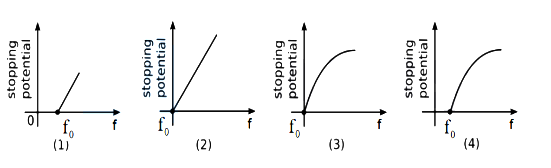
- Following graphs show the variation of stopping potential corresponding to the frequency of incident radiation for a given metal. The correct variation is shown in graph ( Threshold frequency)
 MHT CET 2018 Medium
 - Select the INCORRECT statement regarding transport of respiratory gases.MHT CET 2021 Easy
- Identify the products obtained in the ozonolysis of propene.MHT CET 2024 Medium
- Calculate the number of atoms in 5 gram metal that crystallises to form simple cubic unit cell structure having edge length \(336 \mathrm{pm}\). (Density of metal \(=9.4 \mathrm{~g} \mathrm{~cm}^{-3}\) )MHT CET 2022 Easy
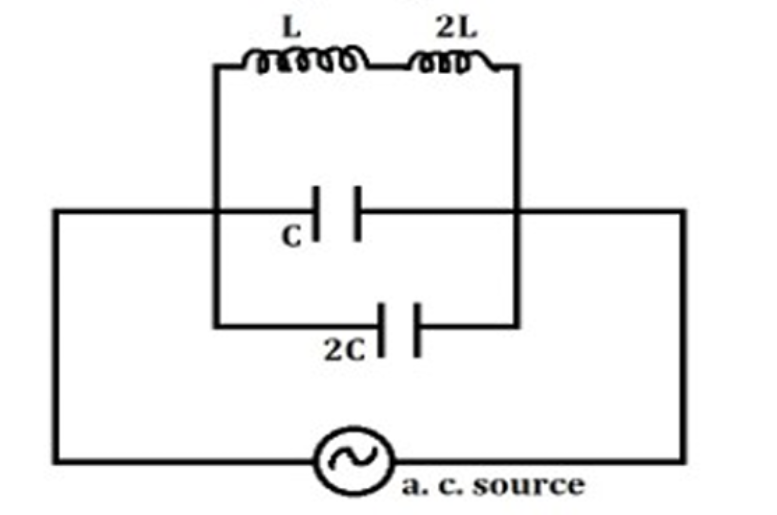
- Figure shows the combination of inductances and capacitances. Resonant frequency of the L - C circuit is
 MHT CET 2025 Medium
 - If \(\theta\) is angle between the vectors \(\bar{a}\) and \(\bar{b}\) where \(|\bar{a}|=4, \quad|\bar{b}|=3 \quad\) and \(\theta \in\left(\frac{\pi}{4}, \frac{\pi}{3}\right)\), then \(|(\bar{a}-\bar{b}) \times(\bar{a}+\bar{b})|^2+4(\bar{a} \cdot \bar{b})^2\) has the valueMHT CET 2023 Medium