


MHT CET · Physics · Mathematics in Physics
A body of mass \(2 \mathrm{~kg}\) is acted upon by two forces each of magnitude \(1 \mathrm{~N}\) and inclined at \(60^{\circ}\) with each other. The acceleration of the body in \(\frac{\mathrm{m}}{\mathrm{s}}\) is \(\left[\cos 60^{\circ}=0.5\right]\)
- A \(\sqrt{0.35}\)
- B \(\sqrt{0.65}\)
- C \(\sqrt{0.75}\)
- D \(\sqrt{0.20}\)
Answer & Solution
Correct Answer
(C) \(\sqrt{0.75}\)
Step-by-step Solution
Detailed explanation
Let us apply the parallelogram law of vectors to find the resultant of the forces.
\(\mathrm{F}_{\text {net }}=\sqrt{\mathrm{F}_{1}^{2}+\mathrm{F}_{2}^{2}+2 \times \mathrm{F}_{1} \mathrm{~F}_{2} \cos \theta}\)
Given: \(\mathrm{F}_{1}=1, \mathrm{~F}_{2}=1\) and \(\theta=60^{\circ}\)
So, \(\mathrm{F}_{\text {net }}=\sqrt{(1)^{2}+(1)^{2}+2 \times 1 \times 1 \times \cos 60^{0}}=\) \(\sqrt{1+1+2 \times 1 / 2}=\sqrt{3} \mathrm{~N}\)
Now
\(\mathrm{F}=\mathrm{ma}\)
or, \(a=\frac{F}{m}=\frac{\sqrt{3}}{2} m / s^{2}\)
Thus, the net acceleration of the body is \(\frac{\sqrt{3}}{2} \mathrm{~m} / \mathrm{s}^{2}\)
\(\mathrm{F}_{\text {net }}=\sqrt{\mathrm{F}_{1}^{2}+\mathrm{F}_{2}^{2}+2 \times \mathrm{F}_{1} \mathrm{~F}_{2} \cos \theta}\)
Given: \(\mathrm{F}_{1}=1, \mathrm{~F}_{2}=1\) and \(\theta=60^{\circ}\)
So, \(\mathrm{F}_{\text {net }}=\sqrt{(1)^{2}+(1)^{2}+2 \times 1 \times 1 \times \cos 60^{0}}=\) \(\sqrt{1+1+2 \times 1 / 2}=\sqrt{3} \mathrm{~N}\)
Now
\(\mathrm{F}=\mathrm{ma}\)
or, \(a=\frac{F}{m}=\frac{\sqrt{3}}{2} m / s^{2}\)
Thus, the net acceleration of the body is \(\frac{\sqrt{3}}{2} \mathrm{~m} / \mathrm{s}^{2}\)
See the Complete Solution
Get step-by-step explanations for this and 2.5 Lakh+ more JEE, NEET & CET questions.
- Unlock all solutions
- Practice the full chapter
- Track accuracy across PYQs
4.8 rated on Google Play · 14,000+ reviews
More questions from Physics
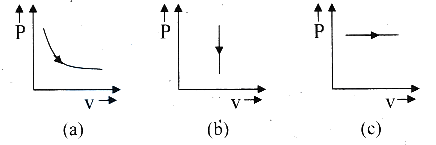
- The \(\mathrm{P}-\mathrm{V}\) diagrams for particular gas of different thermodynamic processes are given by
 MHT CET 2024 Easy
 - Beats are produced by two waves given by \(y_{1}=a \sin 2000 \pi t\) and \(y_{2}=a \sin 2008 \pi t\). The
number of beats heard per second isMHT CET 2009 Medium - Potentiometer measures the potential difference more accurately than a voltmeter becauseMHT CET 2007 Medium
- A particle starts oscillating simple harmonically from its equilibrium position with time period ' \(\mathrm{T}\) '. At time \(\mathrm{t}=\frac{\mathrm{T}}{12}\), the ratio of its kinetic energy to potential energy is
\(\left[\sin \frac{\pi}{3} \cos \frac{\pi}{6}=\frac{\sqrt{3}}{2}, \sin \frac{\pi}{6}=\cos \frac{\pi}{3}=\frac{1}{2}\right]\)MHT CET 2022 Hard - In air, a charged soap bubble of radius ‘ ’ breaks into small soap bubbles of equal radius ‘ ’. Then, the ratio of mechanical force acting per unit area of big soap bubble to that of a small soap bubble isMHT CET 2019 Medium
- The voltmeter has range 10 V and its internal resistance is \(50 \Omega\). To increase the range of voltmeter to 15 V , the resistance which is to be connected isMHT CET 2025 Medium
More PYQs from MHT CET
- If the function given by
\(
f(x)= \begin{cases}-2 \sin x & -\pi \leq x < -(\pi / 2) \ a \sin x+b \end{cases}
\) \(-(\pi / 2) < x < (\pi / 2) \ \cos x (\pi / 2) \leq x \leq \pi\)
is continuous in \([-\pi, \pi]\), then the value of \((3 a+2 b)^3\) isMHT CET 2021 Easy - What is de Broglie's wavelength for a particle having mass \(6.64 \times 10^{-27} \mathrm{~kg}\) moving with velocity of \(3 \times 10^3 \mathrm{~ms}^{-1} ?\left[\mathrm{~h}=6.63 \times 10^{-34} \mathrm{Js}\right]\)MHT CET 2024 Easy
- Which of the following compound is used as a refrigerant?MHT CET 2012 Easy
- Which of the following function has period 2?MHT CET 2019 Easy
- Which among the following is mineral of Sulphur?MHT CET 2020 Easy
- An optician makes spectacles having a combination of a convex lens of focal length 40 cm in contact with a concave lens of focal length 25 cm . The power of this combination of lenses in dioptre isMHT CET 2024 Medium