


MHT CET · Physics · Mechanical Properties of Fluids
A body of density ' \(\rho\) ' is dropped from rest at a height ' \(h\) ' into a lake of density ' \(\sigma\) ' \((\sigma>\rho)\). The maximum depth to which the body sinks before returning to float on the surface is (neglect air dissipative forces)
- A \(\frac{\mathrm{h} \rho}{(\sigma-\rho)}\)
- B \(\frac{h \rho}{(\sigma+\rho)}\)
- C \(\frac{h \rho}{(\rho-\sigma)}\)
- D \(\frac{2 h \rho}{(\sigma-\rho)}\)
Answer & Solution
Correct Answer
(C) \(\frac{h \rho}{(\rho-\sigma)}\)
Step-by-step Solution
Detailed explanation
Initial velocity of the ball \(=\sqrt{2 \text { gh }}\)
Upward force:
\(
\begin{aligned}
& F=\sigma V g-\rho V g \\
& (\rho V) a=V g(\sigma-\rho) \\
\therefore \quad & a=\frac{g(\sigma-\rho)}{\rho}
\end{aligned}
\)
Final velocity is zero when it sinks.
\(
\begin{aligned}
\therefore \quad & v^2-u^2=2 \text { as } \\
& 0-(\sqrt{2 g h})^2=2 \frac{g(\sigma-\rho)}{\rho} H \\
& H=\frac{h \rho}{(\rho-\sigma)}
\end{aligned}
\)
Upward force:
\(
\begin{aligned}
& F=\sigma V g-\rho V g \\
& (\rho V) a=V g(\sigma-\rho) \\
\therefore \quad & a=\frac{g(\sigma-\rho)}{\rho}
\end{aligned}
\)
Final velocity is zero when it sinks.
\(
\begin{aligned}
\therefore \quad & v^2-u^2=2 \text { as } \\
& 0-(\sqrt{2 g h})^2=2 \frac{g(\sigma-\rho)}{\rho} H \\
& H=\frac{h \rho}{(\rho-\sigma)}
\end{aligned}
\)
See the Complete Solution
Get step-by-step explanations for this and 2.5 Lakh+ more JEE, NEET & CET questions.
- Unlock all solutions
- Practice the full chapter
- Track accuracy across PYQs
4.8 rated on Google Play · 14,000+ reviews
More questions from Physics
- The half of a radioactive substance is 25 minutes The time between \(50 \%\) decay and \(87.5 \%\) decay of the substance will beMHT CET 2022 Easy
- In non-uniform circular motion, the ratio of tangential to radial acceleration is (\(r=\) radius of the circle, \(u=\) speed of the particle, \(\alpha=\) angular acceleration)MHT CET 2018 Hard
- Moment of inertia of a disc about a diameter is \(I .\) Find the moment of inertia of disc about an axis perpendicular to its plane and passing through its rim?MHT CET 2010 Medium
- For the following combination of logic gates, when all the three inputs \(A\), \(B\) and \(C\) are first 'high' and then 'low', the output \(Y\) will be respectively.
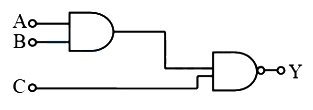 MHT CET 2022 Easy
 - At the poles of earth, a stretched wire of a given length vibrates in unison with a tuning fork. At the equator of earth, for same setting, to produce resonance with same fork, the vibrating length of wireMHT CET 2024 Hard
- Focal length of objective of an astronomical telescope is 1.5 m . Under normal adjustment, length of telescope is 1.56 m . Focal length of the eyepiece isMHT CET 2024 Easy
More PYQs from MHT CET
- The equivalent form of the statement is ________MHT CET 2019 Easy
- What is the highest oxidation state of third row transition elements?MHT CET 2024 Medium
- The cofactor involved in the conversion of glyceraldehyde-3 phosphate to 71. During respiration, phosphorylation occurs in 1,3-bisphosphoglycerate during glycolysis is ____.MHT CET 2024 Medium
- Carbonated water is an example of a solution ofMHT CET 2024 Easy
- The false statement regarding alkane isMHT CET 2012 Medium
- Lenz's law is a consequence of law of conservation ofMHT CET 2012 Easy