


MHT CET · Physics · Mechanical Properties of Fluids
A body of density \(\rho\) is dropped from (at rest) height ' \(h\) ' into a lake of density ' \(\delta\) ' \((\delta>\rho)\). The maximum depth to which the body sinks before returning to float on the surface is [Neglect all dissipative forces]
- A \(\frac{(\delta-\rho)}{2 h \rho}\)
- B \(\frac{2 h \rho}{(\delta-\rho)}\)
- C \(\frac{h \rho}{2(\delta-\rho)}\)
- D \(\frac{h \rho}{(\delta-\rho)}\)
Answer & Solution
Correct Answer
(D) \(\frac{h \rho}{(\delta-\rho)}\)
Step-by-step Solution
Detailed explanation
The velocity of the body when it reaches the surface of the lake is
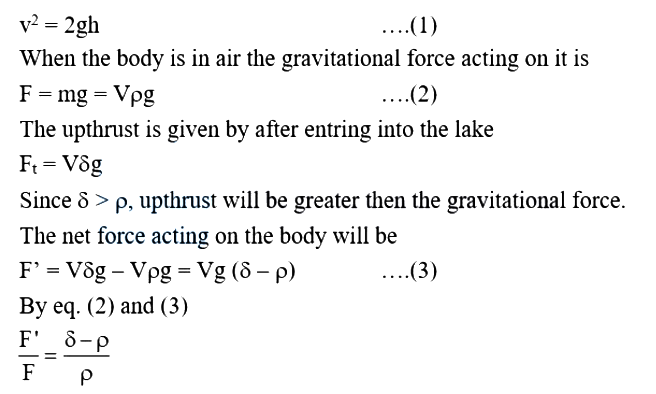
\(
\begin{aligned}
& \frac{\mathrm{a}}{\mathrm{g}}=\frac{\delta-\rho}{\rho} \\
& \therefore \mathrm{a}=\left(\frac{\delta-\rho}{\rho}\right) \mathrm{g}
\end{aligned}
\)
If \(a\) is the acceleration and retardation in the liquid then \(\mathrm{v}^2=2 \mathrm{ad}\)
by eq. (1) and (4)
\(
\begin{aligned}
& 2 \mathrm{ad}=2 \mathrm{gh} \\
& \therefore \mathrm{d}=\frac{\mathrm{g}}{\mathrm{a}} \mathrm{h} \quad \therefore \mathrm{d}=\frac{\rho}{\delta-\rho} \mathrm{h}
\end{aligned}
\)
\(
\begin{aligned}
& \frac{\mathrm{a}}{\mathrm{g}}=\frac{\delta-\rho}{\rho} \\
& \therefore \mathrm{a}=\left(\frac{\delta-\rho}{\rho}\right) \mathrm{g}
\end{aligned}
\)
If \(a\) is the acceleration and retardation in the liquid then \(\mathrm{v}^2=2 \mathrm{ad}\)
by eq. (1) and (4)
\(
\begin{aligned}
& 2 \mathrm{ad}=2 \mathrm{gh} \\
& \therefore \mathrm{d}=\frac{\mathrm{g}}{\mathrm{a}} \mathrm{h} \quad \therefore \mathrm{d}=\frac{\rho}{\delta-\rho} \mathrm{h}
\end{aligned}
\)
See the Complete Solution
Get step-by-step explanations for this and 2.5 Lakh+ more JEE, NEET & CET questions.
- Unlock all solutions
- Practice the full chapter
- Track accuracy across PYQs
4.8 rated on Google Play · 14,000+ reviews
More questions from Physics
- A transparent glass cube of length \(24 \mathrm{~cm}\) has a small air bubble trapped inside. When seen normally through one surface from air outside, its apparent distance is \(10 \mathrm{~cm}\) from the surface. When seen normally from opposite surface, its apparent distance is \(6 \mathrm{~cm}\). The distance of the air bubble from first surface isMHT CET 2023 Medium
- In biprism experiment, if \(5^{\text {th }}\) bright band with wavelength \(\lambda_1\) coincides with \(6^{\text {th }}\) dark band with wavelength \(\lambda_2\) then the ratio \(\left(\lambda_1 / \lambda_2\right)\) isMHT CET 2024 Medium
- If the temperature of cold junction decreases, then neutral temperatureMHT CET 2011 Easy
- A current ' \(\mathrm{I}\) ' is flowing in a conductor of length ' \(\mathrm{L}\) ' when it is bent in the form of a circular loop, its magnetic moment will beMHT CET 2021 Medium
- The molar specific heat of an ideal gas at constant pressure and constant volume is \(C_p\) and \(C_v\) respectively. If \(R\) is the universal gas constant and the ratio of \(C_p\) to \(C_v\) is \(\gamma\) then. \(C_v=\)MHT CET 2022 Easy
- Two wires ' \(\mathrm{A}\) ' and ' \(\mathrm{B}\) ' of equal length are connected in left and right gap respectively of meter bridge, null point is obtained at \(40 \mathrm{~cm}\), from the left end. Diameters of the wires ' \(A\) ' and 'B' are in the ratio \(3: 1\) respectively, the ratio of specific resistance of ' \(\mathrm{A}\) ' to that of ' \(\mathrm{B}\) ' isMHT CET 2021 Hard
More PYQs from MHT CET
- The co-ordinates of foci of the ellipse \(16 x^{2}+9 y^{2}=144\) areMHT CET 2020 Easy
- If \(\mathrm{T}\) is the half-life of a radioactive substance then its instantaneous rate of change of activity is proportional toMHT CET 2020 Easy
- Calculate the time needed for reactant to decompose \(99.9 \%\) if rate constant of first order reaction is 0.576 minute \(^{-1}\).MHT CET 2023 Easy
- The line of intersection of the plane \(\overline{\mathrm{r}} \cdot(3 \hat{i}-\hat{\mathrm{j}}+\hat{\mathrm{k}})=1\) and \(\overline{\mathrm{r}} \cdot(\hat{i}+4 \hat{\mathrm{j}}-2 \hat{\mathrm{k}})=2\) is parallel to the vectorMHT CET 2025 Medium
- In series LCR resonant circuit; the capacitance is changed from C to 3 C . To obtain the same resonant frequency, the inductance should be changed from \(L\) toMHT CET 2024 Easy
- The electromagnetic waves travel in free space with the velocity ofMHT CET 2012 Easy