


MHT CET · Physics · Gravitation
A body is projected in vertically upward direction from the surface of the earth of radius ' \(R\) ' into space with velocity ' \(n V_{\mathrm{c}}\) ' \((n \lt 1)\). The maximum height from the surface of earth to which a body can reach is
- A \(\frac{n^2 R}{\left(1-n^2\right)}\)
- B \(\frac{\mathrm{n}^2 \mathrm{R}^2}{(1-\mathrm{n})}\)
- C \(\frac{\mathrm{nR}^2}{\left(1+\mathrm{n}^2\right)}\)
- D \(\frac{n^2 R^2}{(1+n)}\)
Answer & Solution
Correct Answer
(A) \(\frac{n^2 R}{\left(1-n^2\right)}\)
Step-by-step Solution
Detailed explanation
\(\begin{aligned} & \begin{array}{l}\text { As per the law of conservation of energy, } \\ \\ (K . E+P . E)_{\text {surface }}=(K . E+P . E)_{\text {max height }}\end{array} \\ \therefore \quad & \frac{-G M m}{R}+\frac{1}{2} m\left(n V_e\right)^2=-\frac{G M m}{R+h}+\frac{1}{2} m(0)^2 \\ \therefore \quad & \frac{1}{2} m\left(n V_e\right)^2=G M m\left(\frac{1}{R}-\frac{1}{R+h}\right) \\ \therefore \quad & \left(n V_e\right)^2=2 G M\left(\frac{R+h-R}{R(R+h)}\right) \\ \therefore \quad & \left(n V_e\right)^2=V_e^2\left(\frac{h}{(R+h)}\right)\end{aligned}\)
\(\begin{array}{ll}\therefore & \frac{1}{n^2}=\frac{R}{h}+1 \\ \therefore & \frac{R}{h}=\frac{1-n^2}{n^2} \\ \therefore & h=\frac{n^2 R}{\left(1-n^2\right)}\end{array}\)
\(\begin{array}{ll}\therefore & \frac{1}{n^2}=\frac{R}{h}+1 \\ \therefore & \frac{R}{h}=\frac{1-n^2}{n^2} \\ \therefore & h=\frac{n^2 R}{\left(1-n^2\right)}\end{array}\)
See the Complete Solution
Get step-by-step explanations for this and 2.5 Lakh+ more JEE, NEET & CET questions.
- Unlock all solutions
- Practice the full chapter
- Track accuracy across PYQs
4.8 rated on Google Play · 14,000+ reviews
More questions from Physics
- The magnetic flux near the axis and inside the air core solenoid of length \(60 \mathrm{~cm}\) carrying current ' \(I\) ' is \(1.57 \times 10^{-6} \mathrm{~Wb}\). Its magnetic moment will be \(\left[\mu_0=4 \pi \times 10^{-7}\right.\), SI unit and cross sectional area is very small as compared to length of solenoid.]MHT CET 2021 Medium
- A \(1 \mu \mathrm{~F}\) capacitor is charged to 50 V and is then discharged through 10 mH inductor of negligible resistance. The maximum current in the inductor isMHT CET 2024 Easy
- A thin ring of radius ' \(R\) ' meter has charge ' \(q\) ' coulomb uniformly spread on it. The ring rotates about its axis with a constant frequency of \(f\) revolution/s. The value of magnetic induction in \(\mathrm{Wb} \mathrm{m}{ }^{-2}\) at the center of the ring is ( \(\mu_0=\) Permeability of free space)MHT CET 2021 Medium
- An electric dipole is as shown in figure The electric potential at point \(\mathrm{P}\) due to the dipole is \(\left[\epsilon_0=\right.\) permittivity of free space]
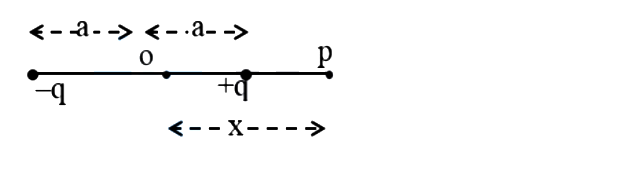 MHT CET 2022 Medium
 - A circular coil of resistance ' \(R\) ', area ' \(A\) ', number of turns ' N ' is rotated about its vertical diameter with angular speed ' \(\omega\) ' in a uniform magnetic field of magnitude ' \(B\) '. The average power dissipated in a complete cycle isMHT CET 2024 Easy
- A source of sound emits sound wave of frequency ' \(f\) ' and moves towards an observer with a velocity \(\frac{\mathrm{V}}{3}\) where V is the velocity of sound. If the observer moves away from the source with a velocity \(\frac{\mathrm{V}}{5}\) the apparent frequency heard by him will beMHT CET 2025 Medium
More PYQs from MHT CET
- Negation of inverse of the following statement pattern \((p \wedge q) \rightarrow(p \vee \sim q)\) isMHT CET 2023 Easy
- Which of the following amines can not be prepared by Gabriel phthalimide synthesis?MHT CET 2020 Medium
- Magnetic field at the centre of a circular loop of area ' \(A\) ' is ' \(B\) '. The magnetic moment of the loop will beMHT CET 2024 Medium
- Calculate rate constant of first order reaction if concentration of reactant decreases by \(90 \%\) in 30 minute?MHT CET 2024 Easy
- A composite slab consists of two materials having coefficient of thermal conductivity \(K\) and \(2 \mathrm{~K}\), thickness \(\mathrm{x}\) and \(4 \mathrm{x}\) respectively. The temperature of the two outer surfaces of a composite slab are \(\mathrm{T}_2\) and \(\mathrm{T}_1\left(\mathrm{~T}_2>\mathrm{T}_1\right)\). The rate of heat transfer through the slab in a steady state is \(\left[\frac{\mathrm{A}\left(\mathrm{T}_2-\mathrm{T}_1\right) \mathrm{K}}{\mathrm{x}}\right] \cdot \mathrm{f}\) where ' \(\mathrm{f}\) ' is equal toMHT CET 2023 Hard
- A step-up transformer operates on \(220 \mathrm{~V}\) and supplies current of \(2 \mathrm{~A}\). The ratio of primary and secondary windings is \(1: 20\). The current in the primary isMHT CET 2021 Medium