


MHT CET · Physics · Mechanical Properties of Fluids
A ball rises to surface at a constant velocity in liquid whose density is 3 times greater than that of the material of the ball. The ratio of force of friction acting on the rising ball to its weight is
- A \(2: 1\)
- B \(3: 1\)
- C \(4: 1\)
- D \(6: 1\)
Answer & Solution
Correct Answer
(A) \(2: 1\)
Step-by-step Solution
Detailed explanation
The ball is moving with constant velocity. Therefore, the net force acting on it is zero.
The weight of the ball \(=\mathrm{W}=\frac{4}{3} \pi \mathrm{r}^3 \rho_{\mathrm{b}} \mathrm{g}\) ...(i)
....(acting downwards)
As the ball is rising up, the viscous force \(F_v\) will be in the downward direction.
The buoyant force \(F_B=\frac{4}{3} \pi r^3 \rho_l g\)
....(acting upwards)
\(\begin{array}{ll}
\therefore & \mathrm{F}_{\mathrm{v}}+W=F_B \\
\therefore & \mathrm{~F}_{\mathrm{v}}=\mathrm{F}_{\mathrm{B}}-\mathrm{W}=\frac{4}{3} \pi \mathrm{r}^3 g\left(\rho_l-\rho_{\mathrm{b}}\right) \\
& \mathrm{F}_{\mathrm{v}}=\frac{4}{3} \pi \mathrm{r}^3 \mathrm{~g} \times 2 \rho_{\mathrm{b}} \quad \ldots\left(\because \rho_l=3 \rho_{\mathrm{b}}\right)...(ii)
\end{array}\)
\(\therefore \quad \frac{F_v}{W}=\frac{\frac{4}{3} \pi r^3 \mathrm{~g} \times 2 \rho_b}{\frac{4}{3} \pi r^3 \rho_b g}=\frac{2}{1} \quad \ldots\) [From(i) and (ii)]
The weight of the ball \(=\mathrm{W}=\frac{4}{3} \pi \mathrm{r}^3 \rho_{\mathrm{b}} \mathrm{g}\) ...(i)
....(acting downwards)
As the ball is rising up, the viscous force \(F_v\) will be in the downward direction.
The buoyant force \(F_B=\frac{4}{3} \pi r^3 \rho_l g\)
....(acting upwards)
\(\begin{array}{ll}
\therefore & \mathrm{F}_{\mathrm{v}}+W=F_B \\
\therefore & \mathrm{~F}_{\mathrm{v}}=\mathrm{F}_{\mathrm{B}}-\mathrm{W}=\frac{4}{3} \pi \mathrm{r}^3 g\left(\rho_l-\rho_{\mathrm{b}}\right) \\
& \mathrm{F}_{\mathrm{v}}=\frac{4}{3} \pi \mathrm{r}^3 \mathrm{~g} \times 2 \rho_{\mathrm{b}} \quad \ldots\left(\because \rho_l=3 \rho_{\mathrm{b}}\right)...(ii)
\end{array}\)
\(\therefore \quad \frac{F_v}{W}=\frac{\frac{4}{3} \pi r^3 \mathrm{~g} \times 2 \rho_b}{\frac{4}{3} \pi r^3 \rho_b g}=\frac{2}{1} \quad \ldots\) [From(i) and (ii)]
See the Complete Solution
Get step-by-step explanations for this and 2.5 Lakh+ more JEE, NEET & CET questions.
- Unlock all solutions
- Practice the full chapter
- Track accuracy across PYQs
4.8 rated on Google Play · 14,000+ reviews
More questions from Physics
- A light of wavelength \(\lambda\) is incident on a photosensitive surface of negligible work function. The photoelectrons emitted from the surface have de-Broglie wavelength \(\lambda_1\). Then ratio \(\lambda: \lambda_1^2\) is ( \(\mathrm{h}=\) Planck's constant, \(\mathrm{c}=\) velocity of light, \(\mathrm{m}=\) mass of electron)MHT CET 2025 Medium
- Two solid spheres of radii \(R_1\) and \(R_2\) made of same material and have similar surfaces. The spheres are raised to the same temperature and then allowed to cool under identical conditions. Assuming spheres to be perfect conductors of heat, then the ratio of initial rates of cooling areMHT CET 2022 Easy
- An aeroplane is flying in a horizontal direction with a velocity of \(540 \mathrm{~km} / \mathrm{hr}\) at a height of \(1960 \mathrm{~m}\). When it is vertically above the point A on the ground, a body is dropped from it. The body strikes the ground at point \(\mathrm{B}\). The distance \(\mathrm{AB}\) is equal to
\(\left(\mathrm{g}=9.8 \mathrm{~m} / \mathrm{s}^2\right)\)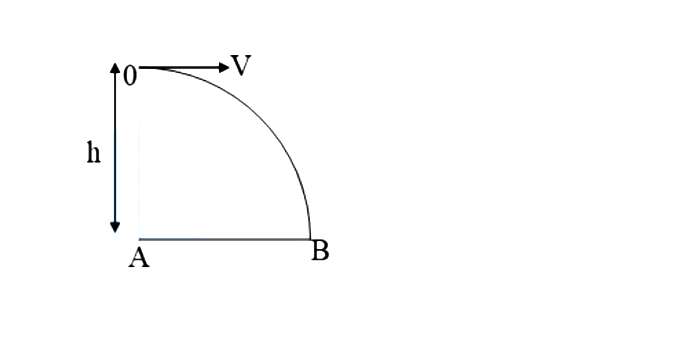 MHT CET 2022 Easy
 - An electron of mass ' \(m\) ' and charge ' \(q\) ' is accelerated from rest in a uniform electric field of intensity ' \(E\) '. The velocity acquired by it as it travels a distance ' \(l\) ' is ' \(v\) '. The ratio \(\frac{\mathrm{q}}{\mathrm{m}}\) in terms of \(\mathrm{E}, l\) and v isMHT CET 2024 Hard
- A source of sound is moving with constant velocity of \(30 \mathrm{~m} / \mathrm{s}\) emitting a note of
frequency \(256 \mathrm{~Hz}\). The ratio of frequencies observed by a stationary observer
while the source is approaching him and after it crosses him is
[speed of sound in air \(=330 \mathrm{~m} / \mathrm{s}]\)MHT CET 2020 Easy - The value of current I in the given circuit is
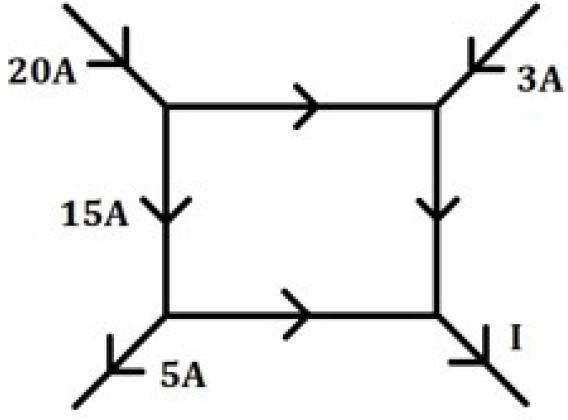 MHT CET 2025 Easy
More PYQs from MHT CET
- If \(2 a+b+3 c=0\), then the line \(a x+b y+c=0\) passes through the fixed point that isMHT CET 2012 Easy
- The difference between the maximum value and minimum value of objective function \(\mathrm{z}=3 x+5 y\) subject to constraints \(x+3 y \leqslant 60\), \(x+\mathrm{y} \geqslant 10, x-\mathrm{y}=0, x, \mathrm{y} \geqslant 0\) isMHT CET 2025 Medium
- The solubility product of NiS is \(4.9 \times 10^{-5}\) at 298 K. Calculate its solubility in \(\mathrm{mol~} \mathrm{dm}^{-3}\) at the same temperature?MHT CET 2025 Easy
- The co-ordinates of the point, where the line \(\frac{x-1}{2}=\frac{y-2}{-3}=\frac{z+5}{4}\) meets the plane \(2 x+4 y-z=3\), areMHT CET 2023 Easy
- Two wires of same length and material are stretched by same force. If their masses are in the ratio \(3: 4\), then the ratio of their elongations isMHT CET 2020 Easy
- The length of the perpendicular from the point \((0,2,3)\) on the line \(\frac{x+3}{5}=\frac{y-1}{2}=\frac{z+4}{3}\)MHT CET 2022 Medium