


MHT CET · Physics · Magnetic Effects of Current
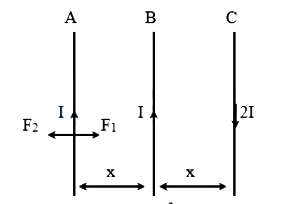
\(\mathrm{A}, \mathrm{B}\) and \(\mathrm{C}\) are three parallel conductors of equal lengths carrying currents I, I and 2I respectively. Distance between A and \(B\) is ' \(x\) ' and that between B and \(C\) is also ' \(x\) '. \(F_1\) is the force exerted by conductor \(\mathrm{B}\) on \(\mathrm{A}\). \(\mathrm{F}_2\) is the force exerted by conductor \(\mathrm{C}\) on \(\mathrm{A}\). Current \(\mathrm{I}\) in \(\mathrm{A}\) and \(\mathrm{I}\) in \(\mathrm{B}\) are in same direction and current \(2 \mathrm{I}\) in \(\mathrm{C}\) is in opposite direction. Then
- A \(\mathrm{F}_1=\mathrm{F}_2\)
- B \(\mathrm{F}_2=2 \mathrm{~F}_1\)
- C \(\mathrm{F}_1=2 \mathrm{~F}_2\)
- D \(\mathrm{F}_1=-\mathrm{F}_2\)
Answer & Solution
Correct Answer
(D) \(\mathrm{F}_1=-\mathrm{F}_2\)
Step-by-step Solution
Detailed explanation
Current in A and B are in the same direction. Hence force \(F_1\) exerted by B on A will be attractive (towards B). Current in A and \(\mathrm{C}\) are in opposite directions. Hence force \(\mathrm{F}_2\), exerted by \(\mathrm{C}\) on A will be repulsive (away from \(C\) ). Thus \(F_1\) and \(F_2\) are opposite in direction.
\(
\begin{aligned}
& \mathrm{F}_1=\frac{\mu_0}{2 \pi} \cdot \frac{\mathrm{I}_1 \mathrm{I}_2}{\mathrm{x}} \cdot \mathrm{L}=\frac{\mu_0}{2 \pi} \cdot \frac{\mathrm{I}^2}{\mathrm{x}} \mathrm{L} \\
& \mathrm{F}_2=\frac{\mu_0}{2 \pi} \cdot \frac{2 \mathrm{I}^2}{2 \mathrm{x}} \cdot \mathrm{L}=\frac{\mu_0}{2 \pi} \cdot \frac{\mathrm{I}^2}{\mathrm{x}} \cdot \mathrm{L}
\end{aligned}
\)
\(\therefore \mathrm{F}_1\) and \(\mathrm{F}_2\) have some magnitude.
\(
\therefore \mathrm{F}_1=-\mathrm{F}_2
\)
\(
\begin{aligned}
& \mathrm{F}_1=\frac{\mu_0}{2 \pi} \cdot \frac{\mathrm{I}_1 \mathrm{I}_2}{\mathrm{x}} \cdot \mathrm{L}=\frac{\mu_0}{2 \pi} \cdot \frac{\mathrm{I}^2}{\mathrm{x}} \mathrm{L} \\
& \mathrm{F}_2=\frac{\mu_0}{2 \pi} \cdot \frac{2 \mathrm{I}^2}{2 \mathrm{x}} \cdot \mathrm{L}=\frac{\mu_0}{2 \pi} \cdot \frac{\mathrm{I}^2}{\mathrm{x}} \cdot \mathrm{L}
\end{aligned}
\)
\(\therefore \mathrm{F}_1\) and \(\mathrm{F}_2\) have some magnitude.
\(
\therefore \mathrm{F}_1=-\mathrm{F}_2
\)
See the Complete Solution
Get step-by-step explanations for this and 2.5 Lakh+ more JEE, NEET & CET questions.
- Unlock all solutions
- Practice the full chapter
- Track accuracy across PYQs
4.8 rated on Google Play · 14,000+ reviews
More questions from Physics
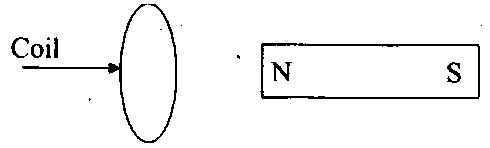
- The coil and magnet are moved in the same direction with same speed (V). The induced e.m.f. is
 MHT CET 2024 Medium
 - The stopping potential for a photelectric emission process is 10 V . The maximum kinetic energy of the electrons ejected in the process is [Charge on electron \(\mathrm{e}=1.6 \times 10^{-19} \mathrm{C}\) ]MHT CET 2024 Easy
- A glass convex lens is of refractive index 1.55 with both faces of same radius of curvature. What is the radius of curvature required if focal length is to be \(20 \mathrm{~cm}\) ?MHT CET 2022 Easy
- A bullet is fired on a target with velocity V. Its velocity decreases from \(v\) to \(v / 2\). When it penetrates 30 cm in a target. Through what thickness it will penetrate further in the target before coming to rest?MHT CET 2024 Medium
- A monoatomic ideal gas, initially at temperature ' \(\mathrm{T}_1\) ' is enclosed in a cylinder fitted with a frictionless piston. The gas is allowed to expand adiabatically to a temperature ' \(\mathrm{T}_2\) ' by releasing the piston suddenly \(L_1\) and \(L_2\) are the lengths of the gas columns before and after the expansion respectively. The \(\frac{T_2}{T_1}\) isMHT CET 2022 Medium
- Modulation is a process of superposingMHT CET 2020 Easy
More PYQs from MHT CET
- Which of the following solutions does not flow in either direction, when separated by semipermeable membrane? (Molar mass: glucose \(=180\), urea \(=60\) )MHT CET 2021 Medium
- When two tuning forks are sounded together, 6 beats per second are heard. One of the fork is in unison with 0.70 m length of sonometer wire and another fork is in unison with 0.69 m length of the same sonometer wire. The frequencies of the two tuning forks areMHT CET 2025 Medium
- The core used in transformer and other electromagnetic devices is laminated toMHT CET 2024 Easy
- The logical expression
\([\mathrm{p} \wedge(\mathrm{q} \vee \mathrm{r})] \vee[(\sim \mathrm{p} \wedge \mathrm{q}) \vee(\sim \mathrm{p} \wedge \mathrm{r})]\) is equivalent toMHT CET 2020 Medium - The vector equation of a line whose Cartesian equations are \(y=2,4 x-3 z+5=0\) isMHT CET 2024 Medium
- Atrial systole lasts for __________ in cardiac cycle.MHT CET 2017 Easy