


MHT CET · Maths · Limits
\(
\lim _{x \rightarrow 1} \frac{(2 x-3)(\sqrt{x}-1)}{2 x^2+x-3}=
\)
- A \(\frac{1}{5}\)
- B \(\frac{1}{10}\)
- C \(\frac{-1}{10}\)
- D \(\frac{-1}{5}\)
Answer & Solution
Correct Answer
(C) \(\frac{-1}{10}\)
Step-by-step Solution
Detailed explanation
\(
\begin{aligned}
& \lim _{x \rightarrow 1} \frac{(2 x-3)(\sqrt{x}-1)}{2 x^2+x-3} \\
& \lim _{x \rightarrow 1} \frac{(2 x-3)(\sqrt{x}-1)}{(x-1)(2 x+3)}=\lim _{x \rightarrow 1} \frac{(2 x-3)(\sqrt{x}-1)}{(\sqrt{x}-1)(\sqrt{x}+1)(2 x+3)} \\
& \lim _{x \rightarrow 1} \frac{(2 x-3)}{(\sqrt{x}+1)(2 x+3)}=\frac{-1}{2(5)}=\frac{-1}{10}
\end{aligned}
\)
\begin{aligned}
& \lim _{x \rightarrow 1} \frac{(2 x-3)(\sqrt{x}-1)}{2 x^2+x-3} \\
& \lim _{x \rightarrow 1} \frac{(2 x-3)(\sqrt{x}-1)}{(x-1)(2 x+3)}=\lim _{x \rightarrow 1} \frac{(2 x-3)(\sqrt{x}-1)}{(\sqrt{x}-1)(\sqrt{x}+1)(2 x+3)} \\
& \lim _{x \rightarrow 1} \frac{(2 x-3)}{(\sqrt{x}+1)(2 x+3)}=\frac{-1}{2(5)}=\frac{-1}{10}
\end{aligned}
\)
See the Complete Solution
Get step-by-step explanations for this and 2.5 Lakh+ more JEE, NEET & CET questions.
- Unlock all solutions
- Practice the full chapter
- Track accuracy across PYQs
4.8 rated on Google Play · 14,000+ reviews
More questions from Maths
- If \(x^{2} y^{2}=\sin ^{-1} \sqrt{x^{2}+y^{2}}+\cos ^{-1} \sqrt{x^{2}+y^{2}}\), then \(\frac{d y}{d x}=\)MHT CET 2020 Easy
- If \(\mathrm{y}=\log _{\mathrm{e}} x^3+3 \sin ^{-1} x+\mathrm{k} x^2\) and \(\mathrm{y}^{\prime}\left(\frac{1}{2}\right)=2 \sqrt{3}\), then \(\mathrm{k}=\)MHT CET 2025 Medium
- The probability that a student is not a swimmer is \(\frac{1}{5}\). The probability that out of 5 students selected at random 4 are swimmers isMHT CET 2025 Medium
- An unbiased die is tossed 500 times. The standard deviation of getting sixes in these 500 tosses isMHT CET 2022 Medium
- If the line passes through the points and then value of is ________MHT CET 2019 Medium
- \(\int \frac{e^{\tan ^{-1} 2 x}}{1+4 x^2}=\)MHT CET 2025 Easy
More PYQs from MHT CET
- If \(\mathrm{f}(x)=\frac{\mathrm{a} \sin x+b \cos x}{\mathrm{c} \sin x+\mathrm{d} \cos x}\) is decreasing for all \(x\), thenMHT CET 2024 Medium
- If the line \(\frac{x-3}{2}=\frac{y+2}{-1}=\frac{z+4}{3}\) lies in the plane \(\ell x+\mathrm{m} y-\mathrm{z}=9\), then \(\ell^2+\mathrm{m}^2\) isMHT CET 2024 Medium
- A simple harmonic progressive wave is given by \(\mathrm{Y}=\mathrm{Y}_0 \sin 2 \pi\) \(\left(\mathrm{nt}-\frac{\mathrm{x}}{\lambda}\right)\). If the wave velocity is \(\left(\frac{1}{8}\right)^{\text {th }}\) the maximum particle velocity, then the wavelength isMHT CET 2021 Easy
- If \(A=\left[\begin{array}{ll}4 & 5 \\ 2 & 1\end{array}\right]\) and \(A^{2}-5 A-6 I=0\), then \(A^{-1}=\)MHT CET 2020 Easy
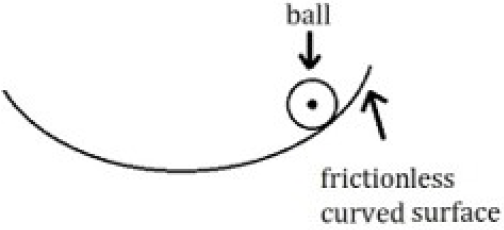
- A small spherical ball of radius ' \(r\) ' is rolling on a curved surface which is frictionless and has a radius of curvature ' R '. Its motion is simple harmonic. Then its time period of oscillation is proportional to ( \(\mathrm{g}=\) acceleration due to gravity)
 MHT CET 2025 Medium
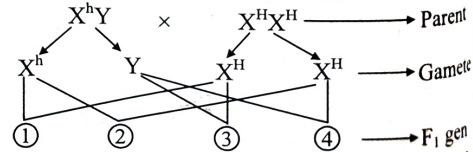
 - Select the correct sequence of the \(\mathrm{F}_1\) generation.
 MHT CET 2017 Medium