


MHT CET · Maths · Continuity and Differentiability
Which of the following functions is not p.d.f. of a continuous random variable X?
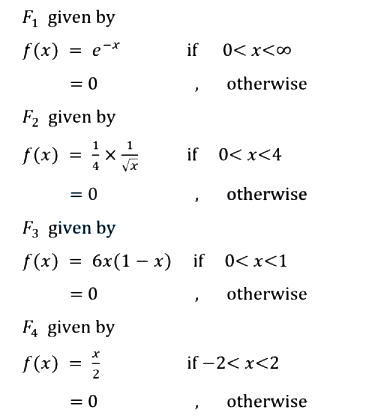
- A \(F_{3}\)
- B \(F_{4}\)
- C \(F_{1}\)
- D \(F_{2}\)
Answer & Solution
Correct Answer
(B) \(F_{4}\)
Step-by-step Solution
Detailed explanation
Since \(P(X=1)=P(X=2)=\ldots \ldots \ldots=P(X=n)\)
and \(P(X=1)+P(X=2)+\ldots \ldots+P(X=n)=1\),
We get \(P(X=1)=P(X=2)=P(X=n)=\frac{1}{n}\)
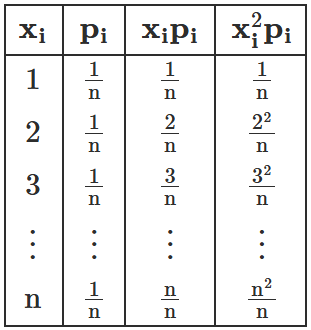
\(\sum \mathrm{x}_{\mathrm{i}} \mathrm{p}_{\mathrm{i}}=\frac{1}{\mathrm{n}}+\frac{2}{\mathrm{n}}+\frac{3}{\mathrm{n}}+\ldots \ldots+\frac{\mathrm{n}}{\mathrm{n}}=\frac{1}{\mathrm{n}}(1+2+3+\) \(\ldots \ldots \ldots \mathrm{n})=\frac{1}{\mathrm{n}} \frac{\mathrm{n}(\mathrm{n}+1)}{2}=\frac{\mathrm{n}+1}{2}\)
\(\sum x_{1}{ }^{2} p_{1} =\frac{1^{2}}{n}+\frac{2^{2}}{n}+\frac{3^{2}}{n}+\ldots \ldots+\frac{n^{2}}{n} \)
\( =\frac{1}{n}\left(1^{2}+2^{2}+3^{2}+\ldots+n^{2}\right)=\) \(\frac{1}{n} \frac{n(n+1)(2 n+1)}{6}-\frac{(n+1)(2 n+1)}{6}\)
Given \(E(X)=V(X)\)
\(\sum x_{i} p_{i}=\sum x_{i}^{2} p_{i}-\left[\sum x_{i} p_{i}\right]^{2} \)
\( \frac{n+1}{2}=\frac{(n+1)(2 n+1)}{6}-\left(\frac{n+1}{2}\right)^{2} \)
\( \frac{n+1}{2}=(n+1)\left(\frac{2 n+1}{6}-\frac{n+1}{4}\right) \Rightarrow \frac{1}{2}=\frac{8 n+4-6 n-6}{24} \)
\( 12=2 n-2 \Rightarrow n=7\)
and \(P(X=1)+P(X=2)+\ldots \ldots+P(X=n)=1\),
We get \(P(X=1)=P(X=2)=P(X=n)=\frac{1}{n}\)
\(\sum \mathrm{x}_{\mathrm{i}} \mathrm{p}_{\mathrm{i}}=\frac{1}{\mathrm{n}}+\frac{2}{\mathrm{n}}+\frac{3}{\mathrm{n}}+\ldots \ldots+\frac{\mathrm{n}}{\mathrm{n}}=\frac{1}{\mathrm{n}}(1+2+3+\) \(\ldots \ldots \ldots \mathrm{n})=\frac{1}{\mathrm{n}} \frac{\mathrm{n}(\mathrm{n}+1)}{2}=\frac{\mathrm{n}+1}{2}\)
\(\sum x_{1}{ }^{2} p_{1} =\frac{1^{2}}{n}+\frac{2^{2}}{n}+\frac{3^{2}}{n}+\ldots \ldots+\frac{n^{2}}{n} \)
\( =\frac{1}{n}\left(1^{2}+2^{2}+3^{2}+\ldots+n^{2}\right)=\) \(\frac{1}{n} \frac{n(n+1)(2 n+1)}{6}-\frac{(n+1)(2 n+1)}{6}\)
Given \(E(X)=V(X)\)
\(\sum x_{i} p_{i}=\sum x_{i}^{2} p_{i}-\left[\sum x_{i} p_{i}\right]^{2} \)
\( \frac{n+1}{2}=\frac{(n+1)(2 n+1)}{6}-\left(\frac{n+1}{2}\right)^{2} \)
\( \frac{n+1}{2}=(n+1)\left(\frac{2 n+1}{6}-\frac{n+1}{4}\right) \Rightarrow \frac{1}{2}=\frac{8 n+4-6 n-6}{24} \)
\( 12=2 n-2 \Rightarrow n=7\)
See the Complete Solution
Get step-by-step explanations for this and 2.5 Lakh+ more JEE, NEET & CET questions.
- Unlock all solutions
- Practice the full chapter
- Track accuracy across PYQs
4.8 rated on Google Play · 14,000+ reviews
More questions from Maths
- The differential equation \(\frac{d y}{d x}=\frac{\sqrt{1-y^2}}{y}\) determines a family of circles withMHT CET 2022 Easy
- If
\(\mathrm{I}=\int \frac{\sin x+\sin ^3 x}{\cos 2 x} \mathrm{~d} x=\mathrm{P} \cos x+\mathrm{Q} \log \left|\frac{\sqrt{2} \cos x-1}{\sqrt{2} \cos x+1}\right|+\mathrm{c},\)
(where \(\mathrm{c}\) is a constant of integration), then the values of \(\mathrm{P}\) and \(\mathrm{Q}\) are respectivelyMHT CET 2023 Hard - If the volume of a tetrahedron whose conterminous edges are \(\bar{a}+\bar{b}, \bar{b}+\bar{c}, \bar{c}+\bar{a}\) is 24 cubic units, then the volume of parallelepiped whose coterminous edges are \(\overline{\mathrm{a}}, \overline{\mathrm{b}}, \overline{\mathrm{c}}\) isMHT CET 2021 Hard
- If then …MHT CET 2019 Hard
- \(\lim _{x \rightarrow 2}\left(\frac{5^x+5^{3-x}-30}{5^{3-x}-5^{\frac{x}{2}}}\right)=\)MHT CET 2024 Hard
- \((2 \hat{i}+6 \hat{i}+27 \hat{k}) \times(\hat{i}+\lambda \hat{j}+\mu \hat{k})=\overline{0}\), then \(\lambda\) and \(\mu\) are respectivelyMHT CET 2021 Medium
More PYQs from MHT CET
- Which of the following function has period 2?MHT CET 2019 Easy
- A liquid drop having surface energy E is spread into 729 droplets of same size. The final surface energy of the droplets isMHT CET 2025 Medium
- If \(x^y \cdot y^x=16\), then \(\frac{\mathrm{d} y}{\mathrm{~d} x}\) at \((2,2)\) isMHT CET 2022 Medium
- Which from following polymers is grouped under elastomers?MHT CET 2024 Easy
- Identify the nitrogen atom of purine base that bonds with \(1^{\prime}\) carbon of ribose to form ribonucleoside?MHT CET 2024 Medium
- Identify ' \(A^{\prime}\) in the following reaction
Salicylic acid \(\stackrel{\text { Acetic anthydride }}{\longrightarrow} \mathrm{A}\)MHT CET 2020 Easy