


MHT CET · Maths · Vector Algebra
Two adjacent sides of a parallelogram \(\mathrm{ABCD}\) are given by \(\overline{\mathrm{AB}}=2 \hat{\mathrm{i}}+10 \hat{\mathrm{j}}+11 \hat{\mathrm{k}}\) and \(\overline{\mathrm{AD}}=-\hat{\mathrm{i}}+2 \hat{\mathrm{j}}+2 \hat{\mathrm{k}}\). The side \(\mathrm{AD}\) is potated by an acute angle \(\alpha\) in the plane of parallelogram so that \(\mathrm{AD}\) becomes \(\mathrm{AD}^{\prime}\). If \(\mathrm{AD}^{\prime}\) makes a right angle with side \(\mathrm{AB}\), then the cosine of the angle \(\alpha\) is given by
- A \(\frac{8}{9}\)
- B \(\frac{\sqrt{17}}{9}\)
- C \(\frac{1}{9}\)
- D \(\frac{4 \sqrt{5}}{9}\)
Answer & Solution
Correct Answer
(B) \(\frac{\sqrt{17}}{9}\)
Step-by-step Solution
Detailed explanation
Let \(\theta\) be the angle between \(\overline{\mathrm{AB}}\) and \(\overline{\mathrm{AD}}\)
\(\therefore \cos \theta =\frac{\overline{\mathrm{AB}} \cdot \overline{\mathrm{AD}}}{|\overline{\mathrm{AB}}||\overline{\mathrm{AD}}|} \)
\( =\frac{(2 \hat{\mathrm{i}}+10 \hat{\mathrm{j}}+11 \hat{\mathrm{k}}) \cdot(-\hat{\mathrm{i}}+2 \hat{\mathrm{j}}+2 \hat{\mathrm{k}})}{\sqrt{4+100+121} \sqrt{1+4+4}} \)
\(=\frac{-2+20+22}{\sqrt{225} \sqrt{9}} \)
\( =\frac{40}{45} \)
\( =\frac{8}{9} \)
\( \therefore \sin \theta =\sqrt{1-\left(\frac{8}{9}\right)^2}=\frac{\sqrt{17}}{9} \)
\(\alpha\) is the angle of rotation of \(A D\).
\(\therefore\) The angle between side \(\mathrm{AB}\) and \(\mathrm{AD}\)
\( =\alpha+\theta\)
\(=90^{\circ}\)
\(\therefore \cos (\alpha+\theta)=\cos \left(90^{\circ}\right) \)
\( \therefore \cos \alpha \cos \theta-\sin \alpha \sin \theta=0 \)
\( \therefore 8 \cos \alpha=\sqrt{17} \sin \alpha \)
\( \therefore 64 \cos ^2 \alpha=17\left(1-\cos ^2 \alpha\right) \)
\( \therefore 81 \cos ^2 \alpha=17 \)
\( \therefore \cos \alpha=\frac{\sqrt{17}}{9}\)
\(\therefore \cos \theta =\frac{\overline{\mathrm{AB}} \cdot \overline{\mathrm{AD}}}{|\overline{\mathrm{AB}}||\overline{\mathrm{AD}}|} \)
\( =\frac{(2 \hat{\mathrm{i}}+10 \hat{\mathrm{j}}+11 \hat{\mathrm{k}}) \cdot(-\hat{\mathrm{i}}+2 \hat{\mathrm{j}}+2 \hat{\mathrm{k}})}{\sqrt{4+100+121} \sqrt{1+4+4}} \)
\(=\frac{-2+20+22}{\sqrt{225} \sqrt{9}} \)
\( =\frac{40}{45} \)
\( =\frac{8}{9} \)
\( \therefore \sin \theta =\sqrt{1-\left(\frac{8}{9}\right)^2}=\frac{\sqrt{17}}{9} \)
\(\alpha\) is the angle of rotation of \(A D\).
\(\therefore\) The angle between side \(\mathrm{AB}\) and \(\mathrm{AD}\)
\( =\alpha+\theta\)
\(=90^{\circ}\)
\(\therefore \cos (\alpha+\theta)=\cos \left(90^{\circ}\right) \)
\( \therefore \cos \alpha \cos \theta-\sin \alpha \sin \theta=0 \)
\( \therefore 8 \cos \alpha=\sqrt{17} \sin \alpha \)
\( \therefore 64 \cos ^2 \alpha=17\left(1-\cos ^2 \alpha\right) \)
\( \therefore 81 \cos ^2 \alpha=17 \)
\( \therefore \cos \alpha=\frac{\sqrt{17}}{9}\)
See the Complete Solution
Get step-by-step explanations for this and 2.5 Lakh+ more JEE, NEET & CET questions.
- Unlock all solutions
- Practice the full chapter
- Track accuracy across PYQs
4.8 rated on Google Play · 14,000+ reviews
More questions from Maths
- In a bank, the principal increases continuously at a rate of \(x \%\) per year. Then the rate, \(x\), if ₹100 double itself in 10 years, is
\((\log 2=0.6931)\)MHT CET 2025 Medium - Argument of the complex number \(\mathrm{z}=\frac{13-5 \mathrm{i}}{4-9 \mathrm{i}}, i=\sqrt{-1}\) isMHT CET 2025 Medium
- The function \(\mathrm{f}(\mathrm{x})\) is defined by \(\mathrm{f}(\mathrm{x})=(\mathrm{x}+2) \mathrm{e}^{-\mathrm{x}}\) isMHT CET 2022 Hard
- Let \(\bar{a}, \bar{b}\) and \(\bar{c}\) be three vectors having magnitudes 1,1 and 2 respectively. If \(\overline{\mathrm{a}} \times(\overline{\mathrm{a}} \times \overline{\mathrm{c}})+\overline{\mathrm{b}}=\overline{0}\), then the acute angle between \(\overline{\mathrm{a}}\) and \(\overline{\mathrm{c}}\) isMHT CET 2024 Medium
- The area bounded by the curve, \(y=-x^2\), x-axis, \(x=1\) and \(x=4\), isMHT CET 2022 Easy
- If \(X\) is a random variable with distribution given below
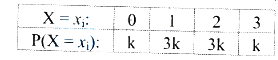
Then the value of \(k\) and its variance are respectively given byMHT CET 2024 Easy
More PYQs from MHT CET
- After \(t\) seconds, the acceleration of a particle, which starts from rest and moves in a straight line is \(\left(8-\frac{\mathrm{t}}{5}\right) \mathrm{cm} / \mathrm{s}^2\), then velocity of the particle at the instant, when the acceleration is zero, isMHT CET 2024 Easy
- What is the number of electrons present in antibonding orbitals of \(\mathrm{N}_2\) molecule according to molecular orbital theory?MHT CET 2024 Medium
- The combined equation of two lines through the origin and making an angle of \(45^{\circ}\) with the line \(3 x+y=0\), isMHT CET 2024 Hard
- How much amount of water is required to excrete 10 gm of uric acid?MHT CET 2024 Medium
- When \(2.0 \mathrm{~g}\) sucrose is oxidised forming \(\mathrm{CO}_2(\mathrm{~g})\) and \(\mathrm{H}_2 \mathrm{O}_{(\ell)}\) the internal energy changes by \(24 \mathrm{~kJ}\). Calculate the value of \(\Delta \mathrm{H}\) at \(298 \mathrm{~K}\) in \(\mathrm{kJ} / \mathrm{mol}\). (Molar mass of sucrose \(=342 \mathrm{~g} \mathrm{~mol}^{-1}\) )MHT CET 2022 Medium
- For a certain reaction \(\Delta H=-225 \mathrm{~kJ}\) and \(\Delta S=-150 \mathrm{JK}^{-1}\). Find the temperature so that \(\Delta \mathrm{G}\) is zero.MHT CET 2025 Medium