


MHT CET · Maths · Probability
Three persons \(\mathrm{P}, \mathrm{Q}\) and R independently try to hit a target. If the probabilities of their hitting the target are \(\frac{3}{4}, \frac{1}{2}\) and \(\frac{5}{8}\) respectively, then the probability that the target is hit by P or Q but not by \(R\), is
- A \(\frac{15}{64}\)
- B \(\frac{21}{64}\)
- C \(\frac{39}{64}\)
- D \(\frac{9}{64}\)
Answer & Solution
Correct Answer
(B) \(\frac{21}{64}\)
Step-by-step Solution
Detailed explanation
\(\mathrm{P}(\mathrm{P})=\frac{3}{4}, \mathrm{P}(\mathrm{Q})=\frac{1}{2}, \mathrm{P}(\mathrm{R})=\frac{5}{8}\)
Since \(\mathrm{P}, \mathrm{Q}, \mathrm{R}\) are independent events, \(\mathrm{P}^{\prime}, \mathrm{Q}^{\prime}, \mathrm{R}^{\prime}\) are also independent events.
\(\therefore P(\text { Target is hit by } P \text { or } Q \text { but not } R) \)
\( = P\left(P \cap \mathrm{Q}^{\prime} \cap \mathrm{R}^{\prime}\right)+P\left(\mathrm{P}^{\prime} \cap \mathrm{Q} \cap \mathrm{R}^{\prime}\right) \)
\(\mathrm{P}\left(\mathrm{P} \cap \mathrm{Q} \cap \mathrm{R}^{\prime}\right) \)
\( = \mathrm{P}(\mathrm{P}) \cdot \mathrm{P}\left(\mathrm{Q}^{\prime}\right) \cdot \mathrm{P}\left(\mathrm{R}^{\prime}\right)+\mathrm{P}\left(\mathrm{P}^{\prime}\right) \cdot \mathrm{P}(\mathrm{Q}) \cdot \mathrm{P}\left(\mathrm{R}^{\prime}\right) \) \(+\mathrm{P}(\mathrm{P}) \cdot \mathrm{P}(\mathrm{Q}) \cdot \mathrm{P}\left(\mathrm{R}^{\prime}\right) \)
\( = \left(\frac{3}{4}\right)\left(\frac{1}{2}\right)\left(\frac{3}{8}\right)+\left(\frac{1}{4}\right)\left(\frac{1}{2}\right)\left(\frac{3}{8}\right)~+\) \(\left(\frac{3}{4}\right)\left(\frac{1}{2}\right)\left(\frac{3}{8}\right) \)
\( = \frac{9+3+9}{64} \)
\( = \frac{21}{64}\)
Since \(\mathrm{P}, \mathrm{Q}, \mathrm{R}\) are independent events, \(\mathrm{P}^{\prime}, \mathrm{Q}^{\prime}, \mathrm{R}^{\prime}\) are also independent events.
\(\therefore P(\text { Target is hit by } P \text { or } Q \text { but not } R) \)
\( = P\left(P \cap \mathrm{Q}^{\prime} \cap \mathrm{R}^{\prime}\right)+P\left(\mathrm{P}^{\prime} \cap \mathrm{Q} \cap \mathrm{R}^{\prime}\right) \)
\(\mathrm{P}\left(\mathrm{P} \cap \mathrm{Q} \cap \mathrm{R}^{\prime}\right) \)
\( = \mathrm{P}(\mathrm{P}) \cdot \mathrm{P}\left(\mathrm{Q}^{\prime}\right) \cdot \mathrm{P}\left(\mathrm{R}^{\prime}\right)+\mathrm{P}\left(\mathrm{P}^{\prime}\right) \cdot \mathrm{P}(\mathrm{Q}) \cdot \mathrm{P}\left(\mathrm{R}^{\prime}\right) \) \(+\mathrm{P}(\mathrm{P}) \cdot \mathrm{P}(\mathrm{Q}) \cdot \mathrm{P}\left(\mathrm{R}^{\prime}\right) \)
\( = \left(\frac{3}{4}\right)\left(\frac{1}{2}\right)\left(\frac{3}{8}\right)+\left(\frac{1}{4}\right)\left(\frac{1}{2}\right)\left(\frac{3}{8}\right)~+\) \(\left(\frac{3}{4}\right)\left(\frac{1}{2}\right)\left(\frac{3}{8}\right) \)
\( = \frac{9+3+9}{64} \)
\( = \frac{21}{64}\)
See the Complete Solution
Get step-by-step explanations for this and 2.5 Lakh+ more JEE, NEET & CET questions.
- Unlock all solutions
- Practice the full chapter
- Track accuracy across PYQs
4.8 rated on Google Play · 14,000+ reviews
More questions from Maths
- If p and q are statements, then \(\qquad\) is a contingency.MHT CET 2024 Easy
- If \(\log (x+y)=\log (x y)+a\), where a is constant, then \(\frac{\mathrm{d} y}{\mathrm{~d} x}\) at \(x=2\) and \(y=4\) isMHT CET 2022 Medium
- If \(y=\tan ^{-1}\left(\frac{2+3 x}{3-2 x}\right)+\tan ^{-1}\left(\frac{4 x}{1+5 x^2}\right)\), then \(\frac{\mathrm{d} y}{\mathrm{~d} x}=\)MHT CET 2024 Easy
- If \(A=\left[\begin{array}{ll}1 & 1 \\ 1 & 2\end{array}\right], \quad B=\left[\begin{array}{ll}4 & 1 \\ 3 & 1\end{array}\right], \quad\) then \((A+B)^{-1}=\)MHT CET 2020 Easy
- \(\int_0^{\frac{\pi}{4}} \log \left(\frac{\sin x+\cos x}{\cos x}\right) d x=\)MHT CET 2024 Medium
- The differential equation whose solution represents the family \(x^2 y=4 e^x+c\), where \(c\) is an arbitrary constant, isMHT CET 2025 Medium
More PYQs from MHT CET
- One of the human embryonic developmental stages has been shown in the diagram. What do the A and B indicate?
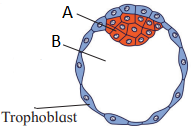 MHT CET 2020 Medium
 - Which among the following gases exhibits very low solubility in water at room temperature?MHT CET 2023 Easy
- The value of \(\cos ^{-1}\left\{\frac{1}{\sqrt{2}}\left(\cos \frac{9 \pi}{10}-\sin \frac{9 \pi}{10}\right)\right\}\) isMHT CET 2024 Hard
- Which among the following is NOT colligative property?MHT CET 2023 Easy
- Transpiration theory was proposed by __________.MHT CET 2023 Easy
- The equation of the plane passing through \((-2,2,2)\) and \((2,-2,-2)\) and perpendicular to the plane \(9 x-13 y-3 z=0\) isMHT CET 2021 Medium