


MHT CET · Maths · Application of Derivatives
The volume of a ball is increasing at the rate of \(4 \pi \mathrm{cc} / \mathrm{sec}\). The rate of increase of the radius, when the volume is \(288 \pi \mathrm{cc}\), is
- A \(\frac{1}{6} \mathrm{~cm} / \mathrm{sec}\)
- B \(\frac{1}{36} \mathrm{~cm} / \mathrm{sec}\)
- C \(6 \mathrm{~cm} / \mathrm{sec}\)
- D \(36 \mathrm{~cm} / \mathrm{sec}\)
Answer & Solution
Correct Answer
(B) \(\frac{1}{36} \mathrm{~cm} / \mathrm{sec}\)
Step-by-step Solution
Detailed explanation
\(\begin{aligned} & V=\frac{4}{3} \pi r^3 \\ & \Rightarrow 288 \pi=\frac{4}{3} \pi r^3 \\ & \Rightarrow r=6 \mathrm{~cm}\end{aligned}\)
\(\begin{aligned} & \quad \mathrm{V}=\frac{4}{3} \pi \mathrm{r}^3 \\ & \therefore \quad \frac{\mathrm{dV}}{\mathrm{dt}}=4 \pi \mathrm{r}^2 \cdot \frac{\mathrm{dr}}{\mathrm{dt}} \\ & \Rightarrow 4 \pi=4 \pi \mathrm{r}^2 \frac{\mathrm{dr}}{\mathrm{dt}} \\ & \therefore \quad \frac{\mathrm{dr}}{\mathrm{dt}}=\frac{1}{\mathrm{r}^2}=\frac{1}{36} \mathrm{~cm} / \mathrm{sec}\end{aligned}\)
\(\begin{aligned} & \quad \mathrm{V}=\frac{4}{3} \pi \mathrm{r}^3 \\ & \therefore \quad \frac{\mathrm{dV}}{\mathrm{dt}}=4 \pi \mathrm{r}^2 \cdot \frac{\mathrm{dr}}{\mathrm{dt}} \\ & \Rightarrow 4 \pi=4 \pi \mathrm{r}^2 \frac{\mathrm{dr}}{\mathrm{dt}} \\ & \therefore \quad \frac{\mathrm{dr}}{\mathrm{dt}}=\frac{1}{\mathrm{r}^2}=\frac{1}{36} \mathrm{~cm} / \mathrm{sec}\end{aligned}\)
See the Complete Solution
Get step-by-step explanations for this and 2.5 Lakh+ more JEE, NEET & CET questions.
- Unlock all solutions
- Practice the full chapter
- Track accuracy across PYQs
4.8 rated on Google Play · 14,000+ reviews
More questions from Maths
- The volume of solid generated by revolving about the \(y\) -axis the figure bounded by the parabola \(y=x^{2}\) and \(x=y^{2}\) isMHT CET 2008 Easy
- If \(f(x)=\frac{x+2}{18},-2 < x < 4\)
\(=0 \quad, \quad\) otherwise,
is the p. d. f. of a r. v. X, then the value of \(\mathrm{P}(|\mathrm{X}| < 2)\) isMHT CET 2020 Medium - The integral \(\int_{\frac{\pi}{6}}^{\frac{\pi}{3}} \sec ^{\frac{2}{3}} x \operatorname{cosec}^{\frac{4}{3}} x \mathrm{~d} x\) is equal toMHT CET 2023 Hard
- If \(y=\tan ^{-1} \sqrt{\frac{1+\cos x}{1-\cos x}}\), then \(\frac{d y}{d x}=\)MHT CET 2021 Medium
- If the angle between the planes and is thenMHT CET 2017 Easy
- Let \(P=\{\theta / \sin \theta-\cos \theta=\sqrt{2} \cos \theta\}\) and \(Q=\{\theta / \sin \theta+\cos \theta=\sqrt{2} \sin \theta\}\) be two sets, thenMHT CET 2024 Hard
More PYQs from MHT CET
- Which from following species does not have number of electrons similar to other three species?MHT CET 2024 Medium
- In the arrangement shown in the figure, the mass ' m ' will ascend with an acceleration (consider pully and rope are massless) ( \(g=\) acceleration due to gravity)
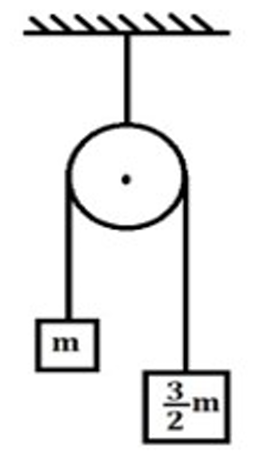 MHT CET 2025 Medium
 - What current strength is required to deposit \(36 \mathrm{~g}\) of \(\mathrm{Ag}\) in 7 minute from \(\mathrm{AgNO}_3\) solution by electrolysis? (Atomic mass \(\mathrm{Ag}=108)\)MHT CET 2022 Easy
- The real part of the principle value of \(2^{-i}\) isMHT CET 2012 Easy
- The fundamental frequency of a sonometer wire is 50 Hz for some length and tension. If the length is increased by \(25 \%\) by keeping tension same then frequency change of second harmonic isMHT CET 2025 Easy
- If \(f(x)=\sin ^{-1}\left(\sqrt{\frac{1-x}{2}}\right)\), then \(f^{\prime}(x)=\)MHT CET 2020 Medium