


MHT CET · Maths · Vector Algebra
The vectors \(\bar{a}\) and \(\bar{b}\) are not perpendicular and \(\overline{\mathrm{c}}\) and \(\overline{\mathrm{d}}\) are two vectors satisfying \(\overline{\mathrm{b}} \times \overline{\mathrm{c}}=\overline{\mathrm{b}} \times \overline{\mathrm{d}}\) and \(\overline{\mathrm{a}} \cdot \overline{\mathrm{d}}=0\), then the vector \(\overline{\mathrm{d}}\) is equal to
- A \(\bar{b}+\left(\frac{\bar{b} \cdot \bar{c}}{\bar{a} \cdot \bar{b}}\right) \bar{c}\)
- B \(\overline{\mathrm{c}}-\left(\frac{\overline{\mathrm{a}} \cdot \overline{\mathrm{c}}}{\overline{\mathrm{a}} \cdot \overline{\mathrm{b}}}\right) \overline{\mathrm{b}}\)
- C \(\bar{b}-\left(\frac{\bar{b} \cdot \bar{c}}{\bar{a} \cdot \bar{b}}\right) \bar{c}\)
- D \(\overline{\mathrm{c}}+\left(\frac{\overline{\mathrm{a}} \cdot \overline{\mathrm{c}}}{\overline{\mathrm{a}} \cdot \overline{\mathrm{b}}}\right) \overline{\mathrm{b}}\)
Answer & Solution
Correct Answer
(B) \(\overline{\mathrm{c}}-\left(\frac{\overline{\mathrm{a}} \cdot \overline{\mathrm{c}}}{\overline{\mathrm{a}} \cdot \overline{\mathrm{b}}}\right) \overline{\mathrm{b}}\)
Step-by-step Solution
Detailed explanation
Given,
Vectors \(\overline{\mathrm{a}}\) and \(\overline{\mathrm{b}}\) are not perpendicular
\(\begin{aligned}
\therefore \quad & \overline{\mathrm{a}} \cdot \overline{\mathrm{~b}} \neq 0 \\
& \overline{\mathrm{a}} \cdot \overline{\mathrm{~d}}=0 \\
& \overline{\mathrm{~b}} \times \overline{\mathrm{c}}=\overline{\mathrm{b}} \times \overline{\mathrm{d}} \\
& \Rightarrow \overline{\mathrm{a}} \times(\overline{\mathrm{b}} \times \overline{\mathrm{c}})=\overline{\mathrm{a}} \times(\overline{\mathrm{b}} \times \overline{\mathrm{d}}) \\
& \Rightarrow(\overline{\mathrm{a}} \cdot \overline{\mathrm{c}}) \overline{\mathrm{b}}-(\overline{\mathrm{a}} \cdot \overline{\mathrm{~b}}) \overline{\mathrm{c}}=(\overline{\mathrm{a}} \cdot \overline{\mathrm{~d}}) \overline{\mathrm{b}}-(\overline{\mathrm{a}} \cdot \overline{\mathrm{~b}}) \overline{\mathrm{d}} \\
& \Rightarrow(\overline{\mathrm{a}} \cdot \overline{\mathrm{~b}}) \overline{\mathrm{d}}=-(\overline{\mathrm{a}} \cdot \overline{\mathrm{c}}) \cdot \overline{\mathrm{b}}+(\overline{\mathrm{a}} \cdot \overline{\mathrm{~b}}) \overline{\mathrm{c}} \\
\quad & \Rightarrow \overline{\mathrm{~d}}=\frac{-(\overline{\mathrm{a}} \cdot \overline{\mathrm{c}}) \overline{\mathrm{b}}}{\overline{\mathrm{a}} \cdot \overline{\mathrm{~b}}}+\overline{\mathrm{c}} \\
\Rightarrow & \overline{\mathrm{~d}}=\overline{\mathrm{c}}-\left(\frac{\overline{\mathrm{a}} \cdot \overline{\mathrm{c}}}{\overline{\mathrm{a}} \cdot \overline{\mathrm{~b}}}\right) \overline{\mathrm{b}}
\end{aligned}\)
Vectors \(\overline{\mathrm{a}}\) and \(\overline{\mathrm{b}}\) are not perpendicular
\(\begin{aligned}
\therefore \quad & \overline{\mathrm{a}} \cdot \overline{\mathrm{~b}} \neq 0 \\
& \overline{\mathrm{a}} \cdot \overline{\mathrm{~d}}=0 \\
& \overline{\mathrm{~b}} \times \overline{\mathrm{c}}=\overline{\mathrm{b}} \times \overline{\mathrm{d}} \\
& \Rightarrow \overline{\mathrm{a}} \times(\overline{\mathrm{b}} \times \overline{\mathrm{c}})=\overline{\mathrm{a}} \times(\overline{\mathrm{b}} \times \overline{\mathrm{d}}) \\
& \Rightarrow(\overline{\mathrm{a}} \cdot \overline{\mathrm{c}}) \overline{\mathrm{b}}-(\overline{\mathrm{a}} \cdot \overline{\mathrm{~b}}) \overline{\mathrm{c}}=(\overline{\mathrm{a}} \cdot \overline{\mathrm{~d}}) \overline{\mathrm{b}}-(\overline{\mathrm{a}} \cdot \overline{\mathrm{~b}}) \overline{\mathrm{d}} \\
& \Rightarrow(\overline{\mathrm{a}} \cdot \overline{\mathrm{~b}}) \overline{\mathrm{d}}=-(\overline{\mathrm{a}} \cdot \overline{\mathrm{c}}) \cdot \overline{\mathrm{b}}+(\overline{\mathrm{a}} \cdot \overline{\mathrm{~b}}) \overline{\mathrm{c}} \\
\quad & \Rightarrow \overline{\mathrm{~d}}=\frac{-(\overline{\mathrm{a}} \cdot \overline{\mathrm{c}}) \overline{\mathrm{b}}}{\overline{\mathrm{a}} \cdot \overline{\mathrm{~b}}}+\overline{\mathrm{c}} \\
\Rightarrow & \overline{\mathrm{~d}}=\overline{\mathrm{c}}-\left(\frac{\overline{\mathrm{a}} \cdot \overline{\mathrm{c}}}{\overline{\mathrm{a}} \cdot \overline{\mathrm{~b}}}\right) \overline{\mathrm{b}}
\end{aligned}\)
See the Complete Solution
Get step-by-step explanations for this and 2.5 Lakh+ more JEE, NEET & CET questions.
- Unlock all solutions
- Practice the full chapter
- Track accuracy across PYQs
4.8 rated on Google Play · 14,000+ reviews
More questions from Maths
- The function \(f(x)=\cot ^{-1} x+x\) is increasing in the interval.MHT CET 2021 Easy
- The symbolic form of the following circuit is
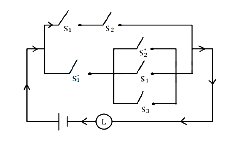
(where \(\mathrm{p}, \mathrm{q}\) and \(\mathrm{r}\) represents switches \(\mathrm{s}_{1}, \mathrm{~s}_{2}\) and \(\mathrm{s}_{3}\) which are closed respectively)MHT CET 2020 Medium - If \(\sin \theta=\frac{1}{2}\left(x+\frac{1}{x}\right)\), then \(\sin 3 \theta+\frac{1}{2}\left(x^3+\frac{1}{x^3}\right)=\)MHT CET 2025 Medium
- By Simpson's rule, the value of \(\int_{1}^{2} \frac{d x}{x}\) dividing the interval (1, 2) into four equal parts, isMHT CET 2008 Easy
- \(\int \frac{\mathrm{d} x}{(x+a)^{\frac{9}{7}}(x-b)^{5 / 7}}=\)MHT CET 2025 Medium
- If \(\mathrm{f}(x)=\left\{\begin{array}{ll}\mathrm{e}^{\cos x} \sin x & , \text { for }|x| \leq 2 \ 2, & \text { otherwise }\end{array}\right.\), then \(\int_{-2}^3 \mathrm{f}(x) \mathrm{d} x\) is equal toMHT CET 2023 Medium
More PYQs from MHT CET
- The particular solution of the differential equation , when isMHT CET 2017 Easy
- A disc of mass 25 kg and radius 0.2 m is rotating at 240 r.p.m. A retarding torque brings it to rest in 20 second. If the torque is due to a force applied tangentially on the rim of the disc then the magnitude of the force isMHT CET 2025 Medium
- Five students are to be arranged on a platform such that the boy \(B_1\) occupies the second position and such that the girl \(\mathrm{G}_1\) is always adjacent to the girl \(G_2\). Then, the number of such possible arrangements isMHT CET 2023 Easy
- Which among the following phenols has highest melting point?MHT CET 2023 Easy
- \(\int e^{\cos ^{-1} x}\left[\frac{x-\sqrt{1-x^{2}}}{\sqrt{1-x^{2}}}\right] d x=\)MHT CET 2020 Hard
- The figure shows the variation of photocurrent with anode potential for four different radiations. Let \(f_a, f_b, f_c\) and \(f_d\) be the frequencies for the curves \(a, b, c\) and \(d\) respectively
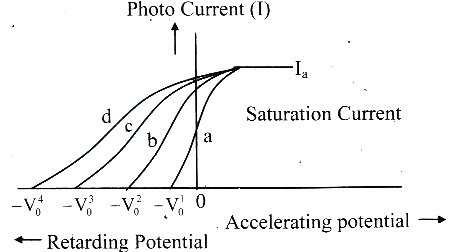 MHT CET 2024 Easy