


MHT CET · Maths · Indefinite Integration
The value of \(\int_{0}^{\infty} \frac{x}{(1+x)\left(x^{2}+1\right)} d x\) is
- A \(2 \pi\)
- B \(\frac{\pi}{4}\)
- C \(\frac{\pi}{16}\)
- D \(\frac{\pi}{32}\)
Answer & Solution
Correct Answer
(B) \(\frac{\pi}{4}\)
Step-by-step Solution
Detailed explanation
Let \(I=\int_{0}^{\infty} \frac{x d x}{(1+x)\left(x^{2}+1\right)}\)
By partial fraction, \(\frac{x}{(1+x)\left(x^{2}+1\right)}=\frac{A}{(1+x)}+\frac{B x+C}{\left(x^{2}+1\right)}\)
\(\Rightarrow x=A\left(x^{2}+1\right)+(1+x)(B x+C)\)
\(\Rightarrow x=A\left(x^{2}+1\right)+\left(B x+B x^{2}+C+C x\right)\)
\(\Rightarrow x=(A+B) x^{2}+(B+C) x+(A+C)\)
On comparing both sides, we get \(A+B=0, \quad\)\(B+C=1, \quad A+C=0 \quad \ldots(\mathrm{i})\)
On adding all these equations, we get
\(A+B+C =\frac{1}{2}...(ii) \)
\( \therefore A=\frac{1}{2}-1 =-\frac{1}{2}, C=\frac{1}{2} \)
\( \text { and } B=\frac{1}{2} \)
\( \therefore I=\int_{0}^{\infty}\left\{\frac{-1}{2(1+x)}+\frac{1}{2} \frac{(x+1)}{\left(x^{2}+1\right)}\right\} d x \)
\(=-\frac{1}{2} \int_{0}^{\infty} \frac{d x}{1+x}+\frac{1}{2} \int_{0}^{\infty} \frac{x}{x^{2}+1} d x \)
\(+\frac{1}{2} \int_{0}^{\infty} \frac{d x}{1+x^{2}} \)
\(=-\frac{1}{2}[\log (1+x)]_{0}^{\infty}+\frac{1}{4}\left[\log \left(x^{2}+1\right)\right]_{0}^{\infty}\)
\(+\frac{1}{2} \times \frac{\pi}{2}\)
\(=-\frac{1}{2} \lim _{x \rightarrow \infty} \log (1+x)+\frac{1}{4}\)
\(\lim _{x \rightarrow \infty} \log \left(1+x^{2}\right)+\frac{\pi}{4}\)
\(=\lim _{x \rightarrow \infty} \log \left[\frac{\left(1+x^{2}\right)^{1 / 4}}{(1+x)^{1 / 2}}\right]+\frac{\pi}{4}\)
\(=\lim _{x \rightarrow \infty} \log \left[\frac{\sqrt{x}\left(\frac{1}{x^{2}}+1\right)^{1 / 4}}{\sqrt{x}\left(\frac{1}{x}+1\right)^{1 / 2}}\right]+\frac{\pi}{4}\)
\(=\log \frac{(0+1)^{1 / 4}}{(0+1)^{1 / 2}}+\frac{\pi}{4}\)
\(=\log (1)+\frac{\pi}{4}=0+\frac{\pi}{4}=\frac{\pi}{4}\)
By partial fraction, \(\frac{x}{(1+x)\left(x^{2}+1\right)}=\frac{A}{(1+x)}+\frac{B x+C}{\left(x^{2}+1\right)}\)
\(\Rightarrow x=A\left(x^{2}+1\right)+(1+x)(B x+C)\)
\(\Rightarrow x=A\left(x^{2}+1\right)+\left(B x+B x^{2}+C+C x\right)\)
\(\Rightarrow x=(A+B) x^{2}+(B+C) x+(A+C)\)
On comparing both sides, we get \(A+B=0, \quad\)\(B+C=1, \quad A+C=0 \quad \ldots(\mathrm{i})\)
On adding all these equations, we get
\(A+B+C =\frac{1}{2}...(ii) \)
\( \therefore A=\frac{1}{2}-1 =-\frac{1}{2}, C=\frac{1}{2} \)
\( \text { and } B=\frac{1}{2} \)
\( \therefore I=\int_{0}^{\infty}\left\{\frac{-1}{2(1+x)}+\frac{1}{2} \frac{(x+1)}{\left(x^{2}+1\right)}\right\} d x \)
\(=-\frac{1}{2} \int_{0}^{\infty} \frac{d x}{1+x}+\frac{1}{2} \int_{0}^{\infty} \frac{x}{x^{2}+1} d x \)
\(+\frac{1}{2} \int_{0}^{\infty} \frac{d x}{1+x^{2}} \)
\(=-\frac{1}{2}[\log (1+x)]_{0}^{\infty}+\frac{1}{4}\left[\log \left(x^{2}+1\right)\right]_{0}^{\infty}\)
\(+\frac{1}{2} \times \frac{\pi}{2}\)
\(=-\frac{1}{2} \lim _{x \rightarrow \infty} \log (1+x)+\frac{1}{4}\)
\(\lim _{x \rightarrow \infty} \log \left(1+x^{2}\right)+\frac{\pi}{4}\)
\(=\lim _{x \rightarrow \infty} \log \left[\frac{\left(1+x^{2}\right)^{1 / 4}}{(1+x)^{1 / 2}}\right]+\frac{\pi}{4}\)
\(=\lim _{x \rightarrow \infty} \log \left[\frac{\sqrt{x}\left(\frac{1}{x^{2}}+1\right)^{1 / 4}}{\sqrt{x}\left(\frac{1}{x}+1\right)^{1 / 2}}\right]+\frac{\pi}{4}\)
\(=\log \frac{(0+1)^{1 / 4}}{(0+1)^{1 / 2}}+\frac{\pi}{4}\)
\(=\log (1)+\frac{\pi}{4}=0+\frac{\pi}{4}=\frac{\pi}{4}\)
See the Complete Solution
Get step-by-step explanations for this and 2.5 Lakh+ more JEE, NEET & CET questions.
- Unlock all solutions
- Practice the full chapter
- Track accuracy across PYQs
4.8 rated on Google Play · 14,000+ reviews
More questions from Maths
- Suppose A is any \(3 \times 3\) non-singular matrix and \((\mathrm{A}-3 \mathrm{I})(\mathrm{A}-5 \mathrm{I})=0\) where \(\mathrm{I}=\mathrm{I}_3\) and \(\mathrm{O}=\mathrm{O}_3\). Here \(\mathrm{O}_3\) represent zero matrix of order 3 and \(\mathrm{I}_3\) is an identity matrix of order 3 . If \(\alpha \mathrm{A}+\beta \mathrm{A}^{-1}=4 \mathrm{I}\), then \(\alpha+\beta\) is equal toMHT CET 2024 Medium
- The value of \((1+\Delta)(1-\nabla)\) isMHT CET 2011 Medium
- A wire of length 8 units is cut into two parts which are bent respectively in the form of a square and a circle. The least value of the sum of the areas so formed isMHT CET 2025 Medium
- Given below is the probability distribution of discrete r.v. X

Then \(\mathrm{P}[\mathrm{X} \geq 4]=\)MHT CET 2020 Easy - If \(0 \leqslant x \leqslant \pi\) and \(81^{\sin ^2 x}+81^{\cos ^2 x}=30\)
Then \(x\) takes the valueMHT CET 2025 Medium - Angle of intersection of the curve \(r=\sin \theta+\cos \theta\) and \(r=2 \sin \theta\) is equal toMHT CET 2008 Easy
More PYQs from MHT CET
- The length of the simple pendulum is made 3 times the original length. If ' T ' is its original time period, then the new time period will beMHT CET 2025 Easy
- A weak monobasic acid is \(3.0 \%\) dissociated in it's \(0.04 \mathrm{M}\) solution. What is the dissociation constant of acid?MHT CET 2021 Medium
- Let k be a non-zero real number.
If \(\mathrm{f}(x)=\left\{\begin{array}{cc}\frac{\left(\mathrm{e}^x-1\right)^2}{\sin \left(\frac{x}{\mathrm{k}}\right) \log \left(1+\frac{x}{4}\right)} & , x \neq 0 \ 12 & , x=0\end{array}\right.\)
is a continuous function, then the value of \(k\) isMHT CET 2024 Hard - Which of the following molecules shows intramolecular hydrogen bonding?MHT CET 2023 Easy
- The negation of \((p \wedge \sim q) \rightarrow(p \vee \sim q)\) isMHT CET 2025 Medium
- In which of the following figures, the p. n. junction diode is reverse biased?
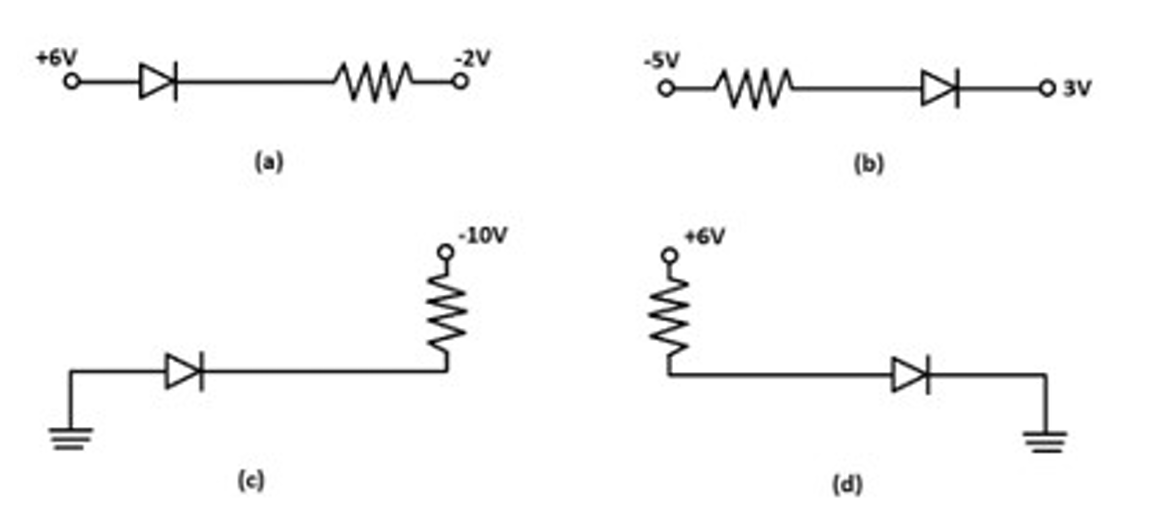 MHT CET 2025 Easy