


MHT CET · Maths · Differential Equations
The solution of \((1+x y) y \mathrm{~d} x+(1-x y) x \mathrm{~d} y=0\) is.
- A \(\log \left(\frac{x}{y}\right)+\frac{1}{x y}=\mathrm{k}\), where \(\mathrm{k}\) is constant of integration.
- B \(\log \left(\frac{x}{y}\right)=\frac{1}{x y}+\mathrm{k}\), where \(\mathrm{k}\) is constant of integration.
- C \(\log \left(\frac{x}{y}\right)+x y=\mathrm{k}\), where \(\mathrm{k}\) is constant of integration.
- D \(\log \left(\frac{x}{y}\right)=x y+\mathrm{k}\), where \(\mathrm{k}\) is constant of integration.
Answer & Solution
Correct Answer
(B) \(\log \left(\frac{x}{y}\right)=\frac{1}{x y}+\mathrm{k}\), where \(\mathrm{k}\) is constant of integration.
Step-by-step Solution
Detailed explanation
\((1+x y) y \mathrm{~d} x+(1-x y) x \mathrm{~d} y=0\)
\(\Rightarrow y \mathrm{~d} x+x \mathrm{~d} y+x y^2 \mathrm{~d} x-x^2 y \mathrm{~d} y=0\)
\(\Rightarrow \frac{y \mathrm{~d} x+x \mathrm{~d} y}{x^2 y^2}+\frac{\mathrm{d} x}{x}-\frac{\mathrm{d} y}{y}=0\)
\(\Rightarrow \frac{\mathrm{d}(x y)}{x^2 y^2}+\frac{\mathrm{d} x}{x}-\frac{\mathrm{d} y}{y}=0\)
Integrating on both sides, we get
\(-\frac{1}{x y}+\log x-\log y=\mathrm{k}\)
\(\Rightarrow \log \left(\frac{x}{y}\right)=\frac{1}{x y}+\mathrm{k}\)
\(\Rightarrow y \mathrm{~d} x+x \mathrm{~d} y+x y^2 \mathrm{~d} x-x^2 y \mathrm{~d} y=0\)
\(\Rightarrow \frac{y \mathrm{~d} x+x \mathrm{~d} y}{x^2 y^2}+\frac{\mathrm{d} x}{x}-\frac{\mathrm{d} y}{y}=0\)
\(\Rightarrow \frac{\mathrm{d}(x y)}{x^2 y^2}+\frac{\mathrm{d} x}{x}-\frac{\mathrm{d} y}{y}=0\)
Integrating on both sides, we get
\(-\frac{1}{x y}+\log x-\log y=\mathrm{k}\)
\(\Rightarrow \log \left(\frac{x}{y}\right)=\frac{1}{x y}+\mathrm{k}\)
See the Complete Solution
Get step-by-step explanations for this and 2.5 Lakh+ more JEE, NEET & CET questions.
- Unlock all solutions
- Practice the full chapter
- Track accuracy across PYQs
4.8 rated on Google Play · 14,000+ reviews
More questions from Maths
- If then _______MHT CET 2016 Easy
- If the direction cosines of a line are \(\frac{1}{c}, \frac{1}{c}, \frac{1}{c}\) thenMHT CET 2020 Easy
- If \(\mathrm{e}^{\mathrm{y}}+x \mathrm{y}=\mathrm{e}\), then the ordered pair \(\left(\frac{\mathrm{dy}}{\mathrm{d} x}, \frac{\mathrm{~d}^2 \mathrm{y}}{\mathrm{d} x^2}\right)\) at \(x=0\) is equal toMHT CET 2025 Medium
- In a triangle \(A B C\), with usual notations, if \(b=\sqrt{3}, c=1, \angle A=30^{\circ}\), then angle \(B\) isMHT CET 2022 Medium
- A random variable \(X\) has the following probability distribution
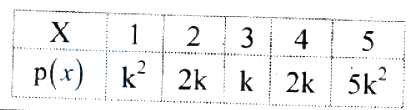
Then \(\mathrm{p}(x \geq 2)\) is equal toMHT CET 2024 Easy - f a line in octant OXYZ makes equal angles with co-ordinate axes, thenMHT CET 2020 Easy
More PYQs from MHT CET
- A galvanometer of resistance \(G\) can be converted into a voltmeter of range \(V\) by connecting a resistance \(R\) in series with it. The series resistance required to change its range to \(\frac{V}{3}\) isMHT CET 2022 Hard
- Two discs of moment of inertia ' \(\mathrm{I}_1\) ' and ' \(\mathrm{I}_2\) ' and angular speeds ' \(\omega_1{ }^{\prime}\) and ' \(\omega_2\) ' are rotating along the collinear axes passing through their centre of mass and perpendicular to their plane. If the two discs are made to rotate together along the same axis. The rotational kinetic energy of the system will beMHT CET 2025 Medium
- If \(f(x)=\sqrt{\tan x}\) and \(g(x)=\sin x \cdot \cos x\), then \(\int \frac{f(x)}{g(x)} d x\) is equal to (where \(C\) is a constant of integration)MHT CET 2022 Easy
- The value of the shunt resistance that allows \(10 \%\) of the main current through the galvanometer of \(99 \Omega\) isMHT CET 2025 Easy
- A student measures time for 20 oscillations of a simple pendulum as \(30 \mathrm{~s}, 32 \mathrm{~s}, 35 \mathrm{~s}\) and 35 s . If the minimum division in the measuring clock is \(1 s\), then correct mean time (in second) isMHT CET 2025 Easy
- Which of the following is a natural polymer?MHT CET 2019 Easy