


MHT CET · Maths · Application of Derivatives
The slope of the tangent to a curve \(y=\mathrm{f}(x)\) at \((x, \mathrm{f}(x))\) is \(2 x+1\). If the curve passes through the point \((1,2)\), then the area (in sq. units), bounded by the curve, the \(\mathrm{X}\)-axis and the line \(x=1\), is
- A \(\frac{3}{2}\)
- B \(\frac{4}{3}\)
- C \(\frac{5}{6}\)
- D \(\frac{1}{12}\)
Answer & Solution
Correct Answer
(C) \(\frac{5}{6}\)
Step-by-step Solution
Detailed explanation
According to the given condition, \(\frac{\mathrm{d} y}{\mathrm{~d} x}=2 x+1\) Integrating w.r.t. \(x\), we get \(y=x^2+x+\mathrm{c}\) As curve passes through \((1,2)\), we get \(2=(1)^2+1+c \Rightarrow c=0\)
\(\therefore \quad\) The equation of the curve is \(y=x^2+x\).
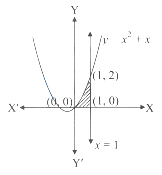
\(\therefore\) Required area
\(\begin{aligned} & =\int_0^1\left(x^2+x\right) \mathrm{d} x \\ & =\left[\frac{x^3}{3}+\frac{x^2}{2}\right]_0^1 \\ & =\frac{1}{3}+\frac{1}{2} \\ & =\frac{5}{6} \text { sq. units }\end{aligned}\)
\(\therefore \quad\) The equation of the curve is \(y=x^2+x\).
\(\therefore\) Required area
\(\begin{aligned} & =\int_0^1\left(x^2+x\right) \mathrm{d} x \\ & =\left[\frac{x^3}{3}+\frac{x^2}{2}\right]_0^1 \\ & =\frac{1}{3}+\frac{1}{2} \\ & =\frac{5}{6} \text { sq. units }\end{aligned}\)
See the Complete Solution
Get step-by-step explanations for this and 2.5 Lakh+ more JEE, NEET & CET questions.
- Unlock all solutions
- Practice the full chapter
- Track accuracy across PYQs
4.8 rated on Google Play · 14,000+ reviews
More questions from Maths
- Let \(\mathrm{z}=x+\mathrm{i} y\) be a complex number, where \(x\) and \(y\) are integers and \(\mathrm{i}=\sqrt{-1}\). Then the area of the rectangle whose vertices are the roots of the equation \(z^3+\bar{z} z^3=350\) isMHT CET 2024 Medium
- If the population grows at the rate of \(8 \%\) per year, then the time taken for the population to be doubled, is (Given \(\log 2=0 \cdot 6912\) )MHT CET 2020 Medium
- If \(\mathrm{y}=\log _{\mathrm{e}} x^3+3 \sin ^{-1} x+\mathrm{k} x^2\) and \(\mathrm{y}^{\prime}\left(\frac{1}{2}\right)=2 \sqrt{3}\), then \(\mathrm{k}=\)MHT CET 2025 Medium
- The value of C for which Mean value Theorem holds for the function \(\mathrm{f}(x)=\log _{\mathrm{e}} x\) on the interval \([1,3]\) isMHT CET 2024 Medium
- The parametric equations of the line passing through A \((3,4,-7), \mathrm{B}(1,-1,6)\) areMHT CET 2020 Medium
- If \(\mathrm{m}_1\) and \(\mathrm{m}_2\) are the slopes of the lines represented by \(a x^2+2 \mathrm{~h} x \mathrm{y}+\mathrm{by}^2=0\) satisfying the condition \(16 \mathrm{~h}^2=25 a \mathrm{~b}\), then \(\ldots\).MHT CET 2025 Medium
More PYQs from MHT CET
- Identify acidic amino acid from following list represented by three letter symbols.MHT CET 2025 Easy
- Let \(f: R \rightarrow R\) be a function defined as
\(f(x)=\left\{\begin{array}{ccc}
5 , & \text { if } x \leq 1 \
a+b x , & \text { if } 1 < x < 3 \
b+5 x,\end{array} \right. \) \(\text {if } 3 \leq x < 5 \
30 , \text {if } x \geq 5\) \(\mid \text {then } f \text { is }\)MHT CET 2022 Medium - If the line \(x \cos \alpha+y \sin \alpha=p\) be normal to the ellipse \(\frac{x^{2}}{a^{2}}+\frac{y^{2}}{b^{2}}=1\), thenMHT CET 2008 Medium
- The equation of the plane passing through the point \((1,1,1)\) and through the line of intersection of \(x+2 y-z+1=0\) and \(3 x-y-4 z+3=0\) isMHT CET 2025 Medium
- Identify the product \(\mathrm{P}\) obtained in following reaction.
\(\text { Benzene + ozone (excess) } \stackrel{\mathrm{CCl}_4}{\longrightarrow}\) \(\text {Benzene triozonide}\) \(\stackrel{\mathrm{Zn}/\mathrm{H}_2 \mathrm{O}}{\longrightarrow} \mathrm{P}+\mathrm{H}_2 \mathrm{O}_2\)MHT CET 2023 Medium - How many isotopes of nitrogen are found?MHT CET 2024 Easy