


MHT CET · Maths · Sequences and Series
The sides of a triangle are three consecutive natural numbers and its largest angle is twice the smallest one, then the sides of the triangle (in units) are
- A \(3,4,5\)
- B \(4,5,6\)
- C \(5,6,7\)
- D \(2,3,4\)
Answer & Solution
Correct Answer
(B) \(4,5,6\)
Step-by-step Solution
Detailed explanation
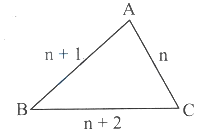
Let \(\mathrm{AC}=\mathrm{n}, \mathrm{AB}=\mathrm{n}+1, \mathrm{BC}=\mathrm{n}+2\)
\(\therefore\) Largest angle is \(\mathrm{A}\) and smallest angle is \(\mathrm{B}\).
\(\therefore \mathrm{A}=2 \mathrm{~B}\)
Since \(\mathrm{A}+\mathrm{B}+\mathrm{C}=180^{\circ}\)
\(\therefore 3 \mathrm{~B}+\mathrm{C}=180^{\circ}\)
\(\Rightarrow \mathrm{C}=180^{\circ}-3 \mathrm{~B} \)
\(\Rightarrow \sin \mathrm{C}=\sin \left(180^{\circ}-3 \mathrm{~B}\right)=\sin 3 \mathrm{B}\)
By sine rule,
\(\frac{\sin A}{n+2}=\frac{\sin B}{n}=\frac{\sin C}{n+1} \)
\(\Rightarrow \frac{\sin 2 B}{n+2}=\frac{\sin B}{n}=\frac{\sin 3 B}{n+1} \)
\(\Rightarrow \frac{2 \sin B \cos B}{n+2}=\frac{\sin B}{n}=\frac{3 \sin B-4 \sin ^3 B}{n+1} \)
\(\Rightarrow \frac{2 \cos B}{n+2}=\frac{1}{n}=\frac{3-4 \sin ^2 B}{n+1} \)
\(\therefore \cos B=\frac{n+2}{2 n}, 3-4 \sin ^2 B=\frac{n+1}{n} \)
\(\therefore 3-4\left(1-\cos ^2 B\right)=\frac{n+1}{n} \)
\(\therefore -4+4\left(\frac{n+2}{2 n}\right)^2=\frac{n+1}{n} \)
\(\Rightarrow-1+\frac{n^2+4 n+4}{n^2}=\frac{n+1}{n} \)
\(\Rightarrow-n^2+n^2+4 n+4=n^2+n \)
\(\Rightarrow n^2-3 n-4=0 \)
\(\Rightarrow(n+1)(n-4)=0 \)
\(\Rightarrow n=-1 \text { or } n=4\)
But \(\mathrm{n}\) cannot be negative.
\(\therefore \mathrm{n}=4\)
\(\therefore \) The sides of the \(\Delta\) are \(4,5,6\).
See the Complete Solution
Get step-by-step explanations for this and 2.5 Lakh+ more JEE, NEET & CET questions.
- Unlock all solutions
- Practice the full chapter
- Track accuracy across PYQs
4.8 rated on Google Play · 14,000+ reviews
More questions from Maths
- If \([x]\) is greatest integer function and \(2[2 x-5]-1=7\), then \(x\) lies inMHT CET 2022 Easy
- The general solution of the differential equation \(\cos x \cdot \sin y d x\) \(+\sin x \cdot \cos y d y=0\) isMHT CET 2021 Medium
- Let \(x\) be the length of each of the equal sides of an isosceles triangle and \(\theta\) be the angle between these sides. If \(x\) is increasing at the rate \(\frac{1}{12} \mathrm{~m} /\) hour and \(\theta\) is increasing at the rate \(\frac{\pi}{180} \mathrm{rad} /\) hour, then the rate at which area of the triangle is increasing when \(x=12 \mathrm{~m}\) and \(\theta=\frac{\pi}{4}\) isMHT CET 2025 Medium
- If \(\overline{\mathrm{a}}=\hat{\mathrm{i}}-2 \hat{\mathrm{j}}+3 \hat{\mathrm{k}}\) and \(\overline{\mathrm{b}}=2 \hat{\mathrm{i}}+3 \hat{\mathrm{j}}-\hat{\mathrm{k}}\) are two vectors, then the angle between the vectors \(3 \bar{a}+5 \bar{b}\) and \(5 \bar{a}+3 \bar{b}\) isMHT CET 2024 Easy
- \(\int \sin ^{-1}\left(\frac{2 x}{1+x^2}\right) \mathrm{d} x=\)MHT CET 2024 Hard
- If \(\tan \theta=\frac{a}{b}\), then \(b \cos 2 \theta+a \sin 2 \theta=\)MHT CET 2022 Medium
More PYQs from MHT CET
- The negation of the statement "The payment will be made if and only if the work is finished in time" isMHT CET 2022 Easy
- Which among the following polymers has high tensile strength and is used to obtain tyre cords?MHT CET 2022 Easy
- A liquid kept in a cylindrical vessel is rotated about vertical axis through the centre
of circular base. The difference in the heights of the liquid at the centre of vessel and
its edge is \((\mathrm{R}=\) radius of vessel, \(\omega=\) angular velocity of rotation, \(\mathrm{g}=\) acceleration
due to gravity)MHT CET 2020 Hard - The integrating factor of \(\mathrm{y}+\frac{\mathrm{d}}{\mathrm{d} x}(x \mathrm{y})=x(\sin x+\log x)\) isMHT CET 2025 Medium
- A horizontal pipeline carries water in a stream-line flow. At a point along the pipe, where the cross-sectional area is \(10 \mathrm{~cm}^2\), the velocity of water is \(1 \mathrm{~m} / \mathrm{s}\) and pressure is 2000 Pa . The pressure of water at another point where the cross-sectional area \(5 \mathrm{~cm}^2\) is
\(\left[\text { Given } \rightarrow \text { density of water }=1000 \mathrm{~kg} / \mathrm{m}^3\right]\)MHT CET 2025 Medium - For the reaction, \(A+3 B \rightarrow 2 C\) rate of consumption of \(A\) is \(1.4 \mathrm{~mol~} \mathrm{dm}^{-3}\) minute \({ }^{-1}\). Calculate rate of consumption of B .MHT CET 2025 Easy