


MHT CET · Maths · Area Under Curves
The shaded region in the following figure is the solution set of the inequations
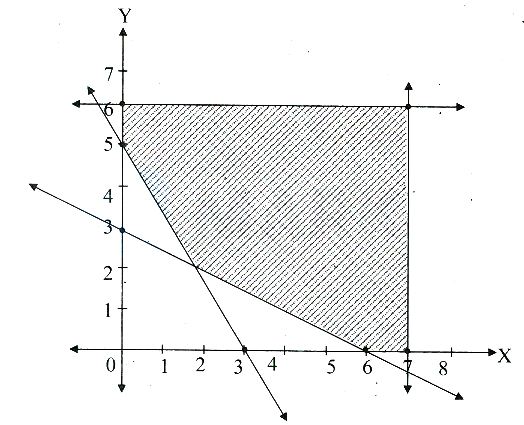
- A \(x+2 y \leq 6,5 x+3 y \geq 15, x \leq 7, y \leq 6, x \text {, } y \geq 0\)
- B \(x+2 y \geq 6,5 x+3 y \geq 15, x \leq 7, y \leq 6, x y \geq 0\)
- C \(x+2 y \geq 6,5 x+3 y \leq 15, x \geq 7, y \leq 6, x, y \geq 0\)
- D \(x+2 y \leq 6,5 x+3 y \leq 15, x \leq 7, y \geq 6, x, y \geq 0\)
Answer & Solution
Correct Answer
(A) \(x+2 y \leq 6,5 x+3 y \geq 15, x \leq 7, y \leq 6, x \text {, } y \geq 0\)
Step-by-step Solution
Detailed explanation
To determine which option corresponds to the shaded region in the figure, let's analyze each inequality represented in the answer choices.
Axes and the Region: The region is bounded by the axes \(x \geq 0\) and \(y \geq 0\), which are present in all options. The other inequalities will help define the upper bounds more clearly.
Inequalities Exploration:
Option (1):
\(x+2 y \leq 6\) (below the line)
\(5 x+3 y \geq 15\) (above the line)
\(x \leq 7\) (to the left of the vertical line)
\(y \leq 6\) (below the horizontal line)
Option (2):
\(x+2 y \geq 6\) (above the line)
\(5 x+3 y \geq 15\) (above the line)
Options continue in the same manner with \(x\) and \(y\).
Interpreting the Shaded Region:
Examine if the inequalities allow a bounded area in the first quadrant.
The acceptable area must lie below the line for \(x+2 y \leq 6\) and above the line for \(5 x+3 y \geq 15\).
Summary of Options:
Option (1) fulfills the conditions that keep the region bounded below \(y=6\), to the left of \(x=7\), and within the first quadrant.
Following the analysis, the correct answer corresponds to the region described in Option (1):
\(\text { (1) } \quad x+2 y \leq 6, \quad 5 x+3 y \geq 15, \quad x \leq 7, \quad y \leq 6, \quad\) \(x, y \geq 0\)
Axes and the Region: The region is bounded by the axes \(x \geq 0\) and \(y \geq 0\), which are present in all options. The other inequalities will help define the upper bounds more clearly.
Inequalities Exploration:
Option (1):
\(x+2 y \leq 6\) (below the line)
\(5 x+3 y \geq 15\) (above the line)
\(x \leq 7\) (to the left of the vertical line)
\(y \leq 6\) (below the horizontal line)
Option (2):
\(x+2 y \geq 6\) (above the line)
\(5 x+3 y \geq 15\) (above the line)
Options continue in the same manner with \(x\) and \(y\).
Interpreting the Shaded Region:
Examine if the inequalities allow a bounded area in the first quadrant.
The acceptable area must lie below the line for \(x+2 y \leq 6\) and above the line for \(5 x+3 y \geq 15\).
Summary of Options:
Option (1) fulfills the conditions that keep the region bounded below \(y=6\), to the left of \(x=7\), and within the first quadrant.
Following the analysis, the correct answer corresponds to the region described in Option (1):
\(\text { (1) } \quad x+2 y \leq 6, \quad 5 x+3 y \geq 15, \quad x \leq 7, \quad y \leq 6, \quad\) \(x, y \geq 0\)
See the Complete Solution
Get step-by-step explanations for this and 2.5 Lakh+ more JEE, NEET & CET questions.
- Unlock all solutions
- Practice the full chapter
- Track accuracy across PYQs
4.8 rated on Google Play · 14,000+ reviews
More questions from Maths
- A vector parallel to the line of intersection of the planes \(\bar{r} \cdot(3 \hat{i}-\hat{j}+\hat{k})=1\) and \(\overline{\mathrm{r}} \cdot(\hat{\mathrm{i}}+4 \hat{\mathrm{j}}-2 \hat{\mathrm{k}})=2\) isMHT CET 2023 Medium
- If order and degree of the differential equation \(\left(\frac{\mathrm{d}^2 y}{\mathrm{~d} x^2}\right)^5+4 \frac{\left(\frac{\mathrm{~d}^2 y}{\mathrm{~d} x^2}\right)^5}{\left(\frac{\mathrm{~d}^3 y}{\mathrm{~d} x^3}\right)}+\frac{\mathrm{d}^3 y}{\mathrm{~d} x^3}=\sin x\), are m and n respectively, then the value of \(\left(m^2+n^2\right)\) is equal toMHT CET 2024 Easy
- \(\int \frac{x \mathrm{~d} x}{(x-1)^2(x+2)}=\)MHT CET 2024 Medium
- If \(\sin (y+z-x), \sin (z+x-y)\) and \(\sin (x+y-z)\) are in \(A P\), thenMHT CET 2021 Hard
- If \(\vec{a}, \vec{b}, \vec{c}\) are position vectors of points \(\mathrm{A}, \mathrm{B}, \mathrm{C}\) respectively, with \(2 \vec{a}+3 \vec{b}-5 \vec{c}=\overrightarrow{0}\), then the ratio in which point \(\mathrm{C}\) divides segment \(\mathrm{AB}\) isMHT CET 2022 Easy
- If \(\int \frac{(\cos x-\sin x)}{8-\sin 2 x} d x=\frac{1}{p} \log \left[\frac{3+\sin x+\cos x}{3-\sin x-\cos x}\right]+c\), then \(\mathrm{p}=(\) Where \(\mathrm{c}\) is a constant of integration)MHT CET 2021 Hard
More PYQs from MHT CET
- The solutions of \(\sin x+\sin 5 x=\sin 3 x\) in \(\left(0, \frac{\pi}{2}\right)\) areMHT CET 2023 Easy
- Resolving power of telescope increases whenMHT CET 2016 Easy
- A poster is to be printed on a rectangular sheet of paper of area \(18 \mathrm{~m}^2\). The margins at the top and bottom of 75 cm each and at the sides 50 cm each are to be left. Then the dimensions i.e. height and breadth of the sheet so that the space available for printing is maximum, are _________ respectively.MHT CET 2024 Medium
- A square plate is contracting at the uniform rate \(4 \mathrm{~cm}^2 / \mathrm{sec}\), then the rate at which the perimeter is decreasing, when side of the square is \(20 \mathrm{~cm}\), isMHT CET 2023 Easy
- Which of the following is a tricarboxylic acid?MHT CET 2024 Medium
- The dimensions of torque are same as that ofMHT CET 2019 Easy