


MHT CET · Maths · Differential Equations
The rate of growth of bacteria is proportional to number present. If initially there
were 1000 bacteria and the number doubles in 1 hour then the number of bacteria
after \(2 \frac{1}{2}\) hours are (Given \(\sqrt{2}=1.414\) )
- A 4646 approximately
- B 5056 approximately
- C 5656 approximately
- D \(400 \sqrt{2}\) approximately
Answer & Solution
Correct Answer
(C) 5656 approximately
Step-by-step Solution
Detailed explanation
The rate of growth is proportional to the number present
\(\therefore \frac{\mathrm{d} \mathrm{N}}{\mathrm{dt}} \propto \mathrm{N} \Rightarrow \frac{\mathrm{d} \mathrm{N}}{\mathrm{dt}}=\mathrm{kN} \Rightarrow \frac{\mathrm{d} \mathrm{N}}{\mathrm{N}}=\mathrm{k} \mathrm{dt}\)
\(\therefore\) On integrating we get
\(\int \frac{\mathrm{dN}}{\mathrm{N}}=\mathrm{k} \int \mathrm{dt}\)
\(\therefore \log \mathrm{N}=\mathrm{kt}+\mathrm{C}\)
When \(\mathrm{t}=0, \mathrm{~N}=1000 \Rightarrow \mathrm{C}=\log 1000\)
\(\therefore \log \mathrm{N}=\mathrm{kt}+\log 1000\)
\(\therefore \quad \log \left(\frac{\mathrm{N}}{1000}\right)=\mathrm{kt}\)
\(\mathrm{N}=1000 \mathrm{e}^{\mathrm{kt}}\) ...(1)
When \(\mathrm{t}=1, \mathrm{~N}=2000\)
\(\therefore \mathrm{e}^{\mathrm{k}}=2 \quad \Rightarrow \mathrm{N}=1000 \times 2^{1} \quad \ldots[\) from (1) \(]\)
When \(t=2 \frac{1}{2}\), we get
\(\mathrm{N}=1000 \times 2^{\frac{5}{2}}=1000 \times 4 \sqrt{2}\)
\(=1000 \times 4 \times 1.414=5656\)
\(\therefore \frac{\mathrm{d} \mathrm{N}}{\mathrm{dt}} \propto \mathrm{N} \Rightarrow \frac{\mathrm{d} \mathrm{N}}{\mathrm{dt}}=\mathrm{kN} \Rightarrow \frac{\mathrm{d} \mathrm{N}}{\mathrm{N}}=\mathrm{k} \mathrm{dt}\)
\(\therefore\) On integrating we get
\(\int \frac{\mathrm{dN}}{\mathrm{N}}=\mathrm{k} \int \mathrm{dt}\)
\(\therefore \log \mathrm{N}=\mathrm{kt}+\mathrm{C}\)
When \(\mathrm{t}=0, \mathrm{~N}=1000 \Rightarrow \mathrm{C}=\log 1000\)
\(\therefore \log \mathrm{N}=\mathrm{kt}+\log 1000\)
\(\therefore \quad \log \left(\frac{\mathrm{N}}{1000}\right)=\mathrm{kt}\)
\(\mathrm{N}=1000 \mathrm{e}^{\mathrm{kt}}\) ...(1)
When \(\mathrm{t}=1, \mathrm{~N}=2000\)
\(\therefore \mathrm{e}^{\mathrm{k}}=2 \quad \Rightarrow \mathrm{N}=1000 \times 2^{1} \quad \ldots[\) from (1) \(]\)
When \(t=2 \frac{1}{2}\), we get
\(\mathrm{N}=1000 \times 2^{\frac{5}{2}}=1000 \times 4 \sqrt{2}\)
\(=1000 \times 4 \times 1.414=5656\)
See the Complete Solution
Get step-by-step explanations for this and 2.5 Lakh+ more JEE, NEET & CET questions.
- Unlock all solutions
- Practice the full chapter
- Track accuracy across PYQs
4.8 rated on Google Play · 14,000+ reviews
More questions from Maths
- If \(A=\left[\begin{array}{ccc}1 & 2 & 1 \\ -1 & 1 & 3\end{array}\right]\) and \(B=\left[\begin{array}{cc}1 & 2 \\ -3 & 1 \\ 0 & 2\end{array}\right]\), then \((A B)^{-1}\)MHT CET 2021 Easy
- If the vectors \(\overrightarrow{\mathbf{a}}=\hat{\mathbf{i}}+a \hat{\mathbf{j}}+a^{2} \hat{\mathbf{k}}\),
\(\overrightarrow{\mathbf{b}}=\hat{\mathbf{i}}+b \hat{\mathbf{j}}+b^{2} \hat{\mathbf{k}}\) and \(\overrightarrow{\mathbf{c}}=\hat{\mathbf{i}}+c \hat{\mathbf{j}}+c^{2} \hat{\mathbf{k}}\) are three
non-coplanar vectors and \(\left|\begin{array}{lll}a & a^{2} & 1+a^{3} \\ b & b^{2} & 1+b^{3} \\ c & c^{2} & 1+c^{3}\end{array}\right|=0\),
then the value of \(a b c\) isMHT CET 2007 Medium - If the line \(\bar{r}=(\hat{\imath}-2 \hat{\jmath}+3 \hat{k})+\lambda(2 \hat{\imath}+\hat{\jmath}+2 \hat{k})\) is parallel to the plane \(\bar{r} \cdot(3 \hat{\imath}-2 \hat{\jmath}-m \hat{k})=5\), then value of \(m\) isMHT CET 2020 Easy
- A random variable \(X\) has the following probability distribution
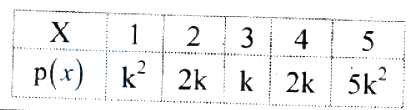
Then \(\mathrm{p}(x \geq 2)\) is equal toMHT CET 2024 Easy - In \(\triangle \mathrm{ABC}\), with usual notations, if \(\frac{1}{b+c}+\frac{1}{c+a}=\frac{3}{a+b+c}\), then \(m \angle C\) is equal toMHT CET 2024 Medium
- \(\mathrm{f}(x)= \begin{cases}{\left[x^2\right]-\left[-x^2\right],} & x \neq 3 \\ \mathrm{k} & , x=3\end{cases}\)
is continuous at \(x=3\), then \(\mathrm{k}=\) where \([\cdot]\) is greatest integer functionMHT CET 2025 Medium
More PYQs from MHT CET
- The diagonal relationship in Be and Al is due toMHT CET 2019 Easy
- Calculate the pH of centimolar solution of monoacidic weak base. Which is \(10 \%\) dissociated in its aqueous solution?MHT CET 2025 Medium
- Which from following groups is selected as principal functional group for nomenclature of a polyfunctional compound according to IUPAC system?MHT CET 2024 Easy
- Which of the following substances conducts electricity?MHT CET 2024 Medium
- The number of solutions of \(\sin x+\sin 3 x+\sin 5 x=0\) in the interval \(\left[\frac{\pi}{2}, \frac{3 \pi}{2}\right]\) isMHT CET 2018 Hard
- The equation of wave motion is \(\mathrm{Y}=5 \sin (10 \pi \mathrm{t}\) \(-0.02 \pi x+\pi / 3)\) where \(x\) is in metre and \(t\) in second. The velocity of the wave isMHT CET 2023 Medium