


MHT CET · Maths · Differential Equations
The population \(\mathrm{P}=\mathrm{P}(\mathrm{t})\) at time \(\mathrm{t}\) of certain species follows the differential equation \(\frac{\mathrm{dP}}{\mathrm{dt}}=0.5 \mathrm{P}-450\). If \(\mathrm{P}(0)=850\), then the time at which population becomes zero is
- A \(2 \log 18\)
- B \(\log 9\)
- C \(\frac{1}{2} \log 18\)
- D \(\log 18\)
Answer & Solution
Correct Answer
(A) \(2 \log 18\)
Step-by-step Solution
Detailed explanation
Given differential equation is
\(\begin{aligned}
& \quad \frac{\mathrm{dP}}{\mathrm{dt}}=0.5 \mathrm{P}-450 \\
& \quad=\frac{\mathrm{P}}{2}-\frac{900}{2} \\
& \therefore \quad \frac{\mathrm{dP}}{\mathrm{dt}}=\frac{\mathrm{P}-900}{2} \\
& \therefore \quad \frac{2 \mathrm{dP}}{\mathrm{P}-900}=\mathrm{dt} \\
& \quad \text { Integrating on both sides, we get } \\
& 2 \log |\mathrm{P}-900|=\mathrm{t}+\mathrm{c} \\
& \mathrm{P}(0)=850 \text { i.e., } \mathrm{P}=850 \text { when } \mathrm{t}=0 \\
& \mathrm{c}=2 \log 50 \\
& 2 \log |\mathrm{P}-900|=\mathrm{t}+2 \log 50 \\
& \mathrm{When} \mathrm{P}=0, \\
& 2 \log 900=\mathrm{t}+2 \log 50 \\
& \Rightarrow \mathrm{t}=2(\log 900-\log 50) \\
& \quad=2 \log \frac{900}{50}=2 \log 18
\end{aligned}\)
\(\begin{aligned}
& \quad \frac{\mathrm{dP}}{\mathrm{dt}}=0.5 \mathrm{P}-450 \\
& \quad=\frac{\mathrm{P}}{2}-\frac{900}{2} \\
& \therefore \quad \frac{\mathrm{dP}}{\mathrm{dt}}=\frac{\mathrm{P}-900}{2} \\
& \therefore \quad \frac{2 \mathrm{dP}}{\mathrm{P}-900}=\mathrm{dt} \\
& \quad \text { Integrating on both sides, we get } \\
& 2 \log |\mathrm{P}-900|=\mathrm{t}+\mathrm{c} \\
& \mathrm{P}(0)=850 \text { i.e., } \mathrm{P}=850 \text { when } \mathrm{t}=0 \\
& \mathrm{c}=2 \log 50 \\
& 2 \log |\mathrm{P}-900|=\mathrm{t}+2 \log 50 \\
& \mathrm{When} \mathrm{P}=0, \\
& 2 \log 900=\mathrm{t}+2 \log 50 \\
& \Rightarrow \mathrm{t}=2(\log 900-\log 50) \\
& \quad=2 \log \frac{900}{50}=2 \log 18
\end{aligned}\)
See the Complete Solution
Get step-by-step explanations for this and 2.5 Lakh+ more JEE, NEET & CET questions.
- Unlock all solutions
- Practice the full chapter
- Track accuracy across PYQs
4.8 rated on Google Play · 14,000+ reviews
More questions from Maths
- \(\bar{a}=\hat{i}-\hat{\mathrm{j}}, \overline{\mathrm{b}}=\hat{\mathrm{j}}-\hat{\mathrm{k}}, \overline{\mathrm{c}}=\hat{\mathrm{k}}-\hat{i}\) then a unit vector \(\overline{\mathrm{d}}\) such that \(\bar{a} \cdot \bar{d}=0=[\bar{b} \bar{c} \bar{d}]\) isMHT CET 2025 Medium
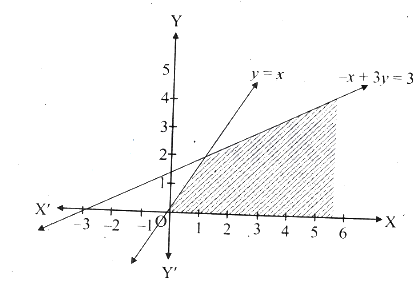
- For the following shaded region, the linear constraints are
 MHT CET 2024 Easy
 - The value of \(\frac{{ }^{10} \mathrm{C}_{\mathrm{r}}}{{ }^{11} \mathrm{C}_{\mathrm{r}}}\), when both the numerator and denominator are at their greatest values, isMHT CET 2023 Medium
- The square roots of the complex number \((-5-12 \mathrm{i})\) areMHT CET 2021 Medium
- If \(\int \frac{5 \tan x}{\tan x-2} d x=x+a \log |\sin x-2 \cos x|+c\), then \(a\) (Where \(\mathrm{c}\) is constant of integration)MHT CET 2021 Hard
- The eccentricity of the ellipse \(y^{2}+4 x^{2}-12 x+6 y+14=0\) isMHT CET 2020 Easy
More PYQs from MHT CET
- Which from following mixtures exhibits positive deviation from Raoult's law?MHT CET 2025 Medium
- Which one of the following statement is INCORRECT regarding ureotelism?MHT CET 2025 Hard
- Select the correct statements from the following regarding gaseous exchange in plants.
Choose the correct option given below.
A. A terrestrial plant has many air spaces between the cells of leaf and root.
B. Woody trees have stomata on bark.
C. In aerated soil, oxygen dissolved in water enters root tissue by diffusion.
D. Vascular bundles provide thin and large surface area for exchange of gases.
E. Carbon dioxide and water vapour diffuse into lenticels.MHT CET 2023 Easy - If the vectors \((2 \hat{\imath}-q \hat{\jmath}+3 \hat{k})\) and \((4 \hat{\imath}-5 \hat{\jmath}+6 \hat{k})\) are collinear, then the value
of \(q\) isMHT CET 2020 Easy - When alcoholic solution of an organic compound is treated with few drops of shiff's reagent, pink colour appears. This confirms the presence of groupMHT CET 2021 Hard
- If \(2 \overrightarrow{\mathbf{a}}+3 \overrightarrow{\mathbf{b}}-5 \overrightarrow{\mathbf{c}}=\overrightarrow{\mathbf{0}}\), then ratio in which \(\overrightarrow{\mathbf{c}}\)
divides \(\overrightarrow{\mathbf{A B}}\) isMHT CET 2009 Medium