


MHT CET · Maths · Linear Programming
The maximum value of \(\mathrm{z}=x+y\), subjected to \(x+y \leq 10,5 x+3 y \geq 15, x \leq 6, x, y \geq 0\)
- A occurs only at unique point.
- B occurs only at two distinct points.
- C occurs at infinitely many points.
- D does not exist.
Answer & Solution
Correct Answer
(C) occurs at infinitely many points.
Step-by-step Solution
Detailed explanation
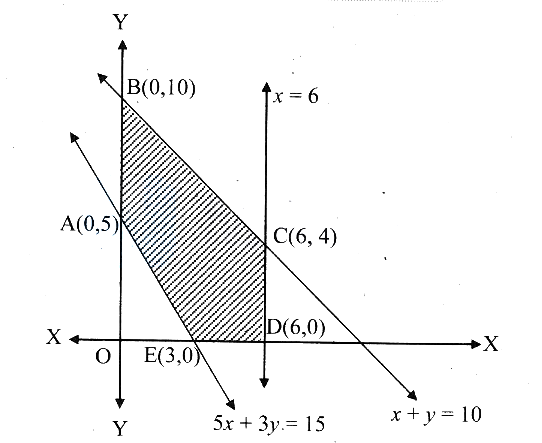
Feasible region lies on the origin side of \(x+y=10, x=6\) and non-origin side of \(5 x+3 y=15\)
The corner points of feasible region are \(\mathrm{A}(0,5)\) and \((0,10), \mathrm{C}(6,4), \dot{D}(6,0), \mathrm{E}(3,0)\)
At A(0,5), z = 0+5=5
At \(B(0,10), z=0+10=10\)
At C(6,4), \(z=6+4=10\)
At \(\mathrm{D}(6,0), \mathrm{z}=6+0=6\)
At \(\mathrm{E}(3,0), \mathrm{z}=3+0=3\)
\(\therefore \quad z\) has maximum value at \(\mathrm{B}(0,10)\) and \(C(6,4)\).
\(\therefore \quad z\) has infinite solution on seg BC.
See the Complete Solution
Get step-by-step explanations for this and 2.5 Lakh+ more JEE, NEET & CET questions.
- Unlock all solutions
- Practice the full chapter
- Track accuracy across PYQs
4.8 rated on Google Play · 14,000+ reviews
More questions from Maths
- Let \(f: R \rightarrow R\) be a function defined as
\(f(x)=\left\{\begin{array}{ccc}
5 , & \text { if } x \leq 1 \
a+b x , & \text { if } 1 < x < 3 \
b+5 x,\end{array} \right. \) \(\text {if } 3 \leq x < 5 \
30 , \text {if } x \geq 5\) \(\mid \text {then } f \text { is }\)MHT CET 2022 Medium - Let \(\overline{\mathrm{a}}=2 \hat{\mathrm{i}}+\hat{\mathrm{j}}-2 \hat{\mathrm{k}}\) and \(\overline{\mathrm{b}}=\hat{\mathrm{i}}+\hat{\mathrm{j}}\). If \(\overline{\mathrm{c}}\) is a vector such that \(\overline{\mathrm{a}} \cdot \overline{\mathrm{c}}=|\overline{\mathrm{c}}|,|\overline{\mathrm{c}}-\overline{\mathrm{a}}|=2 \sqrt{2}\) and the angle between \(\overline{\mathrm{a}} \times \overline{\mathrm{b}}\) and \(\overline{\mathrm{c}}\) is \(\frac{2 \pi}{3}\), then \(|(\overline{\mathrm{a}} \times \overline{\mathrm{b}}) \times \overline{\mathrm{c}}|=\)MHT CET 2023 Medium
- \(\lim _{x \rightarrow 2} \frac{3^x+3^{3-x}-12}{3^{3-x}-3^{\frac{x}{2}}}=\)MHT CET 2024 Easy
- If \(A=\left[\begin{array}{ccc}1 & -1 & 1 \\ 0 & 2 & -3 \\ 2 & 1 & 3\end{array}\right]\) and \(B=\operatorname{adj} A, C=54\), then \(\frac{|\operatorname{adj} B|}{|C|}=\)MHT CET 2022 Easy
- If at is continuous Then …MHT CET 2019 Hard
- \(\int_{-1 / 2}^{1 / 2} \log \left(\frac{1+x}{1-x}\right) \mathrm{d} x=\)MHT CET 2022 Medium
More PYQs from MHT CET
- Identify the product formed when 2-Bromobutane is heated with aqueous solution of sodium hydroxide.MHT CET 2025 Medium
- Identify the reagent ' \(A\) ' used in the following conversion.
Ethyl bromide \(\stackrel{\mathrm{A}}{\longrightarrow}\) EthylpropanoateMHT CET 2023 Easy - One mole of a gas occupying 3 L volume is expanded against a constant external pressure of 1 bar to a volume of 15 L. Calculate work done by the systemMHT CET 2024 Medium
- If \(Q\) is the heat liberated from the system and W is the work done on the system then first law of thermodynamics can be written asMHT CET 2022 Easy
- If \(\frac{2+4+6+8-------\text { upto } n \text { terms }}{1+3+5+7-------\text { upto } n \text { terms }}=\frac{37}{36}\), then \(n=\)MHT CET 2020 Medium
- Which hydride among the following is strongest reducing agent?MHT CET 2019 Easy