


MHT CET · Maths · Application of Derivatives
The maximum area of the rectangle that can be inscribed in a circle of radius \(r\) is
- A \(2 r^2\) sq. units
- B \(\frac{\pi \mathrm{r}^2}{4}\) sq. units
- C \(\pi \mathrm{r}^2\) units
- D \(r^3 \text { sq units }\)
Answer & Solution
Correct Answer
(A) \(2 r^2\) sq. units
Step-by-step Solution
Detailed explanation
Refer figure
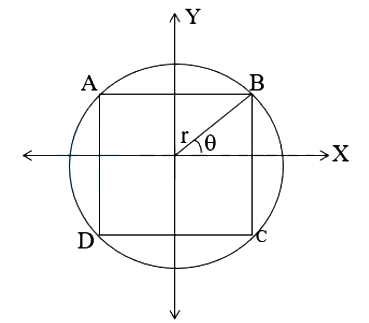
\(
\begin{aligned}
& \mathrm{B}=(\mathrm{r} \cos \theta, \mathrm{r} \sin \theta) \\
& \therefore \mathrm{Ab} 2 \mathrm{r} \cos \theta \text { and } \mathrm{BC}=2 \mathrm{r} \sin \theta \\
& \text { Area }(\mathrm{ABCD})=\mathrm{AB} \times \mathrm{BC} \\
& \therefore \mathrm{f}(\theta)=(2 \mathrm{r} \cos \theta)(2 \mathrm{r} \sin \theta)=2 \mathrm{r}^2 \sin 2 \theta \\
& \mathrm{f}^{\prime}(\theta)=4 \mathrm{r}^2 \cos 2 \theta \text { and when } \mathrm{f}^{\prime}(\theta)=0 \text {, we write } \\
& \cos 2 \theta=0 \Rightarrow \cos 2 \theta=\cos \frac{\pi}{2} \Rightarrow \theta=\frac{\pi}{4} \\
& \mathrm{f}^{\prime \prime}(\theta)=-8 \mathrm{r}^2 \sin 2 \theta \text { and } \mathrm{f}^{\prime \prime}(\theta)_{\left[\theta=\frac{\pi}{4}\right]}=-8 \mathrm{r}^2 < 0
\end{aligned}
\)
Thus, area of required rectangle is maximum when \(\theta=\frac{\pi}{4}\)
\(
\begin{aligned}
& \therefore \mathrm{AB}=2 \mathrm{r} \cos \frac{\pi}{4}=2 \mathrm{r}\left(\frac{1}{\sqrt{2}}\right)=\sqrt{2} \mathrm{r} \text { and } \\
& \mathrm{BC}=2 \mathrm{r} \sin \frac{\pi}{4}=2 \mathrm{r}\left(\frac{1}{\sqrt{2}}\right)=\sqrt{2} \mathrm{r}
\end{aligned}
\)
\(\therefore\) Maximum Area \((\mathrm{ABCD})==(\sqrt{2} \mathrm{r})(\sqrt{2} \mathrm{r})=2 \mathrm{r}^2\)
\(
\begin{aligned}
& \mathrm{B}=(\mathrm{r} \cos \theta, \mathrm{r} \sin \theta) \\
& \therefore \mathrm{Ab} 2 \mathrm{r} \cos \theta \text { and } \mathrm{BC}=2 \mathrm{r} \sin \theta \\
& \text { Area }(\mathrm{ABCD})=\mathrm{AB} \times \mathrm{BC} \\
& \therefore \mathrm{f}(\theta)=(2 \mathrm{r} \cos \theta)(2 \mathrm{r} \sin \theta)=2 \mathrm{r}^2 \sin 2 \theta \\
& \mathrm{f}^{\prime}(\theta)=4 \mathrm{r}^2 \cos 2 \theta \text { and when } \mathrm{f}^{\prime}(\theta)=0 \text {, we write } \\
& \cos 2 \theta=0 \Rightarrow \cos 2 \theta=\cos \frac{\pi}{2} \Rightarrow \theta=\frac{\pi}{4} \\
& \mathrm{f}^{\prime \prime}(\theta)=-8 \mathrm{r}^2 \sin 2 \theta \text { and } \mathrm{f}^{\prime \prime}(\theta)_{\left[\theta=\frac{\pi}{4}\right]}=-8 \mathrm{r}^2 < 0
\end{aligned}
\)
Thus, area of required rectangle is maximum when \(\theta=\frac{\pi}{4}\)
\(
\begin{aligned}
& \therefore \mathrm{AB}=2 \mathrm{r} \cos \frac{\pi}{4}=2 \mathrm{r}\left(\frac{1}{\sqrt{2}}\right)=\sqrt{2} \mathrm{r} \text { and } \\
& \mathrm{BC}=2 \mathrm{r} \sin \frac{\pi}{4}=2 \mathrm{r}\left(\frac{1}{\sqrt{2}}\right)=\sqrt{2} \mathrm{r}
\end{aligned}
\)
\(\therefore\) Maximum Area \((\mathrm{ABCD})==(\sqrt{2} \mathrm{r})(\sqrt{2} \mathrm{r})=2 \mathrm{r}^2\)
See the Complete Solution
Get step-by-step explanations for this and 2.5 Lakh+ more JEE, NEET & CET questions.
- Unlock all solutions
- Practice the full chapter
- Track accuracy across PYQs
4.8 rated on Google Play · 14,000+ reviews
More questions from Maths
- If \(A=\left[\begin{array}{ll}2 & -2 \\ 2 & -3\end{array}\right], B=\left[\begin{array}{cc}0 & -1 \\ 1 & 0\end{array}\right]\), then \(\left(B^{-1} A^{-1}\right)^{-1}=\) ?MHT CET 2021 Easy
- An ellipse has \(O B\) as semi-minor axis, \(S\) and \(S^{\prime}\) are foci and angle \(S B S^{\prime}\) is a right angle. Then the eccentricity of the ellipse isMHT CET 2025 Medium
- Which of the following statement pattern is a contradiction?
\(\mathrm{S}_{1} \equiv(\mathrm{p} \rightarrow \mathrm{q}) \wedge(\mathrm{p} \wedge \sim \mathrm{q}) \ \mathrm{S}_{2} \equiv[\mathrm{p} \wedge(\mathrm{p} \rightarrow \mathrm{q})] \rightarrow \mathrm{q} \ \mathrm{S}_{3} \equiv\) \((\mathrm{p} \vee \mathrm{q}) \rightarrow \sim \mathrm{p} \ \mathrm{S}_{4} \equiv[\mathrm{p} \wedge(\mathrm{p} \rightarrow \mathrm{q})] \leftrightarrow \mathrm{q}\)MHT CET 2020 Medium - \(\sin ^{-1}\left(\frac{1}{2}\right)+\cos ^{-1}\left(\frac{\sqrt{3}}{2}\right)+\cot ^{-1}\left(-\frac{1}{\sqrt{3}}\right)=\)MHT CET 2020 Easy
- \(A\) value of \(\theta\), for which \(\frac{2+3 i \sin \theta}{1-2 \sin \theta}, \mathrm{i}=\sqrt{-1}\) is purely imaginary, isMHT CET 2022 Easy
- Let \(\bar{a}=\hat{i}+\hat{\mathrm{j}}+\hat{\mathrm{k}}, \overline{\mathrm{b}}\) and \(\overline{\mathrm{c}}=\hat{\mathrm{j}}-\hat{\mathrm{k}}\) be three vectors such that \(\bar{a} \times \overline{\mathrm{b}}=\overline{\mathrm{c}}\) and \(\bar{a} \cdot \bar{c}=0\). If the length of projection vector of the vector \(\overline{\mathrm{b}}\) on the vector \(\bar{a} \times \overline{\mathrm{c}}\) is \(l\), then the value of \(3 l^2\) isMHT CET 2025 Hard
More PYQs from MHT CET
- How many moles of ethene are required to prepare \(6.0 \mathrm{~g}\) ethane by hydrogenation process?MHT CET 2020 Medium
- A tetrahedron has vertices \(\mathrm{P}(1,2,1), \mathrm{Q}(2,1,3), \mathrm{R}(-1,1,2)\) and \(\mathrm{O}(0,0,0)\). Then the angle between the faces OPQ and PQR isMHT CET 2022 Medium
- Direction cosines of the line are _______MHT CET 2016 Easy
- Double circulation occurs inMHT CET 2022 Hard
- Edward Jenner in 1796 produced the first vaccine against ___________ .MHT CET 2020 Easy
- If \(a=\sin 175^{\circ}+\cos 175^{\circ}\), thenMHT CET 2020 Easy