


MHT CET · Maths · Three Dimensional Geometry
The line L given by \(\frac{x}{5}+\frac{y}{b}=1\) passes through the point \((13,32)\). The line K is parallel to L and has the equation \(\frac{x}{c}+\frac{y}{3}=1\). Then the distance between L and K is
- A \(\frac{23}{\sqrt{15}}\)
- B \(\sqrt{17}\)
- C \(\frac{17}{\sqrt{15}}\)
- D \(\frac{23}{\sqrt{17}}\)
Answer & Solution
Correct Answer
(D) \(\frac{23}{\sqrt{17}}\)
Step-by-step Solution
Detailed explanation
Line L passes through \((13,32)\).
\(\begin{aligned}
\therefore \quad & \frac{13}{5}+\frac{32}{b}=1 \\
& \Rightarrow b=-20
\end{aligned}\)
So, equation of L is \(\frac{x}{5}-\frac{y}{20}=1 \Rightarrow 4 x-y=20\)
Slope of \(L\) is \(\mathrm{m}_1=4\).
Slope of \(\frac{x}{c}+\frac{y}{3}=1\) is \(\mathrm{m}_2=-\frac{3}{c}\)
\(\begin{aligned}
& \Rightarrow-\frac{3}{c}=4 \\
& \Rightarrow c=-\frac{3}{4}
\end{aligned}\)
Equation of line K is \(-\frac{4 x}{3}+\frac{y}{3}=1\)
\(\Rightarrow 4 x-y=-3\)
Distance between \(L\) and \(K\) is \(\left|\frac{20+3}{\sqrt{16+1}}\right|=\frac{23}{\sqrt{17}}\)
\(\begin{aligned}
\therefore \quad & \frac{13}{5}+\frac{32}{b}=1 \\
& \Rightarrow b=-20
\end{aligned}\)
So, equation of L is \(\frac{x}{5}-\frac{y}{20}=1 \Rightarrow 4 x-y=20\)
Slope of \(L\) is \(\mathrm{m}_1=4\).
Slope of \(\frac{x}{c}+\frac{y}{3}=1\) is \(\mathrm{m}_2=-\frac{3}{c}\)
\(\begin{aligned}
& \Rightarrow-\frac{3}{c}=4 \\
& \Rightarrow c=-\frac{3}{4}
\end{aligned}\)
Equation of line K is \(-\frac{4 x}{3}+\frac{y}{3}=1\)
\(\Rightarrow 4 x-y=-3\)
Distance between \(L\) and \(K\) is \(\left|\frac{20+3}{\sqrt{16+1}}\right|=\frac{23}{\sqrt{17}}\)
See the Complete Solution
Get step-by-step explanations for this and 2.5 Lakh+ more JEE, NEET & CET questions.
- Unlock all solutions
- Practice the full chapter
- Track accuracy across PYQs
4.8 rated on Google Play · 14,000+ reviews
More questions from Maths
- The scalar product of the vector \(\hat{i}+\hat{j}+\hat{k}\) with a unit vector along the sum of the vectors \(2 \hat{i}+4 \hat{j}-5 \hat{k}\) and \(\lambda \hat{i}+2 \hat{j}+3 \hat{k}\) is equal to 1 , then value of \(\lambda\) isMHT CET 2023 Easy
- The shortest distance between the lines \(\frac{x-3}{3}=\frac{y-8}{-1}=\frac{z-3}{1}\) and \(\frac{x+3}{-3}=\frac{y+7}{2}=\frac{z-6}{4}\) isMHT CET 2022 Easy
- The approximate value of \((3 \cdot 978)^{3 / 2}\) isMHT CET 2024 Easy
- A ladder, 5 meters long; rests against a vertical wall. If its top slides downwards at the rate of \(10 \mathrm{~cm} / \mathrm{s}\), then the angle between the ladder and the floor is decreasing at the rate of radians/second when it's lower end is \(\overline{4 \mathrm{~m} \text { away from the wall. }}\)MHT CET 2023 Medium
- The radius of the circle passing through the points \((5,7),(2,-2)\) and \((-2,0)\) isMHT CET 2020 Medium
- If \(\mathrm{A}=\left[\begin{array}{ll}\mathrm{i} & 1 \\ 1 & 0\end{array}\right]\) where \(\mathrm{i}=\sqrt{-1}\) and \(\mathrm{B}=\mathrm{A}^{2029}\), then \(\mathrm{B}^{-1}=\)MHT CET 2023 Easy
More PYQs from MHT CET
- Identify the product obtained in the following reaction.
\(\mathrm{CH}_3 \mathrm{CH}_2 \mathrm{Br}+\mathrm{CH}_3 \mathrm{COOAg} \xrightarrow{\Delta} \mathrm{x}+\mathrm{AgBr}\)MHT CET 2024 Easy - The equations of the lines which make intercepts on the axes whose sum is 8 and
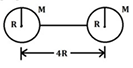
product is 15 areMHT CET 2020 Medium - Two spheres each of mass M and radius R are connected with a massless rod of length 4 R . The moment of inertia of the system about an axis passing through the centre of one of the spheres and perpendicular to the rod will be
 MHT CET 2025 Medium
 - The fundamental frequency of open pipe is 'n'. If it is closed from one end then frequency of the \(2^{\text {nd }}\) harmonic of closed pipe is higher by \(200 \mathrm{~Hz}\) than \({ }^{\prime} \mathrm{n}^{\prime}\). The value of 'n' isMHT CET 2020 Easy
- Identify the product ' \(A\) ' obtained in following reaction.
\(\mathrm{N} \text {-alkyl phthalimide } \xrightarrow[\text { sodium phthalate }+\mathrm{A}]{\stackrel{\mathrm{NaOH}_{(a q)}}{ }}\)MHT CET 2024 Easy - A sonometer wire ' \(A\) ' of diameter ' \(\mathrm{d}\) ' under tension ' \(T\) ' having density ' \(\rho_1\) ' vibrates with fundamental frequency ' \(n\) '. If we use another wire 'B' which vibrates with same frequency under tension ' \(2 \mathrm{~T}\) ' and diameter ' \(2 \mathrm{D}\) ' then density ' \(\rho_2\) ' of wire ' \(B\) ' will beMHT CET 2023 Hard