


MHT CET · Maths · Three Dimensional Geometry
The incentre of the triangle \(\mathrm{ABC}\), whose vertices are \(\mathrm{A}(0,2,1), \mathrm{B}(-2,0,0)\) and \(\mathrm{C}(-2,0,2)\), is
- A \(\left(-\frac{3}{2}, \frac{1}{2}, 1\right)\)
- B \(\left(\frac{3}{2}, \frac{1}{2}, 1\right)\)
- C \(\left(-\frac{3}{2},-\frac{1}{2},-1\right)\)
- D \(\left(\frac{3}{2},-\frac{1}{2},-1\right)\)
Answer & Solution
Correct Answer
(A) \(\left(-\frac{3}{2}, \frac{1}{2}, 1\right)\)
Step-by-step Solution
Detailed explanation
Let \(\bar{a}=2 \hat{j}+\hat{k}, \hat{b}=-2 \hat{i}, \hat{c}=-2 \hat{i}+2 \hat{k}\)
\(\therefore \quad \overline{\mathrm{AB}}=-2 \hat{\mathrm{i}}-2 \hat{\mathrm{j}}-\hat{\mathrm{k}}\),
\(\overline{\mathrm{BC}}=2 \hat{\mathrm{k}}\)
\(\begin{aligned} & \overline{\mathrm{AC}}=-2 \hat{\mathrm{i}}-2 \hat{\mathrm{j}}+\hat{\mathrm{k}} \\ & \Rightarrow|\overline{\mathrm{AB}}|=3,|\overline{\mathrm{BC}}|=2,|\overline{\mathrm{AC}}|=3\end{aligned}\)
Incentre of \(\triangle \mathrm{ABC}\) is given by
\(\frac{|\overline{\mathrm{AB}}| \overline{\mathrm{c}}+|\overline{\mathrm{BC}}| \overline{\mathrm{a}}+|\overline{\mathrm{AC}}| \overline{\mathrm{b}}}{|\overline{\mathrm{AB}}|+|\overline{\mathrm{BC}}|+|\overline{\mathrm{AC}}|}\)
\(\begin{aligned} & =\frac{3(-2 \hat{i}+2 \hat{k})+2(2 \hat{j}+\hat{k})+3(-2 \hat{i})}{3+2+3} \\ & =\frac{-12 \hat{i}+4 \hat{j}+8 \hat{k}}{8} \\ & =-\frac{3}{2} \hat{i}+\frac{1}{2} \hat{j}+\hat{k}\end{aligned}\)
\(\therefore \quad \overline{\mathrm{AB}}=-2 \hat{\mathrm{i}}-2 \hat{\mathrm{j}}-\hat{\mathrm{k}}\),
\(\overline{\mathrm{BC}}=2 \hat{\mathrm{k}}\)
\(\begin{aligned} & \overline{\mathrm{AC}}=-2 \hat{\mathrm{i}}-2 \hat{\mathrm{j}}+\hat{\mathrm{k}} \\ & \Rightarrow|\overline{\mathrm{AB}}|=3,|\overline{\mathrm{BC}}|=2,|\overline{\mathrm{AC}}|=3\end{aligned}\)
Incentre of \(\triangle \mathrm{ABC}\) is given by
\(\frac{|\overline{\mathrm{AB}}| \overline{\mathrm{c}}+|\overline{\mathrm{BC}}| \overline{\mathrm{a}}+|\overline{\mathrm{AC}}| \overline{\mathrm{b}}}{|\overline{\mathrm{AB}}|+|\overline{\mathrm{BC}}|+|\overline{\mathrm{AC}}|}\)
\(\begin{aligned} & =\frac{3(-2 \hat{i}+2 \hat{k})+2(2 \hat{j}+\hat{k})+3(-2 \hat{i})}{3+2+3} \\ & =\frac{-12 \hat{i}+4 \hat{j}+8 \hat{k}}{8} \\ & =-\frac{3}{2} \hat{i}+\frac{1}{2} \hat{j}+\hat{k}\end{aligned}\)
See the Complete Solution
Get step-by-step explanations for this and 2.5 Lakh+ more JEE, NEET & CET questions.
- Unlock all solutions
- Practice the full chapter
- Track accuracy across PYQs
4.8 rated on Google Play · 14,000+ reviews
More questions from Maths
- In , with usual notations, if are in thenMHT CET 2018 Easy
- An ice ball melts at the rate which is proportional to the amount of ice at that instant. Half of the quantity of ice melts in 15 minutes. \(x_0\) is the initial quantity of ice. If after 30 minutes the amount of ice left is \(k x_0\), then the value of \(k\) isMHT CET 2024 Easy
- If
\(y=[(x+1)(2 x+1)(3 x+1) \ldots \ldots \ldots(\mathrm{n} x+1)]^2,\)
then \(\frac{\mathrm{d} y}{\mathrm{~d} x}\) at \(x=0\) isMHT CET 2024 Medium - \(\quad \int \operatorname{cosec}(x-a) \cdot \operatorname{cosec} x d x=\)MHT CET 2024 Hard
- The value of \(4 \cos ^3 20^{\circ}\) isMHT CET 2022 Easy
- Derivative of \(\sin ^2 x\) with respect to \(\mathrm{e}^{\cos x}\) isMHT CET 2024 Easy
More PYQs from MHT CET
- A long solenoid has 1500 turns. When a current of \(3.5 \mathrm{~A}\) flows through it, the magnetic flux linked with each turn of solenoid is \(2.8 \times 10^{-3}\) weber. The self-inductance of solenoid isMHT CET 2023 Medium
- The attractive interactions between cations and mobile electrons in metallic solid is calledMHT CET 2025 Easy
- The number of integral values of \(K\) for which \(x^2+\mathrm{y}^2+\mathrm{k} x+(1-\mathrm{k}) \mathrm{y}+5=0\) represents a circle whose radius cannot exceeds 5, areMHT CET 2025 Medium
- Let \(A\) be the cross-sectional area and \(\rho\) be the specific resistance of a potentiometer wire. If \(I\) is the current passing through the wire, then the potential gradient along the length of the wire isMHT CET 2022 Easy
- Which one of the following four graphs showing lines \(\mathrm{P}, \mathrm{Q}, \mathrm{R}\) and \(\mathrm{S}\) between maximum kinetic energy (E) and intensity of incident light (I) is correct?
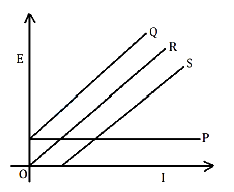 MHT CET 2020 Easy
 - The radius of the orbit of a geostationary satellite is (mean radius of the earth is \(\mathrm{R}\),
angular velocity about an axis in \(\omega\) and accleration due to gravity on earth's surface
is g)MHT CET 2020 Medium