


MHT CET · Maths · Differential Equations
The general solution of the differential equation \(\frac{\mathrm{d} y}{\mathrm{~d} x}=y \tan x-y^2 \sec x\) is
- A \(\tan x=(\mathrm{c}+\sec x) y\), where c is constant of integration.
- B \(\sec y=(\mathrm{c}+\tan y) x\), where c is constant of integration.
- C \(\sec x=(\mathrm{c}+\tan x) y\), where c is constant of integration.
- D \(\cos y=(\mathrm{c}+\tan y)\), where c is constant of integration.
Answer & Solution
Correct Answer
(C) \(\sec x=(\mathrm{c}+\tan x) y\), where c is constant of integration.
Step-by-step Solution
Detailed explanation
\(\begin{aligned}
& \frac{\mathrm{d} y}{\mathrm{~d} x}=y \tan x-y^2 \sec x \\
& \Rightarrow \frac{1}{y^2} \cdot \frac{\mathrm{~d} y}{\mathrm{~d} x}+\tan x\left(-\frac{1}{y}\right)=-\sec x \ldots (i)\\
& \text { Put } \mathrm{v}=-\frac{1}{y} \Rightarrow \frac{\mathrm{dv}}{\mathrm{~d} x}=\frac{1}{y^2} \cdot \frac{\mathrm{~d} y}{\mathrm{~d} x}
\end{aligned}\)
\(\therefore \quad \frac{\mathrm{dv}}{\mathrm{d} x}+(\tan x) \mathrm{v}=-\sec x \quad \ldots[\) From (i) \(]\)
\(\therefore \quad\) I.F. \(=\mathrm{e}^{\int \tan x \mathrm{dx}}=\mathrm{e}^{\log (\sec x)}=\sec x\)
\(\therefore \quad\) solution of the given equation is
\(\begin{aligned} & \text { v. } \sec x=\int-\sec x \cdot \sec x \mathrm{~d} x+\mathrm{c}_1 \\ & \Rightarrow \mathrm{v} \sec x=-\tan x+\mathrm{c}_1 \\ & \Rightarrow-\frac{1}{y} \sec x=-\tan x+\mathrm{c}_1 \\ & \Rightarrow \sec x=y(\tan x+\mathrm{c}), \text { where } \mathrm{c}=-\mathrm{c}_1\end{aligned}\)
& \frac{\mathrm{d} y}{\mathrm{~d} x}=y \tan x-y^2 \sec x \\
& \Rightarrow \frac{1}{y^2} \cdot \frac{\mathrm{~d} y}{\mathrm{~d} x}+\tan x\left(-\frac{1}{y}\right)=-\sec x \ldots (i)\\
& \text { Put } \mathrm{v}=-\frac{1}{y} \Rightarrow \frac{\mathrm{dv}}{\mathrm{~d} x}=\frac{1}{y^2} \cdot \frac{\mathrm{~d} y}{\mathrm{~d} x}
\end{aligned}\)
\(\therefore \quad \frac{\mathrm{dv}}{\mathrm{d} x}+(\tan x) \mathrm{v}=-\sec x \quad \ldots[\) From (i) \(]\)
\(\therefore \quad\) I.F. \(=\mathrm{e}^{\int \tan x \mathrm{dx}}=\mathrm{e}^{\log (\sec x)}=\sec x\)
\(\therefore \quad\) solution of the given equation is
\(\begin{aligned} & \text { v. } \sec x=\int-\sec x \cdot \sec x \mathrm{~d} x+\mathrm{c}_1 \\ & \Rightarrow \mathrm{v} \sec x=-\tan x+\mathrm{c}_1 \\ & \Rightarrow-\frac{1}{y} \sec x=-\tan x+\mathrm{c}_1 \\ & \Rightarrow \sec x=y(\tan x+\mathrm{c}), \text { where } \mathrm{c}=-\mathrm{c}_1\end{aligned}\)
See the Complete Solution
Get step-by-step explanations for this and 2.5 Lakh+ more JEE, NEET & CET questions.
- Unlock all solutions
- Practice the full chapter
- Track accuracy across PYQs
4.8 rated on Google Play · 14,000+ reviews
More questions from Maths
- The function, \(f(x)=x \sqrt{1-x}\), where \(x \in(0,1)\), has local maximum at \(x=\)MHT CET 2022 Easy
- If \(f(x)=\frac{2 x+3}{3 x-2}, x \neq \frac{2}{3}\), then the function fof isMHT CET 2020 Easy
- The lines \(\frac{\mathrm{x}-3}{1}=\frac{\mathrm{y}-2}{1}=\frac{\mathrm{z}-5}{-\mathrm{k}}\) and \(\frac{\mathrm{x}-4}{\mathrm{k}}=\frac{\mathrm{y}-3}{1}=\frac{\mathrm{z}-3}{2}\) are coplanar, hence \(\mathrm{k}=\)MHT CET 2025 Medium
- Eight chairs are numbered 1 to 8 . Two women and three men wish to occupy one chair each. First the women choose chairs from amongst the chairs marked 1 to 4 , and then the men select the chairs from amongst the remaining. The number of possible arrangements isMHT CET 2024 Medium
- \(\int_0^{\frac{\pi}{4}} \frac{\cos ^2 x \sin ^2 x}{\left(\cos ^3 x+\sin ^3 x\right)^2} \mathrm{~d} x=\)MHT CET 2025 Medium
- If \(\quad X \sim B(n, p)\) then \(\frac{P(X=k)}{P(X=k-1)}=\)MHT CET 2025 Medium
More PYQs from MHT CET
- A radioactive element having half-life 30 min . is undergoing beta decay. The fraction of radioactive element remains undecayed after 90 min . will beMHT CET 2025 Easy
- A simple pendulum of length \(L\) has mass \(m\) and it oscillates freely with amplitude A. At extreme position, its potential energy is ( \(\mathrm{g}=\) acceleration due to gravity)MHT CET 2024 Easy
- Resultant of two vectors \(\overrightarrow{\mathrm{P}}\) and \(\overrightarrow{\mathrm{Q}}\) is of magnitude \(\mathrm{R}_{1}\). If direction of \(\overrightarrow{\mathrm{Q}}\) is reversed, the resultant is of magnitude \(\mathrm{R}_{2}\). The value of \(\left(\mathrm{R}_{1}^{2}+\mathrm{R}_{2}^{2}\right)\) is \([\cos (\pi-\theta)=-\cos \theta]\)MHT CET 2020 Easy
- In ozone molecule the formal charge on the central oxygen atom isMHT CET 2019 Easy
- Identify product ' \(B\) ' in the following sequence of reactions.
\(\text { 1,2 Dibromoethane } \xrightarrow[\text { alcohol }]{\mathrm{KOH}} \mathrm{~A} \xrightarrow{\text { sodamide }} \mathrm{B}\)MHT CET 2025 Medium - Three charges \(Q,+q\) and \(+q\) are placed at the vertices of right-angle triangle as shown. The net electrostatic energy of the configuration is zero. The value of \(Q\) is
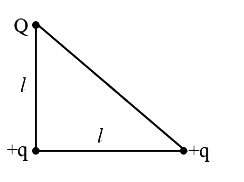 MHT CET 2022 Easy