


MHT CET · Maths · Application of Derivatives
The function \(f(x)=\frac{\log (\pi+x)}{\log (e+x)}\) is
- A decreasing on \(\left(0, \frac{\pi}{\mathrm{e}}\right)\), increasing on \(\left(\frac{\pi}{\mathrm{e}}, \infty\right)\)
- B increasing on \(\left(0, \frac{\pi}{\mathrm{e}}\right)\), decreasing on \(\left(\frac{\pi}{\mathrm{e}}, \infty\right)\)
- C increasing on \((0, \infty)\)
- D decreasing on \((0, \infty)\)
Answer & Solution
Correct Answer
(D) decreasing on \((0, \infty)\)
Step-by-step Solution
Detailed explanation
\(\mathrm{f}(\mathrm{x})=\frac{\log (\pi+\mathrm{x})}{\log (\mathrm{e}+\mathrm{x})} \)
\( \Rightarrow \mathrm{f}^{\prime}(\mathrm{x})=\frac{\frac{1}{\pi+\mathrm{x}} \log (\mathrm{e}+\mathrm{x})-\log (\pi+\mathrm{x}) \times \frac{1}{\mathrm{e}+\mathrm{x}}}{\{\log (\mathrm{e}+\mathrm{x})\}^2} \)
\( \Rightarrow \mathrm{f}^{\prime}(\mathrm{x})=\frac{(\mathrm{e}+\mathrm{x}) \log (\mathrm{e}+\mathrm{x})-(\pi+\mathrm{x}) \log (\pi+\mathrm{x})}{(\pi+\mathrm{x})(\mathrm{e}+\mathrm{x})\{\log (\mathrm{e}+\mathrm{x})\}^2}\)
Let \(g(x)=(e+x) \log (e+x)-(\pi+x) \log (\pi+x)\)
\(\Rightarrow \mathrm{g}^{\prime}(\mathrm{x})=\log (\mathrm{e}+\mathrm{x})-\log (\pi+\mathrm{x})<0\)
So, \(\mathrm{g}(\mathrm{x})\) is decreasing
\(\Rightarrow \mathrm{g}(\mathrm{x})<\mathrm{g}(0) \forall \mathrm{x} \in(0, \infty) \)
\( \Rightarrow(\mathrm{e}+\mathrm{x}) \log (\mathrm{e}+\mathrm{x})-(\pi+\mathrm{x}) \log (\pi+\mathrm{x})<\mathrm{e}\) \(\log \mathrm{e}\) \(-\pi \log \pi<0 \)
\( \Rightarrow \mathrm{f}^{\prime}(\mathrm{x})<0 \forall \mathrm{x} \in(0, \infty) \)
\( \Rightarrow \mathrm{f}(\mathrm{x}) \text { is decreasing on }(0, \infty)\)
\( \Rightarrow \mathrm{f}^{\prime}(\mathrm{x})=\frac{\frac{1}{\pi+\mathrm{x}} \log (\mathrm{e}+\mathrm{x})-\log (\pi+\mathrm{x}) \times \frac{1}{\mathrm{e}+\mathrm{x}}}{\{\log (\mathrm{e}+\mathrm{x})\}^2} \)
\( \Rightarrow \mathrm{f}^{\prime}(\mathrm{x})=\frac{(\mathrm{e}+\mathrm{x}) \log (\mathrm{e}+\mathrm{x})-(\pi+\mathrm{x}) \log (\pi+\mathrm{x})}{(\pi+\mathrm{x})(\mathrm{e}+\mathrm{x})\{\log (\mathrm{e}+\mathrm{x})\}^2}\)
Let \(g(x)=(e+x) \log (e+x)-(\pi+x) \log (\pi+x)\)
\(\Rightarrow \mathrm{g}^{\prime}(\mathrm{x})=\log (\mathrm{e}+\mathrm{x})-\log (\pi+\mathrm{x})<0\)
So, \(\mathrm{g}(\mathrm{x})\) is decreasing
\(\Rightarrow \mathrm{g}(\mathrm{x})<\mathrm{g}(0) \forall \mathrm{x} \in(0, \infty) \)
\( \Rightarrow(\mathrm{e}+\mathrm{x}) \log (\mathrm{e}+\mathrm{x})-(\pi+\mathrm{x}) \log (\pi+\mathrm{x})<\mathrm{e}\) \(\log \mathrm{e}\) \(-\pi \log \pi<0 \)
\( \Rightarrow \mathrm{f}^{\prime}(\mathrm{x})<0 \forall \mathrm{x} \in(0, \infty) \)
\( \Rightarrow \mathrm{f}(\mathrm{x}) \text { is decreasing on }(0, \infty)\)
See the Complete Solution
Get step-by-step explanations for this and 2.5 Lakh+ more JEE, NEET & CET questions.
- Unlock all solutions
- Practice the full chapter
- Track accuracy across PYQs
4.8 rated on Google Play · 14,000+ reviews
More questions from Maths
- If \(\mathrm{I}=\int \sin (\log (x)) \mathrm{d} x\), then \(\mathrm{I}\) is given byMHT CET 2023 Hard
- If \(m_{1}\) and \(m_{2}\) are the slopes of tangents to the circle \(x^{2}+y^{2}=4\) from the point \((3,2)\), then \(m_{1}-m_{2}\) is equal toMHT CET 2009 Hard
- The value of \(\int \frac{\cos ^3 x}{\sin ^2 x+\sin x} \mathrm{~d} x\) isMHT CET 2024 Medium
- The complex number with argument \(\frac{5 \pi^c}{6}\) at a distance of 2 units from the origin isMHT CET 2021 Easy
- \(\int(\sqrt{\tan x}+\sqrt{\cot } x) d x\)MHT CET 2011 Hard
- \(\tan ^{-1} \frac{1}{3}+\tan ^{-1} \frac{1}{5}+\tan ^{-1} \frac{1}{7}+\tan ^{-1} \frac{1}{8}\) has the valueMHT CET 2022 Easy
More PYQs from MHT CET
- Which is NOT the function of lymph?MHT CET 2015 Medium
- In moving coil galvanometer, strong horse shoe magnet of concave shaped pole pieces is used toMHT CET 2019 Medium
- In the logic circuit given, \(\mathrm{A}, \mathrm{B}\) and C are the inputs and Y is the output. The output Y is HIGH
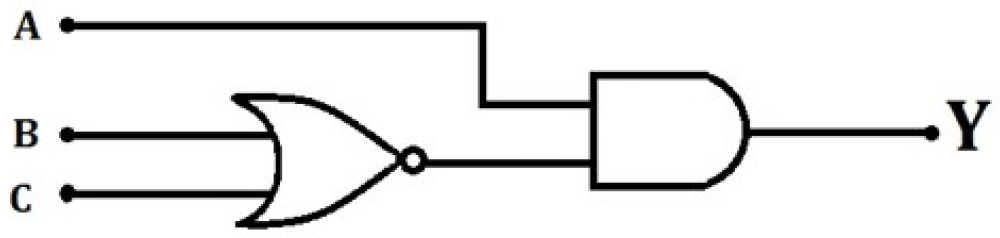 MHT CET 2025 Easy
 - A ceiling fan rotates about its own axis with some angular velocity. When the fan is switched off, the angular velocity becomes of the original in time and revolutions are made in that time. The number of revolution made by the fan during the time interval between switch off and rest are (Angular retardation is uniform)MHT CET 2017 Hard
- A compound made of elements A and B form fcc structure. Atoms of A are at the corners and atoms of B are present at the centres of faces of cube. What is the formula of the compound?MHT CET 2023 Medium
- The perimeter of a triangle is \(10 \mathrm{~cm}\). If one of its side is \(4 \mathrm{~cm}\), then remaining sides of the triangle, when area of triangle is maximum areMHT CET 2020 Medium