


MHT CET · Maths · Continuity and Differentiability
The function \(\mathrm{f}\) defined on \(\left(-\frac{1}{3}, \frac{1}{3}\right)\) by
\(\mathrm{f}(x)=\left\{\begin{array}{cc}
\frac{1}{x} \log \left(\frac{1+3 x}{1-2 x}\right), & x \neq 0 \
\mathrm{k} & , \quad x=0
\end{array}\right.\)
is continuous at \(x=0\), then \(\mathrm{k}\) is
- A 6
- B 1
- C 5
- D -5
Answer & Solution
Correct Answer
(C) 5
Step-by-step Solution
Detailed explanation
\(\mathrm{f}\) is continuous at \(x=0\).
\(\begin{aligned}
\therefore \quad \mathrm{f}(0) & =\lim _{x \rightarrow 0} \mathrm{f}(x) \\
\therefore \quad \mathrm{k} & =\lim _{x \rightarrow 0}\left(\frac{1}{x} \log (1+3 x)-\frac{1}{x} \log (1-2 x)\right) \\
& =\lim _{x \rightarrow 0}\left(\frac{3 \log (1+3 x)}{3 x}+\frac{2 \log (1-2 x)}{-2 x}\right) \\
& =3+2=5
\end{aligned}\)
\(\begin{aligned}
\therefore \quad \mathrm{f}(0) & =\lim _{x \rightarrow 0} \mathrm{f}(x) \\
\therefore \quad \mathrm{k} & =\lim _{x \rightarrow 0}\left(\frac{1}{x} \log (1+3 x)-\frac{1}{x} \log (1-2 x)\right) \\
& =\lim _{x \rightarrow 0}\left(\frac{3 \log (1+3 x)}{3 x}+\frac{2 \log (1-2 x)}{-2 x}\right) \\
& =3+2=5
\end{aligned}\)
See the Complete Solution
Get step-by-step explanations for this and 2.5 Lakh+ more JEE, NEET & CET questions.
- Unlock all solutions
- Practice the full chapter
- Track accuracy across PYQs
4.8 rated on Google Play · 14,000+ reviews
More questions from Maths
- For two data sets each of size 5 , the variance are given to be 4 and 5 and the corresponding means are given to be 2 and 4 respectively. The variance of the combined data set isMHT CET 2021 Medium
- Given \(\mathrm{A}=\left[\begin{array}{lll}x & 3 & 2 \\ 1 & y & 4 \\ 2 & 2 & z\end{array}\right], x y z=60\) and \(8 x+4 y+3 z=20\), then \(\mathrm{A} \cdot(\operatorname{adjA})\) is equal toMHT CET 2022 Medium
- Then foot of the perpendicular from the point \((0,2,3)\) on the line \(\frac{x+3}{5}=\frac{y-1}{2}=\frac{z+4}{3}\)MHT CET 2022 Easy
- If \(\mathrm{A}, \mathrm{B}, \mathrm{C}\) are the angles of a \(\Delta \mathrm{ABC}\), then with usual notations, \(\frac{c^{2}-a^{2}+b^{2}}{a^{2}-b^{2}+c^{2}}=\)MHT CET 2020 Medium
- If \(y=\tan ^{-1}\left[\frac{1}{1+x+x^2}\right]+\tan ^{-1}\left[\frac{1}{x^2+3 x+3}\right], x>0\), then \(\frac{d y}{d x}=\)MHT CET 2021 Medium
- The maximum area of the rectangle that can be inscribed in a circle of radius \(r\) isMHT CET 2021 Hard
More PYQs from MHT CET
- An ideal transformer converts 220 a.c. to 3.3 kV a.c. to transmit a power of 4.4 kW . If primary coil has 600 turns then alternating current in secondary coil isMHT CET 2025 Medium
- The angle between the linee \(\bar{r}=(i+\hat{j}-\hat{k})+\lambda(3 i+\hat{j})\) and the plane \(2+3 \hat{k})=8\)MHT CET 2020 Easy
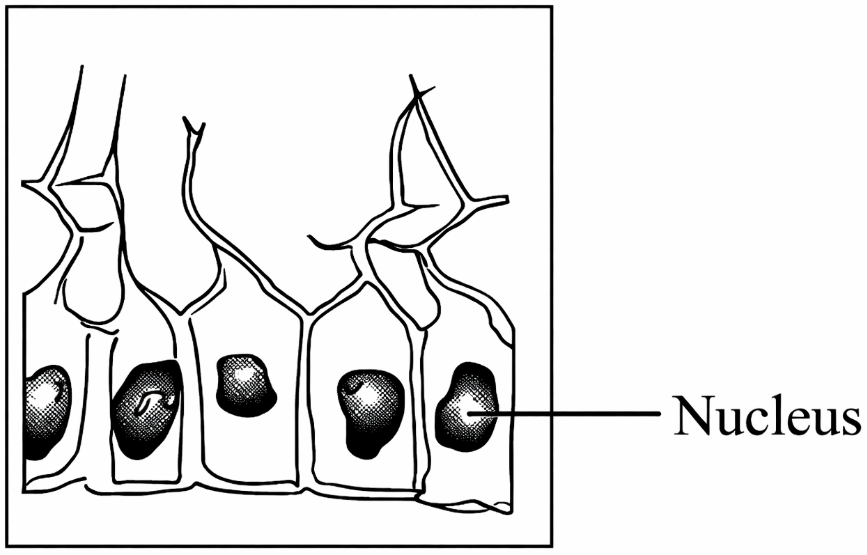
- Match the type of glial cell shown in the figure with its function. Select the correct option.
 MHT CET 2023 Easy
 - How many statement from the following are correct?
(a) In plants, phosphorylation occurs by three different ways.
(b) Substrate level phosphorylation is a direct phosphorylation of ADP by transfer of a phosphate group from any suitable substance.
(c) Substrate level phosphorylation occurs cytoplasm of cell only.
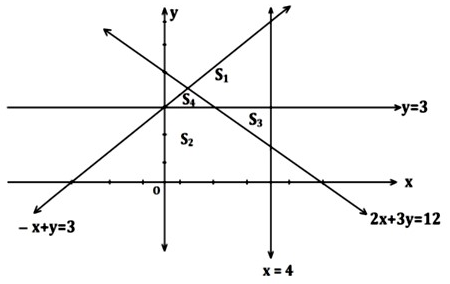
(d) Oxidative phosphorylation occurs on the inner mitochondrial membrane only.MHT CET 2022 Medium - The feasible region represented by the given constraints \(2 x+3 \mathrm{y} \geqslant 12,-x+\mathrm{y} \leqslant 3, x \leqslant 4, \mathrm{y} \geqslant 3\) is denoted by
 MHT CET 2025 Medium
 - The equation of the tangent to the curve \(\left(1+x^2\right) y=2-x\), where it crosses the X-axis, isMHT CET 2025 Medium