


MHT CET · Maths · Quadratic Equation
The equation \(x^3+x-1=0\) has
- A no real root.
- B exactly two real roots.
- C exactly one real root.
- D more than two real roots.
Answer & Solution
Correct Answer
(C) exactly one real root.
Step-by-step Solution
Detailed explanation
Let \(\mathrm{f}(x)=x^3+x-1\)
A root of \(\mathrm{f}(x)\) exists, if \(\mathrm{f}(x)=0\) for at least one value of \(x\).
\(
\begin{aligned}
& \mathrm{f}(0)=-1 < 0 \\
& \mathrm{f}(1)=1>0
\end{aligned}
\)
\(\therefore\) By intermediate value theorem, there has to be a point ' \(c\) ' between 0 and 1 such that \(\mathrm{f}(x)=0\).
\(\therefore\) The given equation has exactly one real root.
Alternate Method:
Let \(\mathrm{f}(x)=x^3+x-1\)
\(\therefore \mathrm{f}^{\prime}(x)=3 x^2+1 \)
\( \Rightarrow \mathrm{f}^{\prime}(x)>0 \forall x \in \mathrm{R}\)
\(\Rightarrow \mathrm{f}(x)\) is an increasing function.
\(\Rightarrow \mathrm{f}(x)\) intersects \(\mathrm{X}\)-axis at only one point.
\(\therefore\) The given equation has exactly one real root.
A root of \(\mathrm{f}(x)\) exists, if \(\mathrm{f}(x)=0\) for at least one value of \(x\).
\(
\begin{aligned}
& \mathrm{f}(0)=-1 < 0 \\
& \mathrm{f}(1)=1>0
\end{aligned}
\)
\(\therefore\) By intermediate value theorem, there has to be a point ' \(c\) ' between 0 and 1 such that \(\mathrm{f}(x)=0\).
\(\therefore\) The given equation has exactly one real root.
Alternate Method:
Let \(\mathrm{f}(x)=x^3+x-1\)
\(\therefore \mathrm{f}^{\prime}(x)=3 x^2+1 \)
\( \Rightarrow \mathrm{f}^{\prime}(x)>0 \forall x \in \mathrm{R}\)
\(\Rightarrow \mathrm{f}(x)\) is an increasing function.
\(\Rightarrow \mathrm{f}(x)\) intersects \(\mathrm{X}\)-axis at only one point.
\(\therefore\) The given equation has exactly one real root.
See the Complete Solution
Get step-by-step explanations for this and 2.5 Lakh+ more JEE, NEET & CET questions.
- Unlock all solutions
- Practice the full chapter
- Track accuracy across PYQs
4.8 rated on Google Play · 14,000+ reviews
More questions from Maths
- Let a random variable \(X\) have a Binomial distribution with mean 8 and variance 4 , If \(P(X \leq 2)=\frac{k}{2^{16}}\) then \(k\) is equal toMHT CET 2022 Easy
- The value of the integral \(\int_1^2 \frac{x \mathrm{~d} x}{(x+2)(x+3)}\) isMHT CET 2025 Medium
- The equation of the curve passing through the origin and satisfying the equation \(\left(1+x^2\right) \frac{\mathrm{dy}}{\mathrm{d} x}+2 x y=4 x^2\), isMHT CET 2025 Medium
- Area of the triangle formed by the line \(y^2-9 x y+18 x^2=0\) and \(y=9\) isMHT CET 2021 Easy
- If and are foot of perpendicular drawn from point to the planes and , then equation of plane through the points and is _______MHT CET 2016 Medium
- The maximum value of \(x y\) when \(x+2 y=8\) isMHT CET 2023 Easy
More PYQs from MHT CET
- Which among the following is NOT intensive property?MHT CET 2022 Easy
- The bond angle in in gaseous phase isMHT CET 2019 Easy
- Three charges Q, (-2q) and (-2q) are placed at the vertices of an isosceles right angled triangle as shown in figure. The net electrostatic potential energy is zero if Q is equal to
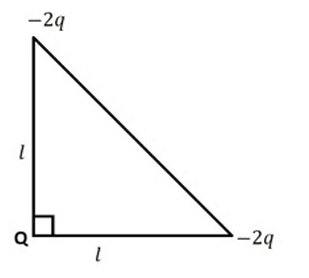 MHT CET 2025 Medium
 - If a cell 'A' is having osmotic pressure = 100 bars, turgor pressure 50 bars and cell 'B' is having osmatic pressure 100 bars and turgor pressure 60 bars then, the flow of water occurs __________ .MHT CET 2023 Medium
- If then ________MHT CET 2019 Easy
- Clones are produced by asexual reproduction and resulting individuals are identical ________.MHT CET 2025 Medium