


MHT CET · Maths · Probability
The discrete random variable \(\mathrm{X}\) can take all possible integer values from 1 to \(\mathrm{k}\), each with a probability \(\frac{1}{\mathrm{k}}\), then its variance is
- A \(\frac{\mathrm{k}^2-1}{12}\)
- B \(\frac{\mathrm{k}^2-1}{6}\)
- C \(\frac{\mathrm{k}^2+1}{12}\)
- D \(\frac{\mathrm{k}^2+1}{6}\)
Answer & Solution
Correct Answer
(A) \(\frac{\mathrm{k}^2-1}{12}\)
Step-by-step Solution
Detailed explanation
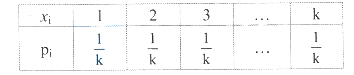
\(\begin{aligned} & \mathrm{E}(\mathrm{X})=\sum_{\mathrm{i}=1}^{\mathrm{k}} x_{\mathrm{i}} \mathrm{p}_{\mathrm{i}}=\frac{1}{\mathrm{k}}+\frac{2}{\mathrm{k}}+\ldots+\frac{\mathrm{k}}{\mathrm{k}}=\frac{\mathrm{k}+1}{2} \\ & \mathrm{E}\left(\mathrm{X}^2\right)=\sum_{\mathrm{i}=1}^{\mathrm{k}} x_{\mathrm{i}}^2 \mathrm{p}_{\mathrm{i}}=\frac{1^2+2^2+3^2+\ldots+\mathrm{k}^2}{\mathrm{k}} \\ & =\frac{(\mathrm{k}+1)(2 \mathrm{k}+1)}{6} \\ & \therefore \quad \text { Variance }=\mathrm{E}\left(\mathrm{X}^2\right)-[\mathrm{E}(\mathrm{X})]^2 \\ & =\frac{2 \mathrm{k}^2+3 \mathrm{k}+1}{6}-\frac{\mathrm{k}^2+2 \mathrm{k}+1}{4} \\ & \end{aligned}\)
\(\begin{aligned} & =\frac{4 \mathrm{k}^2+6 \mathrm{k}+2-3 \mathrm{k}^2-6 \mathrm{k}-3}{12} \\ & =\frac{\mathrm{k}^2-1}{12}\end{aligned}\)
See the Complete Solution
Get step-by-step explanations for this and 2.5 Lakh+ more JEE, NEET & CET questions.
- Unlock all solutions
- Practice the full chapter
- Track accuracy across PYQs
4.8 rated on Google Play · 14,000+ reviews
More questions from Maths
- The differential equation of all parabolas with axis parallel to the axis of \(y\) isMHT CET 2007 Medium
- The value of \(\lim _{x \rightarrow \infty} \frac{1+2+3 \ldots+n}{n^{2}}\) isMHT CET 2010 Easy
- If \(f(x)=\left\{\begin{array}{cl}x \sin \frac{1}{x} & , x \neq 0 \ k & , x=0\end{array}\right.\) is continuous at
\(x=0\), then the value of \(k\) isMHT CET 2008 Medium - If \(\mathrm{A}(-4,5, \mathrm{P}), \mathrm{B}(3,1,4)\) and \(\mathrm{C}(-2,0, \mathrm{q})\) are the vertices of a triangle \(A B C\) and \(G(r, q, 1)\) is its centroid, then the value of \(2 p+q-r\) is equal toMHT CET 2024 Easy
- If \(\int \frac{\sin x}{3+4 \cos ^2 x} \mathrm{~d} x=\mathrm{A} \tan ^{-1}(\mathrm{~B} \cos x)+\mathrm{C}\), (where \(\mathrm{c}\) is a constant of integration), then the value of \(\mathrm{A}+\mathrm{B}\) isMHT CET 2023 Medium
- If angle \(\theta\) in \([0,2 \pi]\) satisfies both the equations \(\cot \theta=\sqrt{3}\) and \(\sqrt{3} \sec \theta+2=0\), then \(\theta\) is equal toMHT CET 2024 Easy
More PYQs from MHT CET
- Which one of the following is INCORRECT regarding crossbreeding?MHT CET 2024 Medium
- The general solution of the differential equation \(\cos x \cdot \sin y d x\) \(+\sin x \cdot \cos y d y=0\) isMHT CET 2021 Medium
- A convex lens is dipped in a liquid whose refractive index is equal to refractive index of lens material. Then its focal length willMHT CET 2022 Medium
- Frequency of the series limit of Balmer series of hydrogen atom of Rydberg's constant ' \(R\) ' and velocity of light ' C ' isMHT CET 2024 Medium
- The general solution of \(\sin x-3 \sin 2 x+\sin 3\)\( x=\cos x-3 \cos 2 x+\cos 3 x\) isMHT CET 2024 Medium
- In the study of transistor as an amplifier if \(\alpha=\frac{I_C}{I_E}=0.98\) and \(\beta=\frac{I_C}{I_B}=49\), where \(I_C, I_B\) and \(\mathrm{I}_{\mathrm{E}}\) are cóllector, base and emitter current respectively then \(\left(\frac{1}{\alpha}-\frac{1}{\beta}\right)\) is equal toMHT CET 2023 Medium