


MHT CET · Maths · Three Dimensional Geometry
The direction cosines of a line which lies in ZoX plane and makes an angle of \(30^{\circ}\)
with Z-axis are
- A \(0, \frac{1}{2}, \pm \frac{\sqrt{3}}{2}\)
- B \(\pm \frac{1}{2}, 0, \frac{\sqrt{3}}{2}\)
- C \(0, \frac{\sqrt{3}}{2}, \pm \frac{1}{2}\)
- D \(\frac{\sqrt{3}}{2}, 0, \pm \frac{1}{2}\)
Answer & Solution
Correct Answer
(B) \(\pm \frac{1}{2}, 0, \frac{\sqrt{3}}{2}\)
Step-by-step Solution
Detailed explanation
Direction cosines are the cosines of the angles which a line makes with the positive coordinate axes in anticlockwise direction. They are represented by \(\langle l, m, n\rangle\) where \(\mathrm{l}, \mathrm{m}, \mathrm{n}\) correspond to the \(\mathrm{x}\)-axis, \(\mathrm{y}\)-axis, and \(\mathrm{z}\)-axis respectively. One important property of direction cosines is that the sum of their squares is unity.
i.e., \(l^{2}+m^{2}+n^{2}=1\)
If the line lies in the zox plane, it implies that the \(y\)-axis is normal to the line as the \(y\)-axis is normal to the ZOX plane. Which means the angle the line makes with the \(y\)-axis is \(90^{\circ}\) or \(\frac{\pi}{2}\) radians. Thus, \(m=\cos \left(\frac{\pi}{2}\right)=0\)
It is given that the line makes an angle of \(30^{\circ}\) or \(\frac{\pi}{6}\) radians with the positive z-axis. Thus, \(n=\cos \left(\frac{\pi}{6}\right)=\frac{\sqrt{3}}{2}\)
Now we use the property \(l^{2}+m^{2}+n^{2}=1\)
Substituting the values of \(m\) and \(n\), we get the following values of । \(l=\pm \frac{1}{2}\)
We get two values of I because the only information given is that the line makes an angle of \(\frac{\pi}{6}\) with the z-axis, so it can make an angle of either \(\frac{\pi}{3}\) or \(\frac{2 \pi}{3}\) with the \(x\)-axis, which correspond to the two values of I.
Therefore, the direction cosines are
\(\langle l, m, n\rangle=\left\langle\pm \frac{1}{2}, 0, \frac{\sqrt{3}}{2}\right\rangle\)
i.e., \(l^{2}+m^{2}+n^{2}=1\)
If the line lies in the zox plane, it implies that the \(y\)-axis is normal to the line as the \(y\)-axis is normal to the ZOX plane. Which means the angle the line makes with the \(y\)-axis is \(90^{\circ}\) or \(\frac{\pi}{2}\) radians. Thus, \(m=\cos \left(\frac{\pi}{2}\right)=0\)
It is given that the line makes an angle of \(30^{\circ}\) or \(\frac{\pi}{6}\) radians with the positive z-axis. Thus, \(n=\cos \left(\frac{\pi}{6}\right)=\frac{\sqrt{3}}{2}\)
Now we use the property \(l^{2}+m^{2}+n^{2}=1\)
Substituting the values of \(m\) and \(n\), we get the following values of । \(l=\pm \frac{1}{2}\)
We get two values of I because the only information given is that the line makes an angle of \(\frac{\pi}{6}\) with the z-axis, so it can make an angle of either \(\frac{\pi}{3}\) or \(\frac{2 \pi}{3}\) with the \(x\)-axis, which correspond to the two values of I.
Therefore, the direction cosines are
\(\langle l, m, n\rangle=\left\langle\pm \frac{1}{2}, 0, \frac{\sqrt{3}}{2}\right\rangle\)
See the Complete Solution
Get step-by-step explanations for this and 2.5 Lakh+ more JEE, NEET & CET questions.
- Unlock all solutions
- Practice the full chapter
- Track accuracy across PYQs
4.8 rated on Google Play · 14,000+ reviews
More questions from Maths
- \(\int_0^2|2 x| \mathrm{d}=\) (where [.] denotes the greatest integer function.)MHT CET 2022 Easy
- If \(f(x)=\frac{x+2}{18},-2 < x < 4\)
\(=0 \quad, \quad\) otherwise,
is the p. d. f. of a r. v. X, then the value of \(\mathrm{P}(|\mathrm{X}| < 2)\) isMHT CET 2020 Medium - The approximate value of \(3^{2.001}\), if \(\log 3=1.0986\) isMHT CET 2024 Easy
- Let \(\mathrm{f}(x)=\frac{1-\tan x}{4 x-\pi}, x \neq \frac{\pi}{4}, x \in\left[0, \frac{1}{2}\right], \quad \mathrm{f}(x)\) is continuous in \(\left[0, \frac{\pi}{2}\right]\), then \(f\left(\frac{\pi}{4}\right)\) isMHT CET 2024 Medium
- If \(I=\int_0^{\frac{\pi}{4}} \log (1+\tan x) d x\), then value of \(I\) isMHT CET 2024 Medium
- If and , thenMHT CET 2018 Hard
More PYQs from MHT CET
- Consider the following statement about electric field intensity and electric potential.
A. The electric field intensity due to a charged spherical shell is inversely proportional to square of its radius.
B. The electric potential due to a point charge is inversely proportional to the distance between charge and the point.MHT CET 2022 Easy - Identify the correct set of labelling in the given diagram.
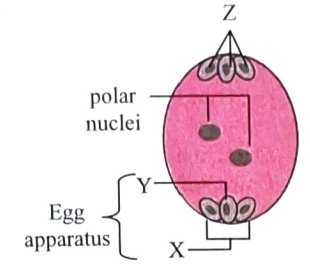 MHT CET 2020 Hard
 - Two bodies A and B at temperatures ' \(\mathrm{T}_1\) ' \(\mathrm{K}\) and ' \(\mathrm{T}_2\) ' \(\mathrm{K}\) respectively have the same dimensions. Their emissivities are in the ratio \(1: 3\). If they radiate the same amount of heat per unit area per unit time, then the ratio of their temperatures \(\left(T_1: T_2\right)\) isMHT CET 2023 Medium
- If \(u_{0}=8, u_{1}=3, u_{2}=12, u_{3}=51\), then the value of \(\Delta^{3} u_{0}\) isMHT CET 2010 Easy
- If \(A=\left[\begin{array}{lll}1 & 2 & 3 \\ 1 & 3 & 4 \\ 3 & 4 & 3\end{array}\right]\), then \(A^{-1}=\)MHT CET 2022 Easy
- The self-inductance \(L\) of a solenoid of length \(\lambda\) and area of crosssection \(A\) with a fixed number of turns \(N\) increases asMHT CET 2022 Easy