


MHT CET · Maths · Differential Equations
The differential equation of all parabolas, whose axes are parallel to \(\mathrm{Y}\)-axis, is
- A \(y_3=1\)
- B \(y_3=-1\)
- C \(y_3=0\)
- D \(yy_3+y_1=0\)
Answer & Solution
Correct Answer
(C) \(y_3=0\)
Step-by-step Solution
Detailed explanation
Parabola whose axes are parallel to \(\mathrm{Y}\)-axis. Vertex is not \((0,0)\)
Equation becomes
\((x-\mathrm{h})^2=4 \mathrm{~b}(y-\mathrm{k})\)
Differentiating w.r.t. \(x\), we get
\(2(x-h)=4 b\left(\frac{d y}{d x}\right)\)
Again differentiating w.r.t. \(x\), we get
\(2=4 \mathrm{~b}\left(\frac{\mathrm{d}^2 y}{\mathrm{~d} x^2}\right)\)
Again differentiating w.r.t. \(x\), we get
\(\begin{aligned}
& 0=4 b\left(\frac{\mathrm{d}^3 y}{\mathrm{~d} x^3}\right) \\
\therefore \quad & \frac{\mathrm{d}^3 y}{\mathrm{~d} x^3}=0 \\
& \text { i.e., } y_3=0
\end{aligned}\)
Equation becomes
\((x-\mathrm{h})^2=4 \mathrm{~b}(y-\mathrm{k})\)
Differentiating w.r.t. \(x\), we get
\(2(x-h)=4 b\left(\frac{d y}{d x}\right)\)
Again differentiating w.r.t. \(x\), we get
\(2=4 \mathrm{~b}\left(\frac{\mathrm{d}^2 y}{\mathrm{~d} x^2}\right)\)
Again differentiating w.r.t. \(x\), we get
\(\begin{aligned}
& 0=4 b\left(\frac{\mathrm{d}^3 y}{\mathrm{~d} x^3}\right) \\
\therefore \quad & \frac{\mathrm{d}^3 y}{\mathrm{~d} x^3}=0 \\
& \text { i.e., } y_3=0
\end{aligned}\)
See the Complete Solution
Get step-by-step explanations for this and 2.5 Lakh+ more JEE, NEET & CET questions.
- Unlock all solutions
- Practice the full chapter
- Track accuracy across PYQs
4.8 rated on Google Play · 14,000+ reviews
More questions from Maths
- In \(\triangle \mathrm{ABC}\), with tustal notations, \(\mathrm{m} \angle \mathrm{C}=\frac{\pi}{2}\), if \(\tan \left(\frac{\mathrm{A}}{2}\right)\) and \(\tan \left(\frac{\mathrm{B}}{2}\right)\) are the roots of the equation. \(\mathrm{a}_1 x^2+\mathrm{b}_1 x+\mathrm{c}_1=0\left(\mathrm{a}_1 \neq 0\right)\), thenMHT CET 2023 Medium
- The vector equation of the line passing through \(\mathrm{P}(1,2,3)\) and \(\mathrm{Q}(2,3,4)\) isMHT CET 2021 Easy
- Consider the following three statements
\(P: 11\) is a prime number.
Q: 7 is a factor of 176 .
\(R\) : LCM of 3 and 7 is 21 .
Then, the truth value of which one of the following statement is true?MHT CET 2022 Easy - The variance of first 50 even natural numbers isMHT CET 2024 Easy
- \(I: y^{\prime}=\frac{y+x}{x} ; \quad \text { II }: y^{\prime}=\frac{x^2+y}{x^3} ; \quad \text { III }: y^{\prime}=\frac{2 x y}{y^2-x^2}\)
S1: Differential equations given by I and II are homogeneous differential equations.
S2: Differential equations given by II and III are homogeneous differential equations.
S3: Differential equations given by I and III are homogeneous differential equations.MHT CET 2021 Easy - The 1. Order and Degree of the differential equation \(\sqrt{\frac{\mathrm{dy}}{\mathrm{d} x}}-4 \frac{\mathrm{dy}}{\mathrm{d} x}-7 x=0\) is respectivelyMHT CET 2025 Easy
More PYQs from MHT CET
- Identify negatively charged sol from following.MHT CET 2021 Easy
- The IUPAC name of following compound is:
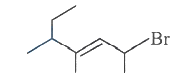 MHT CET 2023 Easy
 - The area bounded by the parabola \(y=x^2\) and the line \(y=x\) isMHT CET 2021 Hard
- Urea formaldehyde resin is an example ofMHT CET 2022 Easy
- A centigrade and Fahrenheit thermometer are dipped in boiling water. The water temperature is lowered until the Fahrenheit temperature observed is \(140^{\circ} \mathrm{F}\). At that time the temperature registered by the centigrade thermometer isMHT CET 2025 Easy
- A ray of light is incident normally on a glass slab of thickness and refractive index . The time taken to travel by a ray from source to surface of the slab is the same as to travel through glass slab. The distance of the source from the surface isMHT CET 2018 Medium