


MHT CET · Maths · Application of Derivatives
The curve \(y=a x^3+b x^2+c x+5\) touches X-axis at \(P(-2,0)\) and cuts \(\mathrm{Y}\)-axis at a point \(\mathrm{Q}\), where its gradient is 3 , then
- A \(\mathrm{a}=\frac{1}{2}, \mathrm{~b}=\frac{3}{4}, \mathrm{c}=3\)
- B \(\mathrm{a}=\frac{1}{2}, \mathrm{~b}=\frac{-1}{4}, \mathrm{c}=-3\)
- C \(a=\frac{1}{2}, b=\frac{-3}{4}, c=-3\)
- D \(\mathrm{a}=\frac{-1}{2}, \mathrm{~b}=\frac{-3}{4}, \mathrm{c}=3\)
Answer & Solution
Correct Answer
(D) \(\mathrm{a}=\frac{-1}{2}, \mathrm{~b}=\frac{-3}{4}, \mathrm{c}=3\)
Step-by-step Solution
Detailed explanation
The curve \(y=a x^3+b x^2+c x+5\) touches \(X\)-axis at \(P(-2,0)\) \(\therefore 0=\mathrm{a}(-2)^3+\mathrm{b}(-2)^2+\mathrm{c}(-2)+5\)
\(\therefore 8 a-4 b+2 c=5\quad\ldots(1)\)
\(\frac{d y}{d x}=3 a x^2+2 b x+c\) and at point \(Q\) on \(Y\) axis, we have \(\frac{d y}{d x}=3\).
Let \(Q \equiv(0, k)\)
\(\therefore 3=3 a(0)+2(0)+c \Rightarrow c=3\quad\ldots(2)\)
The equation (1) becomes \(8 a-4 b+6=5\) i.e. \(8 a-4 b=-1\)
\(\Rightarrow 2 \mathrm{a}-\mathrm{b}=\frac{-1}{4}\)
At \(\mathrm{P}(-2,0)\)
\(\frac{\mathrm{dy}}{\mathrm{dx}}=0\)
\(12 a-4 b+c=0\quad\ldots(3)\)
From (1), (2) & (3)
\(\mathrm{a}=\frac{-1}{2}, \mathrm{~b}=\frac{-3}{4}, \mathrm{c}=3\)
\(\therefore 8 a-4 b+2 c=5\quad\ldots(1)\)
\(\frac{d y}{d x}=3 a x^2+2 b x+c\) and at point \(Q\) on \(Y\) axis, we have \(\frac{d y}{d x}=3\).
Let \(Q \equiv(0, k)\)
\(\therefore 3=3 a(0)+2(0)+c \Rightarrow c=3\quad\ldots(2)\)
The equation (1) becomes \(8 a-4 b+6=5\) i.e. \(8 a-4 b=-1\)
\(\Rightarrow 2 \mathrm{a}-\mathrm{b}=\frac{-1}{4}\)
At \(\mathrm{P}(-2,0)\)
\(\frac{\mathrm{dy}}{\mathrm{dx}}=0\)
\(12 a-4 b+c=0\quad\ldots(3)\)
From (1), (2) & (3)
\(\mathrm{a}=\frac{-1}{2}, \mathrm{~b}=\frac{-3}{4}, \mathrm{c}=3\)
See the Complete Solution
Get step-by-step explanations for this and 2.5 Lakh+ more JEE, NEET & CET questions.
- Unlock all solutions
- Practice the full chapter
- Track accuracy across PYQs
4.8 rated on Google Play · 14,000+ reviews
More questions from Maths
- If \(\int x^{x}(1+\log x) d x=k x^{x}+c\), then \(k=\)MHT CET 2020 Medium
- Using differentiation, approximate value of at x = 2.99 is ….MHT CET 2019 Medium
- The integral \(\int \frac{2 x^3-1}{x^4+x} \mathrm{~d} x\) is equal toMHT CET 2024 Hard
- Bismath has half life of 5 days. If sample originally has a mass of \(800 \mathrm{mg}\). then the mass remaining after 30 days will beMHT CET 2020 Medium
- For a suitable chosen real constant a, let the function \(f: R-\{-a\} \rightarrow R\) be defined by \(f(x)=\frac{a-x}{a+x}\). Further, suppose that for any real number \(x \neq-a\) and \(f(x) \neq-a,(f o f)(x)=x\). Then, \(f\left(-\frac{1}{2}\right)\) is equal toMHT CET 2022 Hard
- If then ________MHT CET 2019 Easy
More PYQs from MHT CET
- If the standard deviation of first \(n\) natural numbers is 2 , then the value of \(n\) isMHT CET 2022 Easy
- An electron of mass ' \(m\) ' and a photon have same energy \(E\). The ratio of the de-Broglie wavelengths associated with them is (c = velocity of light in air)MHT CET 2022 Medium
- If \(f(x)=\int \frac{5 x^8+7 x^6}{\left(x^2+1+2 x^7\right)^2} d x, x \geq 0\) and \(f(0)=0\), then value of \(f(1)\) isMHT CET 2022 Medium
- What is the IUPAC name of following compound?
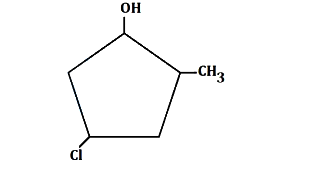 MHT CET 2020 Medium
 - The joint equation of a pair of lines passing through the origin and making an angle of \(\frac{\pi}{4}\) with the line \(3 x+2 y-8=0\) isMHT CET 2023 Medium
- The L.P.P. to maximize \(z=x+y\), subject to \(x+y \leq 30, x \leq 15, y \leq 20, x+y \geq 15\),
\(x, y \geq 0\) hasMHT CET 2020 Easy