


MHT CET · Maths · Application of Derivatives
The co-ordinates of a point on the curve \(y=x \log x\) at which the normal is parallel to the line \(2 x-2 y=3\) are
- A \(\left(-\mathrm{e}^{-2}, 2 \mathrm{e}^{-2}\right)\)
- B \(\left(-\mathrm{e}^{-2},-2 \mathrm{e}^{-2}\right)\)
- C \(\quad\left(\mathrm{e}^{-2}, 2 \mathrm{e}^{-2}\right)\)
- D \(\left(\mathrm{e}^{-2},-2 \mathrm{e}^{-2}\right)\)
Answer & Solution
Correct Answer
(D) \(\left(\mathrm{e}^{-2},-2 \mathrm{e}^{-2}\right)\)
Step-by-step Solution
Detailed explanation
\(\begin{aligned}
& y=x \log x \\
\therefore \quad & \frac{\mathrm{~d} y}{\mathrm{~d} x}=1+\log x
...(i)\end{aligned}\)
Slope of the normal \(=-\frac{1}{\left(\frac{\mathrm{~d} y}{\mathrm{~d} x}\right)}=\frac{-1}{1+\log x}\)
Slope of the given line is 1 .
Since the normal is parallel to the given line.
\(\begin{aligned}
\therefore \quad & \frac{-1}{1+\log x}=1 \\
& \Rightarrow \log x=-2 \\
& \Rightarrow x=\mathrm{e}^{-2}
\end{aligned}\)
From (i), \(y=-2 \mathrm{e}^{-2}\)
\(\therefore \quad\) Co-ordinates of the point are \(\left(\mathrm{e}^{-2},-2 \mathrm{e}^{-2}\right)\).
& y=x \log x \\
\therefore \quad & \frac{\mathrm{~d} y}{\mathrm{~d} x}=1+\log x
...(i)\end{aligned}\)
Slope of the normal \(=-\frac{1}{\left(\frac{\mathrm{~d} y}{\mathrm{~d} x}\right)}=\frac{-1}{1+\log x}\)
Slope of the given line is 1 .
Since the normal is parallel to the given line.
\(\begin{aligned}
\therefore \quad & \frac{-1}{1+\log x}=1 \\
& \Rightarrow \log x=-2 \\
& \Rightarrow x=\mathrm{e}^{-2}
\end{aligned}\)
From (i), \(y=-2 \mathrm{e}^{-2}\)
\(\therefore \quad\) Co-ordinates of the point are \(\left(\mathrm{e}^{-2},-2 \mathrm{e}^{-2}\right)\).
See the Complete Solution
Get step-by-step explanations for this and 2.5 Lakh+ more JEE, NEET & CET questions.
- Unlock all solutions
- Practice the full chapter
- Track accuracy across PYQs
4.8 rated on Google Play · 14,000+ reviews
More questions from Maths
- For \(x>1\), if \((2 x)^{2 y}=4 \mathrm{e}^{2 x-2 y}\), then \(\left(1+\log _e 2 x\right)^2 \frac{d y}{d x}\) is equal toMHT CET 2023 Medium
- The value of \(\tan ^{-1}\left(\tan \frac{7 \pi}{6}\right)\) isMHT CET 2024 Easy
- The abscissae of the two points A and B are the roots of the equation \(x^2+2 \mathrm{a} x-\mathrm{b}^2=0\) and their ordinates are roots of the equation \(y^2+2 p y-q^2=0\). Then the equation of the circle with AB as diameter is given byMHT CET 2024 Medium
- Let the line \(\frac{x-2}{3}=\frac{y-1}{-5}=\frac{z+2}{2}\) lie in the plane \(x+3 y-\alpha z+\beta=0\), then the value of \((\beta-\alpha)\) is equal toMHT CET 2025 Medium
- If the lines \(\frac{1-x}{2}=\frac{7 y+4}{2 \lambda}=\frac{2 z-5}{2}\) and \(\frac{7-7 x}{3 \lambda}=\frac{y-1}{7}=\frac{6-z}{5}\) are at right angle, then the value of \(\lambda\) isMHT CET 2025 Medium
- If \(\tan \theta=\frac{\sin \alpha-\cos \alpha}{\sin \alpha+\cos \alpha}, 0 \leq \alpha \leq \frac{\pi}{2}\), then the value of \(\cos 2 \theta\) isMHT CET 2023 Easy
More PYQs from MHT CET
- Two cells of e.m.f.'s \(E_1\) and \(E_2\left(E_1>E_2\right)\) are connected as shown in figure:
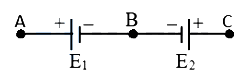
When a potentiometer is connected between A and B the balancing length of the potentiometer wire is \(300 \mathrm{~cm}\). By connecting the same potentiometer between \(\mathrm{A}\) and \(\mathrm{C}\), the balancing length is \(100 \mathrm{~cm}\). The ratio of \(\frac{E_1}{E_2}\) isMHT CET 2022 Medium - A pair of hormones produced by kidneys isMHT CET 2016 Medium
- \(10^{23}\) molecules of a gas, each having a mass of \(3 \times 10^{-27} \mathrm{~kg}\) strike per second per sq.cm of a rigid wall at an angle of \(60^{\circ}\) with the normal and rebound with a velocity of \(500 \mathrm{~m} / \mathrm{s}\). The pressure exerted by the gas molecules on the wall isMHT CET 2022 Medium
- Given below are the two statements.
Statement I: Directional isolation favours the intermediate forms phenotypic extremes. and eliminate both
Statement II: In directional isolation, more individuals acquire a value other than mean character value.
In the light of above statements, choose the correct answer from the options given below:MHT CET 2024 Easy - Rate law for a reaction is \(\mathrm{r}=\mathrm{k}[\mathrm{A}]^2[\mathrm{~B}]\). If rate constant is \(6.25 \mathrm{~mol}^{-2} \mathrm{dm}^6 \mathrm{~s}^{-1}\), what is the rate of reaction when \([\mathrm{A}]=1 \mathrm{~mol} \mathrm{dm}^{-3}\) and \([\mathrm{B}]=0.2 \mathrm{~mol} \mathrm{dm}^{-3}\) ?MHT CET 2024 Medium
- Two dice are thrown together. The probability that sum of the numbers is divisible by 2 or 3 isMHT CET 2020 Easy