


MHT CET · Maths · Three Dimensional Geometry
The Cartesian equation of the plane \(\bar{r}=(\hat{i}-\hat{j})+\lambda(\hat{i}+\hat{j}+\hat{k})+\mu(\hat{i}-2 \hat{j}+3 \hat{k})\) is
- A \(\mathrm{x}+\mathrm{y}+\mathrm{z}=0\)
- B \(5 \mathrm{x}+2 \mathrm{y}+3 \mathrm{z}=0\)
- C \(2 x+y+z=0\)
- D \(5 \mathrm{x}-2 \mathrm{y}-3 \mathrm{z}-7=0\)
Answer & Solution
Correct Answer
(D) \(5 \mathrm{x}-2 \mathrm{y}-3 \mathrm{z}-7=0\)
Step-by-step Solution
Detailed explanation
\(
\begin{aligned}
& \overline{\mathrm{r}}=(\hat{\mathrm{i}}-\hat{\mathrm{j}})+\lambda(\hat{\mathrm{i}}+\hat{\mathrm{j}}+\hat{\mathrm{k}})+\mu(\hat{\mathrm{i}}-2 \hat{\mathrm{j}}+3 \hat{\mathrm{k}}) \\
& \overline{\mathrm{a}}=\hat{\mathrm{i}}-\hat{\mathrm{j}}, \overline{\mathrm{A}}=\hat{\mathrm{i}}+\hat{\mathrm{j}}+\hat{\mathrm{k}}, \overline{\mathrm{B}}=\hat{\mathrm{i}}-2 \hat{\mathrm{j}}+3 \hat{\mathrm{k}}
\end{aligned}
\)
\(\overline{\mathrm{n}}\) is \(\perp\) er \(\overline{\mathrm{A}}\) and \(\overline{\mathrm{B}}\)
\(
\begin{aligned}
& \therefore \overline{\mathrm{n}}=\overline{\mathrm{A}} \times \overline{\mathrm{B}}=\left|\begin{array}{ccc}
\hat{\mathrm{i}} & \hat{\mathrm{j}} & \hat{\mathrm{k}} \\
1 & 1 & 1 \\
1 & -2 & 3
\end{array}\right| \\
& =\hat{\mathrm{i}}(3+2)-\hat{\mathrm{j}}(3-1)+\hat{\mathrm{k}}(-2-1)=5 \hat{\mathrm{i}}-2 \hat{\mathrm{j}}-3 \hat{\mathrm{k}} \\
& \overline{\mathrm{a}} \cdot \overline{\mathrm{n}}=\mathrm{d}=(\hat{\mathrm{i}}-\hat{\mathrm{j}}) \cdot(5 \hat{\mathrm{i}}-2 \hat{\mathrm{j}}-3 \hat{\mathrm{k}})=5+2=7 \\
& \therefore \overline{\mathrm{r}} \cdot(5 \hat{\mathrm{i}}-2 \hat{\mathrm{j}}-3 \hat{\mathrm{k}})=7 \\
& \Rightarrow \text { Cartesian equation is } 5 \mathrm{x}-2 \mathrm{y}-3 \mathrm{z}-7=0
\end{aligned}
\)
\begin{aligned}
& \overline{\mathrm{r}}=(\hat{\mathrm{i}}-\hat{\mathrm{j}})+\lambda(\hat{\mathrm{i}}+\hat{\mathrm{j}}+\hat{\mathrm{k}})+\mu(\hat{\mathrm{i}}-2 \hat{\mathrm{j}}+3 \hat{\mathrm{k}}) \\
& \overline{\mathrm{a}}=\hat{\mathrm{i}}-\hat{\mathrm{j}}, \overline{\mathrm{A}}=\hat{\mathrm{i}}+\hat{\mathrm{j}}+\hat{\mathrm{k}}, \overline{\mathrm{B}}=\hat{\mathrm{i}}-2 \hat{\mathrm{j}}+3 \hat{\mathrm{k}}
\end{aligned}
\)
\(\overline{\mathrm{n}}\) is \(\perp\) er \(\overline{\mathrm{A}}\) and \(\overline{\mathrm{B}}\)
\(
\begin{aligned}
& \therefore \overline{\mathrm{n}}=\overline{\mathrm{A}} \times \overline{\mathrm{B}}=\left|\begin{array}{ccc}
\hat{\mathrm{i}} & \hat{\mathrm{j}} & \hat{\mathrm{k}} \\
1 & 1 & 1 \\
1 & -2 & 3
\end{array}\right| \\
& =\hat{\mathrm{i}}(3+2)-\hat{\mathrm{j}}(3-1)+\hat{\mathrm{k}}(-2-1)=5 \hat{\mathrm{i}}-2 \hat{\mathrm{j}}-3 \hat{\mathrm{k}} \\
& \overline{\mathrm{a}} \cdot \overline{\mathrm{n}}=\mathrm{d}=(\hat{\mathrm{i}}-\hat{\mathrm{j}}) \cdot(5 \hat{\mathrm{i}}-2 \hat{\mathrm{j}}-3 \hat{\mathrm{k}})=5+2=7 \\
& \therefore \overline{\mathrm{r}} \cdot(5 \hat{\mathrm{i}}-2 \hat{\mathrm{j}}-3 \hat{\mathrm{k}})=7 \\
& \Rightarrow \text { Cartesian equation is } 5 \mathrm{x}-2 \mathrm{y}-3 \mathrm{z}-7=0
\end{aligned}
\)
See the Complete Solution
Get step-by-step explanations for this and 2.5 Lakh+ more JEE, NEET & CET questions.
- Unlock all solutions
- Practice the full chapter
- Track accuracy across PYQs
4.8 rated on Google Play · 14,000+ reviews
More questions from Maths
- The constraints \(-x_{1}+x_{2} \leq 1,-x_{1}+3 x_{2} \leq 9\), \(x_{1}, x_{2}>, 0\) defines onMHT CET 2011 Easy
- Let \(\overline{\mathrm{a}}, \overline{\mathrm{b}}\) and \(\overline{\mathrm{c}}\) be three non-zero vectors such that no two of them are collinear and \((\overline{\mathrm{a}} \times \overline{\mathrm{b}}) \times \overline{\mathrm{c}}=\frac{1}{3}|\overline{\mathrm{~b}}||\overline{\mathrm{c}}| \overline{\mathrm{a}}\). If \(\theta\) is the angle between vectors \(\overline{\mathrm{b}}\) and \(\overline{\mathrm{c}}\), then the value of \(\operatorname{cosec} \theta\) isMHT CET 2024 Medium
- Let z be the complex number with \(\operatorname{Im}(\mathrm{z})=10\) and satisfing \(\frac{2 \mathrm{z}-\mathrm{n}}{2 \mathrm{z}+\mathrm{n}}=2 i-1\), where \(i=\sqrt{-1}\), for some natural number ' n ' thenMHT CET 2025 Medium
- If \(\mathrm{y}=\tan ^{-1}\left[\frac{4 \sin 2 x}{\cos 2 x-6 \sin ^2 x}\right]\), then \(\frac{\mathrm{dy}}{\mathrm{d} x}\) at \(x=0\) isMHT CET 2025 Medium
- Following is the probability distribution of smart phones sold in a shop per day

Then \(E(x)=\)MHT CET 2022 Easy - The integrating factor of the differential equation \(x \frac{d y}{d x}+y \log x=x^{2}\) isMHT CET 2020 Medium
More PYQs from MHT CET
- An observer moves towards a stationary source of sound with a velocity of one-fifth of the velocity of sound. The percentage increase in the apparent frequency isMHT CET 2024 Easy
- The co-ordinates of the point in which line joining \((1,1,1)\) and \((2,2,2)\) intersects the plane \(x+y+z=9\) areMHT CET 2025 Medium
- By increasing the aperture of the objective lens, wavelength of light, focal length
of the objective lens and the resolving power of an astronomical telescope
respectivelyMHT CET 2020 Easy - A body is projected vertically upwards from earth's surface. If velocity of projection is \(\left(\frac{1}{3}\right)^{\text {rd }}\) of escape velocity, then the height upto which a body rises is
\((\mathrm{R}=\) radius of earth \()\)MHT CET 2020 Medium - With usual notation, in triangle \(\mathrm{ABC}, \mathrm{m} \angle \mathrm{A}=30^{\circ}\), then the value of \(\left(1+\frac{a}{c}+\frac{b}{c}\right)\left(1+\frac{c}{b}-\frac{a}{b}\right)\) is equal toMHT CET 2025 Medium
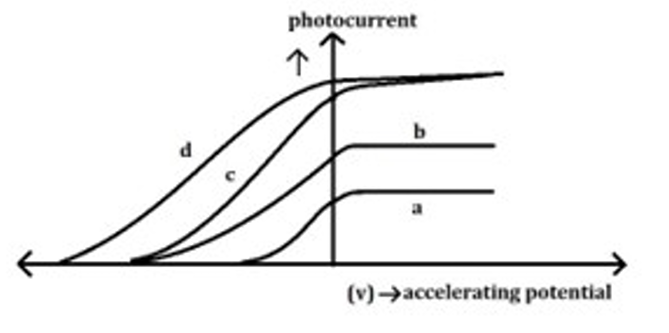
- The graph shows the variation of photocurrent with anode potential for four different radiations. Let \(I_a, I_b, I_c\) and \(I_d\) are intensities and \(f_a, f_b, f_c\) and \(f_d\) be the frequencies for the curves \(a, b, c\) and \(d\) respectively, then
 MHT CET 2025 Medium