


MHT CET · Maths · Area Under Curves
The angle between the curves \(y=\sin x\) and \(y=\cos x 0 - A \(\tan ^{-1}(\sqrt{2})\)
- B \(\tan ^{-1}(3 \sqrt{2})\)
- C \(\tan ^{-1}(2 \sqrt{2})\)
- D \(\tan ^{-1}(3 \sqrt{3})\)
- A \(\tan ^{-1}(\sqrt{2})\)
- B \(\tan ^{-1}(3 \sqrt{2})\)
- C \(\tan ^{-1}(2 \sqrt{2})\)
- D \(\tan ^{-1}(3 \sqrt{3})\)
Answer & Solution
Correct Answer
(C) \(\tan ^{-1}(2 \sqrt{2})\)
Step-by-step Solution
Detailed explanation
\(y=\sin x\) and \(y=\cos x\) intersects at \(x=\frac{\pi}{4}\)
\(\left(\frac{\mathrm{d} y}{\mathrm{~d} x}\right)_{\text {for first curve at } x=\frac{\pi}{4}}=\cos \frac{\pi}{4}=\frac{1}{\sqrt{2}}\)
\(\left(\frac{\mathrm{d} y}{\mathrm{~d} x}\right)_{\text {for second curve at } x=\frac{\pi}{4}}=-\sin \frac{\pi}{4}=-\frac{1}{\sqrt{2}}\)
Required angle \(=\theta=\tan ^{-1}\left\{\frac{\frac{1}{\sqrt{2}}-\left(-\frac{1}{\sqrt{2}}\right)}{1+\left(\frac{1}{\sqrt{2}}\right)\left(-\frac{1}{\sqrt{2}}\right)}\right\}=\tan ^{-1}\left(\frac{\sqrt{2}}{\frac{1}{2}}\right)\)
\(=\tan ^{-1}(2 \sqrt{2})\)
\(\left(\frac{\mathrm{d} y}{\mathrm{~d} x}\right)_{\text {for first curve at } x=\frac{\pi}{4}}=\cos \frac{\pi}{4}=\frac{1}{\sqrt{2}}\)
\(\left(\frac{\mathrm{d} y}{\mathrm{~d} x}\right)_{\text {for second curve at } x=\frac{\pi}{4}}=-\sin \frac{\pi}{4}=-\frac{1}{\sqrt{2}}\)
Required angle \(=\theta=\tan ^{-1}\left\{\frac{\frac{1}{\sqrt{2}}-\left(-\frac{1}{\sqrt{2}}\right)}{1+\left(\frac{1}{\sqrt{2}}\right)\left(-\frac{1}{\sqrt{2}}\right)}\right\}=\tan ^{-1}\left(\frac{\sqrt{2}}{\frac{1}{2}}\right)\)
\(=\tan ^{-1}(2 \sqrt{2})\)
See the Complete Solution
Get step-by-step explanations for this and 2.5 Lakh+ more JEE, NEET & CET questions.
- Unlock all solutions
- Practice the full chapter
- Track accuracy across PYQs
4.8 rated on Google Play · 14,000+ reviews
More questions from Maths
- The first derivative of the function \(\left(\cos ^{-1}\left(\sin \sqrt{\frac{1+x}{2}}\right)+x^x\right)\) with respect to \(x\) at \(x=1\) isMHT CET 2025 Medium
- Let \(\mathrm{f}(x)=\frac{\mathrm{ax}}{x+1}, x \neq-1\), then for \(\alpha=\) _____________, \(\mathrm{f}(\mathrm{f}(\mathrm{x}) \mathrm{)}=x\).MHT CET 2024 Easy
- The equation of the lines passing through the point \((3,2)\) and making an acute angle of \(45^{\circ}\) with the lien \(x-2 y-3=0\) areMHT CET 2022 Easy
- \(\tan \left\{\frac{1}{2} \cos ^{-1} \frac{\sqrt{5}}{3}\right\}\) has the valueMHT CET 2022 Easy
- The direction cosines of a line which lies in ZoX plane and makes an angle of \(30^{\circ}\)
with Z-axis areMHT CET 2020 Easy - The area bounded by the curve, \(y=-x^2\), x-axis, \(x=1\) and \(x=4\), isMHT CET 2022 Easy
More PYQs from MHT CET
- Which of the following pair of compounds demonstrates the law of multiple proportions?MHT CET 2023 Easy
- The general solution of \(\frac{\mathrm{dy}}{\mathrm{d} x}=2 x \mathrm{ye}^{x^2}\) isMHT CET 2025 Easy
- Let \(\bar{a}\) and \(\bar{c}\) be unit vectors at an angle \(\frac{\pi}{3}\) with each other. If \((\bar{a} \times(\bar{b} \times \bar{c})) \cdot(\bar{a} \times \bar{c})=5\), then \(\left[\begin{array}{lll}\bar{a} & \bar{b} & \bar{c}\end{array}\right]=\)MHT CET 2025 Hard
- For a feasible region \(O C D B O\) given below, the maximum value of the objective function \(z=3 x+4 y\) is
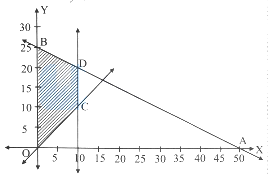 MHT CET 2023 Medium
 - During \(CO _2\) transport, movement of chloride ions across the membrane of RBCs from plasma is called ________.MHT CET 2025 Easy
- The area of the triangle formed by the lines joining vertex of the parabola \(x^{2}=12 y\)
to the extremities of its latus rectum isMHT CET 2020 Easy