


MHT CET · Maths · Straight Lines
\(\mathrm{p}\) is the length of perpendicular from the origin to the line whose intercepts on the axes are a and \(\mathrm{b}\) respectively, then \(\frac{1}{\mathrm{a}^2}+\frac{1}{\mathrm{~b}^2}\) equals
- A \(\mathrm{p}^2\)
- B \(\frac{2}{\mathrm{p}^2}\)
- C \(\frac{1}{\mathrm{p}^2}\)
- D \(\frac{1}{2 p^2}\)
Answer & Solution
Correct Answer
(C) \(\frac{1}{\mathrm{p}^2}\)
Step-by-step Solution
Detailed explanation
Let the equation of the line be \(\frac{x}{\mathrm{a}}+\frac{y}{\mathrm{~b}}=1\)
According to the given condition,
\(
\begin{aligned}
& \mathrm{p}=\left|\frac{\mathrm{ab}}{\sqrt{\mathrm{a}^2+b^2}}\right| \\
& \Rightarrow \frac{\mathrm{a}^2+\mathrm{b}^2}{\mathrm{a}^2 \mathrm{~b}^2}=\frac{1}{\mathrm{p}^2} \\
& \Rightarrow \frac{1}{\mathrm{a}^2}+\frac{1}{\mathrm{~b}^2}=\frac{1}{\mathrm{p}^2}
\end{aligned}
\)
According to the given condition,
\(
\begin{aligned}
& \mathrm{p}=\left|\frac{\mathrm{ab}}{\sqrt{\mathrm{a}^2+b^2}}\right| \\
& \Rightarrow \frac{\mathrm{a}^2+\mathrm{b}^2}{\mathrm{a}^2 \mathrm{~b}^2}=\frac{1}{\mathrm{p}^2} \\
& \Rightarrow \frac{1}{\mathrm{a}^2}+\frac{1}{\mathrm{~b}^2}=\frac{1}{\mathrm{p}^2}
\end{aligned}
\)
See the Complete Solution
Get step-by-step explanations for this and 2.5 Lakh+ more JEE, NEET & CET questions.
- Unlock all solutions
- Practice the full chapter
- Track accuracy across PYQs
4.8 rated on Google Play · 14,000+ reviews
More questions from Maths
- The function \(\mathrm{f}(\mathrm{x})=\log (1+\mathrm{x})-\frac{2 \mathrm{x}}{2+\mathrm{x}}\) is increasing onMHT CET 2021 Easy
- \(\int \frac{\mathrm{d} x}{\mathrm{e}^x-1}=\)MHT CET 2025 Medium
- If three distinct numbers are chosen randomly from first 100 natural numbers, then the probability that all three of them are divisible by both 2 and 3 isMHT CET 2022 Easy
- The co-ordinates of the foot of the perpendicular drawn from the origin to the plane \(2 x+6 y-3 z=63\) areMHT CET 2022 Easy
- If the polar co-ordinates of a point are \(\left(2, \frac{\pi^c}{4}\right)\), then its Cartesian co-ordinates areMHT CET 2021 Medium
- Which of the following matrix is invertible?
\(A_{1}=\left[\begin{array}{ll}4 & 2 \\ 2 & 1\end{array}\right]\)
\(A_{2}=\left[\begin{array}{ccc}-1 & -2 & 3 \\ 4 & 5 & 7 \\ 2 & 4 & -6\end{array}\right]\)
\(A_{3}=\left[\begin{array}{lll}1 & 0 & 0 \\ 5 & 2 & 1 \\ 7 & 2 & 1\end{array}\right]\)
\(A_{4}=\left[\begin{array}{lll}1 & 0 & 1 \\ 0 & 2 & 3 \\ 1 & 2 & 1\end{array}\right]\)MHT CET 2020 Easy
More PYQs from MHT CET
- A coil of 'n' turns and resistance 'R' \(\Omega\) is connected in series with a resistance \(\frac{\mathrm{R}}{2}\) The combination is moved for time 't' second through magnetic flux \(\phi_{1}\) to \(\phi_{2}\). The induced current in the circuit isMHT CET 2020 Easy
- In Young's double slit experiment with monochromatic light, fringes are obtained on a screen placed at some distance from the slits.
If the screen is moved by \(5 \times 10^{-2} \mathrm{~m}\) towards the slits, the change in fringe width is \(3 \times 10^{-5} \mathrm{~m}\). If the separation between the slits is \(10^{-3} \mathrm{~m}\), the wavelength of light used isMHT CET 2022 Easy - A tetrahedron has vertices \(\mathrm{P}(1,2,1), \mathrm{Q}(2,1,3), \mathrm{R}(-1,1,2)\) and \(\mathrm{O}(0,0,0)\). Then the angle between the faces OPQ and PQR isMHT CET 2022 Medium
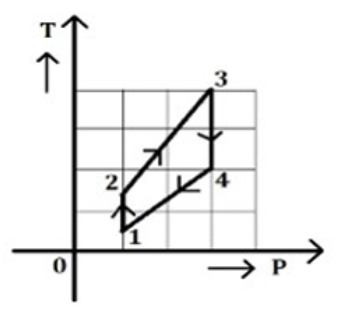
- Two moles of an ideal monoatomic gas undergo a cyclic process as shown in figure. The temperatures in different states are given as \(6 \mathrm{~T}_1=3 \mathrm{~T}_2=2 \mathrm{~T}_4=\mathrm{T}_3=2400 \mathrm{~K}\). The work done by the gas during the complete cycle is ( \(R=\) Universal gas constant )
 MHT CET 2025 Medium
 - Which of the following is NOT a globular protein?MHT CET 2023 Easy
- For the reaction \(\mathrm{A}+\mathrm{B} \longrightarrow\) product, rate law equation is, rate \(=\mathrm{k}[\mathrm{A}]^2[\mathrm{~B}]\). If rate of reaction is \(0.22 \mathrm{~mol} \mathrm{~L}^{-1} \cdot \mathrm{~s}^{-1}\), calculate rate constant. \(\left([\mathrm{A}]=1 \mathrm{~mol} \mathrm{~L}^{-1},[\mathrm{~B}]=0.25 \mathrm{~mol} \mathrm{~L}^{-1}\right)\)MHT CET 2024 Easy