


MHT CET · Maths · Vector Algebra
One side and one diagonal of a parallelogram are represented by \(3 \hat{i}+\hat{j}-\hat{k}\) and \(2 \hat{i}+\hat{j}-2 \hat{k}\) respectively, then the area of parallelogram in square units is
- A \(2 \sqrt{3}\)
- B \(3 \sqrt{2}\)
- C \(6 \sqrt{2}\)
- D \(4 \sqrt{3}\)
Answer & Solution
Correct Answer
(B) \(3 \sqrt{2}\)
Step-by-step Solution
Detailed explanation
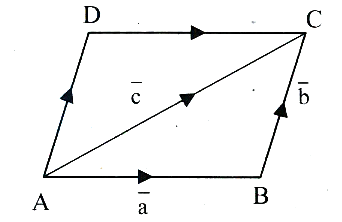
\(\overline{\mathrm{a}}=3 \hat{\mathrm{i}}+\hat{\mathrm{j}}-\hat{\mathrm{k}} \text { and } \overline{\mathrm{c}}=2 \hat{\mathrm{i}}+\hat{\mathrm{j}}-2 \hat{\mathrm{k}}\)
In \(\triangle \mathrm{ABC}\),
\(\begin{aligned}
& \overline{\mathrm{a}+\overline{\mathrm{b}}}=\overline{\overline{\mathrm{c}}} \ldots \ldots[\text { Using triangle law of addition] } \\
& \begin{aligned}
\Rightarrow \overline{\mathrm{b}} & =\overline{\mathrm{c}}-\overline{\mathrm{a}} \\
& =2 \hat{\mathrm{i}}+\hat{\mathrm{j}}-2 \hat{\mathrm{k}}-(3 \hat{\mathrm{i}}+\hat{\mathrm{j}}-\hat{\mathrm{k}})=-\hat{\mathrm{i}}-\hat{\mathrm{k}} \\
\overline{\mathrm{a}} \times \overline{\mathrm{b}} & =\left|\begin{array}{ccc}
\hat{\mathrm{i}} & \hat{\mathrm{j}} & \hat{\mathrm{k}} \\
3 & 1 & -1 \\
-1 & 0 & -1
\end{array}\right|=-\hat{\mathrm{i}}+4 \hat{\mathrm{j}}+\hat{\mathrm{k}}
\end{aligned}
\end{aligned}\)
\(\therefore \text { Area of parallelogram } =|\overline{\mathrm{a}} \times \overline{\mathrm{b}}| \)
\( =\sqrt{1+16+1} \)
\( =\sqrt{18}=3 \sqrt{2} \text { sq. units}\)
See the Complete Solution
Get step-by-step explanations for this and 2.5 Lakh+ more JEE, NEET & CET questions.
- Unlock all solutions
- Practice the full chapter
- Track accuracy across PYQs
4.8 rated on Google Play · 14,000+ reviews
More questions from Maths
- The Cartesian equation of the plane \(\bar{r}=(2 \hat{i}-3 \hat{j})+\lambda(\hat{i}+2 \hat{j}-\hat{k})+\mu(2 \hat{i}+3 \hat{j}+\hat{k})\) isMHT CET 2025 Medium
- In a triangle ABC , with usual notations, \(\cot \left(\frac{A+B}{2}\right) \cdot \tan \left(\frac{A-B}{2}\right)=\)MHT CET 2025 Medium
- If \(x=a(\theta+\sin \theta)\) and \(y=a(1-\cos \theta)\) then \(\left(\frac{d^2 y}{dx^2}\right)_{a t \theta=\pi / 2}=\)MHT CET 2021 Hard
- \(\tan ^{-1} 2+\tan ^{-1} 3=\)MHT CET 2022 Easy
- If \(\quad X \sim B(n, p)\) then \(\frac{P(X=k)}{P(X=k-1)}=\)MHT CET 2025 Medium
- If the function \(\mathrm{f}(x)=x(x+3) \mathrm{e}^{-\frac{x}{2}}\) satisfies all the conditions of Rolle's theorem in \([-3,0]\), then c isMHT CET 2025 Easy
More PYQs from MHT CET
- A water drop of \(0.01 \mathrm{~cm}^3\) is squeezed between two glass plates and spreads in to area of \(10 \mathrm{~cm}^2\). If surface tension of water is 70 dyne \(/ \mathrm{cm}\) then the normal force required to separate glass plates from each other will beMHT CET 2025 Medium
- A particle is executing a linear simple harmonic motion. Let ' \(\mathrm{V}_1\) ' and ' \(\mathrm{V}_2\) ' are its speed at distance ' \(x_1\) ' and ' \(x_2\) ' from the equilibrium position. The amplitude of oscillation isMHT CET 2024 Hard
- Identify neutral complex from following.MHT CET 2021 Easy
- A cross between two pea plants tall with axial flowers and dwarf with terminal flowers produced offsprings tall with axial flowers and tall with terminal flowers in the ratio 1: 1. What will be the genotype of parents?MHT CET 2016 Hard
- A simple pendulum is oscillating with frequency ' \(F\) ' on the surface of the earth. It is taken to a depth \(\frac{R}{3}\) below the surface of earth. ( \(R=\) radius of earth). The frequency of oscillation at depth \(R / 3\) isMHT CET 2023 Medium
- The value of \(\int \cos \left(\log _e(x)\right) \mathrm{d} x\) is equal to (where \(C\) is a constant of integration.)MHT CET 2022 Easy