


MHT CET · Maths · Application of Derivatives
On the interval \([0,1]\) the function \(x^{25}(1-x)^{75}\) takes its maximum value at the point
- A 0
- B \(1 / 4\)
- C \(1 / 2\)
- D \(1 / 3\)
Answer & Solution
Correct Answer
(B) \(1 / 4\)
Step-by-step Solution
Detailed explanation
Given, \(f(x)=x^{25}(1-x)^{75}\)
\(\Rightarrow f^{\prime}(x) =25 x^{24}(1-x)^{75}-75 x^{25}(1-x)^{74} \)
\( =25 x^{24}(1-x)^{74}(1-4 x) \)
\( \therefore f^{\prime}(x) =0 \)
\( \Rightarrow x =0,1,1 / 4\)
If \(x < 1 / 4\), then
\(
f^{\prime}(x)=25 x^{24}(1-x)^{74}(1-4 x)>0 .
\)
and if \(x>1 / 4\), then
\(
f^{\prime}(x)=25 x^{24}(1-x)^{74}(1-4 x) < 0 .
\)
Thus, \(f^{\prime}(x)\) changes its sign from positive to negative as \(x\) passes through \(1 / 4\) from left to right. Hence, \(f(x)\) attains its maximum at \(x=1 / 4\).
\(\Rightarrow f^{\prime}(x) =25 x^{24}(1-x)^{75}-75 x^{25}(1-x)^{74} \)
\( =25 x^{24}(1-x)^{74}(1-4 x) \)
\( \therefore f^{\prime}(x) =0 \)
\( \Rightarrow x =0,1,1 / 4\)
If \(x < 1 / 4\), then
\(
f^{\prime}(x)=25 x^{24}(1-x)^{74}(1-4 x)>0 .
\)
and if \(x>1 / 4\), then
\(
f^{\prime}(x)=25 x^{24}(1-x)^{74}(1-4 x) < 0 .
\)
Thus, \(f^{\prime}(x)\) changes its sign from positive to negative as \(x\) passes through \(1 / 4\) from left to right. Hence, \(f(x)\) attains its maximum at \(x=1 / 4\).
See the Complete Solution
Get step-by-step explanations for this and 2.5 Lakh+ more JEE, NEET & CET questions.
- Unlock all solutions
- Practice the full chapter
- Track accuracy across PYQs
4.8 rated on Google Play · 14,000+ reviews
More questions from Maths
- The mean and variance of seven observations are 8 and 16 respectively. If five of the observations are \(2,4,10,12,14\), then the product of remaining two observations isMHT CET 2024 Medium
- The solution of the differential equation \((1+x) y \mathrm{~d} x+(1-y) x \mathrm{~d} y=0\) isMHT CET 2022 Easy
- The general solution of the differential equation \(\frac{d y}{d x}=\frac{3 e^{2 x}+3 e^{4 x}}{. e^x+e^{-x}}\) isMHT CET 2024 Medium
- The shaded area in the given figure is a solution set for some system of inequalities. The maximum value of the function \(z=4 x+3 y\) subject to linear constraints given by the system is
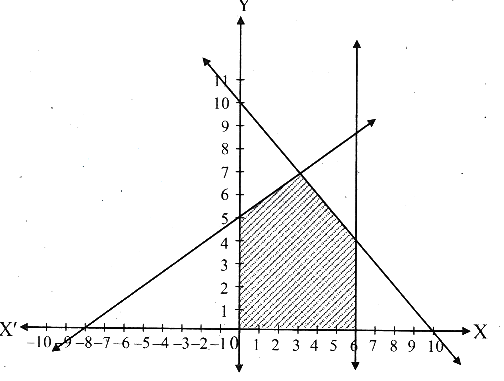 MHT CET 2024 Easy
 - The rate at which a substance cools in moving air, is proportional to the difference between the temperature of the substance and that of air. The temperature of air is 290 K and the substance cools from 370 K to 330 K in 10 minutes. Then the time to cool the substance upto 295 K isMHT CET 2025 Medium
- If the angles of a triangle are in the ratio \(4: 1: 1\), then the ratio of the longest side to its perimeter isMHT CET 2023 Easy
More PYQs from MHT CET
- ' n ' small water drops of same size (radius r ) fall through air with constant velocity V. They coalesce to form a big drop of radius R. The terminal velocity of the big drop isMHT CET 2025 Medium
- The equation of the curve passing through \(\left(2, \frac{9}{2}\right)\) and having the slope \(\left(1-\frac{1}{x^2}\right)\) at \((\mathrm{x}, \mathrm{y})\) isMHT CET 2025 Medium
- The lines \(\frac{x-1}{3}=\frac{y+1}{2}=\frac{z-1}{5} \quad\) and \(\frac{x+2}{4}=\frac{y-1}{3}=\frac{z+1}{2}\)MHT CET 2023 Easy
- Select the correct statement.MHT CET 2024 Hard
- Which among the following is NOT Alliylic halide?MHT CET 2025 Easy
- Which of the following is least reactive towards SN \(^{1}\) reactions?MHT CET 2020 Medium