


MHT CET · Maths · Vector Algebra
Let the vectors \(\overline{\mathrm{a}}, \overline{\mathrm{b}}, \overline{\mathrm{c}}\) be such that \(|\bar{a}|=2 ;|\vec{b}|=4\) and \(|\bar{c}|=4\). If the projection of \(\bar{b}\) on \(\bar{a}\) is equal to the projection of \(\bar{c}\) on \(\bar{a}\) and \(\bar{b}\) is perpendicular to \(\bar{c}\), then the value of \(|\bar{a}+\bar{b}-\bar{c}|\) is
- A \(2 \sqrt{5}\)
- B 6
- C 4
- D \(4 \sqrt{2}\)
Answer & Solution
Correct Answer
(B) 6
Step-by-step Solution
Detailed explanation
\(|\overrightarrow{\mathrm{a}}|=2,|\overline{\mathrm{~b}}|=4,|\overrightarrow{\mathrm{c}}|=4\)
According to the given condition, Projection of \(\overline{\mathrm{b}}\) on \(\overline{\mathrm{a}}=\) projection of \(\overline{\mathrm{c}}\) on \(\overline{\mathrm{a}}\)
\(\begin{aligned}
& \Rightarrow \frac{\overline{\mathrm{b}} \cdot \overline{\mathrm{a}}}{|\overline{\mathrm{a}}|}=\frac{\overline{\mathrm{c}} \cdot \overline{\mathrm{a}}}{|\overline{\mathrm{a}}|} \\
& \Rightarrow \overline{\mathrm{b}} \cdot \overrightarrow{\mathrm{a}}=\overline{\mathrm{c}} \cdot \overline{\mathrm{a}} \\
& \Rightarrow(\overline{\mathrm{~b}}-\overline{\mathrm{c}}) \cdot \overline{\mathrm{a}}=0...(i)
\end{aligned}\)
Now, \(|\bar{a}+\bar{b}-\bar{c}|=\sqrt{|\bar{a}+\bar{b}-\bar{c}|^2}\)
\(=\sqrt{|\bar{a}|^2+|\bar{b}-\bar{c}|^2+2 \bar{a} \cdot(\bar{b}-\bar{c})}\)
\(=\sqrt{(2)^2+|\bar{b}-\bar{c}|^2+2(0)}\)
...[From (i)]
\(=\sqrt{4+|\vec{b}-\bar{c}|^2}\)
\(=\sqrt{4+|\bar{b}|^2+|\bar{c}|^2-2(\bar{b} \cdot \bar{c})}\)
\(\begin{aligned}
& =\sqrt{4+4^2+4^2-2(0)} \\
& =\sqrt{36}=6
\end{aligned}\)
...[ \(\bar{b}\) is perpendicular to \(\bar{c}]\)
According to the given condition, Projection of \(\overline{\mathrm{b}}\) on \(\overline{\mathrm{a}}=\) projection of \(\overline{\mathrm{c}}\) on \(\overline{\mathrm{a}}\)
\(\begin{aligned}
& \Rightarrow \frac{\overline{\mathrm{b}} \cdot \overline{\mathrm{a}}}{|\overline{\mathrm{a}}|}=\frac{\overline{\mathrm{c}} \cdot \overline{\mathrm{a}}}{|\overline{\mathrm{a}}|} \\
& \Rightarrow \overline{\mathrm{b}} \cdot \overrightarrow{\mathrm{a}}=\overline{\mathrm{c}} \cdot \overline{\mathrm{a}} \\
& \Rightarrow(\overline{\mathrm{~b}}-\overline{\mathrm{c}}) \cdot \overline{\mathrm{a}}=0...(i)
\end{aligned}\)
Now, \(|\bar{a}+\bar{b}-\bar{c}|=\sqrt{|\bar{a}+\bar{b}-\bar{c}|^2}\)
\(=\sqrt{|\bar{a}|^2+|\bar{b}-\bar{c}|^2+2 \bar{a} \cdot(\bar{b}-\bar{c})}\)
\(=\sqrt{(2)^2+|\bar{b}-\bar{c}|^2+2(0)}\)
...[From (i)]
\(=\sqrt{4+|\vec{b}-\bar{c}|^2}\)
\(=\sqrt{4+|\bar{b}|^2+|\bar{c}|^2-2(\bar{b} \cdot \bar{c})}\)
\(\begin{aligned}
& =\sqrt{4+4^2+4^2-2(0)} \\
& =\sqrt{36}=6
\end{aligned}\)
...[ \(\bar{b}\) is perpendicular to \(\bar{c}]\)
See the Complete Solution
Get step-by-step explanations for this and 2.5 Lakh+ more JEE, NEET & CET questions.
- Unlock all solutions
- Practice the full chapter
- Track accuracy across PYQs
4.8 rated on Google Play · 14,000+ reviews
More questions from Maths
- The Cartesian equation of a line is \(3 x+1=6 y-2=-z+1\), then its vector equation isMHT CET 2021 Easy
- The rate of change of the volume of a sphere with respect to its surface area, when its radius is 2 cm , isMHT CET 2024 Easy
- The L.P.P. , minimize \(z=30 x+20 y, \quad x+y \leqslant 8, \quad x+2 y \geqslant 4, \quad 6 x+4 y \geqslant 12\), \(x \geqslant 0, y \geqslant 0\) hasMHT CET 2025 Medium
- The centroid of tetrahedron with vertices \(\mathrm{P}(5,-7,0), \mathrm{Q}(\mathrm{a}, 5,3), \mathrm{R}(4,-6, \mathrm{~b})\) and \(\mathrm{S}(6, \mathrm{c}, 2)\) is \((4,-3,2)\), then the value of \(2 a+3 b+c\) is equal toMHT CET 2024 Medium
- In a triangle \(\mathrm{ABC}\), with usual notations \(\angle A=60^{\circ}\), then \(\left(1+\frac{a}{c}+\frac{b}{c}\right)\left(1+\frac{c}{b}-\frac{a}{b}\right)=\)MHT CET 2022 Medium
- Two adjacent sides of a parallelogram are \(2 \hat{i}-4 \hat{j}+5 \hat{k}\) and \(\hat{i}-2 \hat{j}-3 \hat{k}\), then the unit vector parallel to its diagonal isMHT CET 2023 Medium
More PYQs from MHT CET
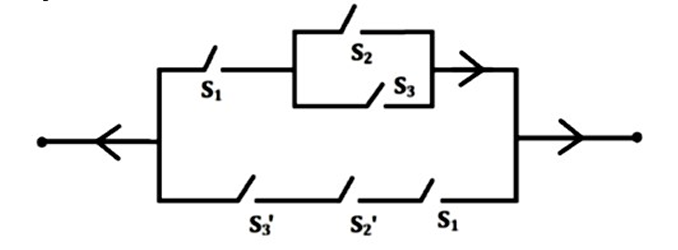
- If \(\mathrm{p} \equiv\) The switch \(\mathrm{S}_1\) is closed, \(\mathrm{q} \equiv\) The switch \(\mathrm{S}_2\) is closed, \(\mathrm{r} \equiv\) switch \(S_3\) is closed, then symbolic form of following switching circuit is equivalent to
 MHT CET 2025 Medium
 - A disc of radius \(R\) and thickness \(\frac{R}{6}\) has a moment of inertia \(I\) about an axis passing through its centre and perpendicular to its plane. The disc is melted and recast into a solid sphere. The moment of inertia of a sphere about its diameter isMHT CET 2016 Easy
- Number of common tangents to the circles \(x^2+y^2-6 x-14 y+48=0\) and \(x^2+y^2-6 x=0\) areMHT CET 2023 Medium
- A line is drawn through a fixed point \(P(\alpha, \beta)\) to cut the circle \(x^{2}+y^{2}=r^{2}\) at \(A\) and \(B\). Then
\(P A \cdot P B\) is equal toMHT CET 2007 Hard - Muscular ridges at inner surface of ventricles are calledMHT CET 2016 Easy
- A vehicle runs on a straight road of length ' L '. It travels half the distance with speed V and the remaining distance with speed \(\frac{\mathrm{V}}{3}\). Its average speed isMHT CET 2024 Medium