


MHT CET · Maths · Functions
Let the function \(\mathrm{g}:(-\infty, \infty) \rightarrow\left(-\frac{\pi}{2}, \frac{\pi}{2}\right)\) be given by \(\mathrm{g}(\mathrm{u})=2 \tan ^{-1}\left(\mathrm{e}^{\mathrm{u}}\right)-\frac{\pi}{2}\). Then g is
- A even and is strictly increasing in \((0, \infty)\).
- B odd and is strictly decreasing in \((-\infty, \infty)\).
- C odd and is strictly increasing in \((-\infty, \infty)\).
- D neither even nor odd, but is strictly increasing in \((-\infty, \infty)\).
Answer & Solution
Correct Answer
(C) odd and is strictly increasing in \((-\infty, \infty)\).
Step-by-step Solution
Detailed explanation
\(\begin{aligned}
& \mathrm{g}(\mathrm{u})=2 \tan ^{-1}\left(\mathrm{e}^{\mathrm{u}}\right)-\frac{\pi}{2} \\
& \Rightarrow \mathrm{~g}(\mathrm{u})=\tan ^{-1}\left(\mathrm{e}^{\mathrm{u}}\right)-\left(\frac{\pi}{2}-\tan ^{-1}\left(\mathrm{e}^{\mathrm{u}}\right)\right) \\
& \Rightarrow \mathrm{g}(\mathrm{u})=\tan ^{-1}\left(\mathrm{e}^{\mathrm{u}}\right)-\cot ^{-1}\left(e^{\mathrm{u}}\right) \\
& \Rightarrow \mathrm{g}(-\mathrm{u})=\tan ^{-1}\left(\mathrm{e}^{-\mathrm{u}}\right)-\cot ^{-1}\left(\mathrm{e}^{-\mathrm{u}}\right) \\
& \Rightarrow \mathrm{g}(-\mathrm{u})=\tan ^{-1}\left(\frac{1}{\mathrm{e}^{\mathrm{u}}}\right)-\cot ^{-1}\left(\frac{1}{\mathrm{e}^u}\right) \\
& \Rightarrow \mathrm{g}(-\mathrm{u})=\cot ^{-1}\left(\mathrm{e}^{\mathrm{u}}\right)-\tan ^{-1}\left(\mathrm{e}^{\mathrm{u}}\right)=-\mathrm{g}(\mathrm{u})
\end{aligned}\)
Now, \(\dot{g(\mathrm{u}})=2 \tan ^{-1}\left(\mathrm{e}^{\mathrm{u}}\right)-\frac{\pi}{2}\)
\(\Rightarrow \mathrm{g}^{\prime}(\mathrm{u})=\frac{2 \mathrm{e}^{\mathrm{u}}}{1+\mathrm{e}^{2 \mathrm{u}}}\gt0 \text { for all } \mathrm{u} \in(-\infty, \infty)\)
\(\Rightarrow \mathrm{g}\) is strictly increasing function in \((-\infty, \infty)\). Hence, \(\mathrm{g}(\mathrm{u})\) is odd and is strictly increasing in \((-\infty, \infty)\).
& \mathrm{g}(\mathrm{u})=2 \tan ^{-1}\left(\mathrm{e}^{\mathrm{u}}\right)-\frac{\pi}{2} \\
& \Rightarrow \mathrm{~g}(\mathrm{u})=\tan ^{-1}\left(\mathrm{e}^{\mathrm{u}}\right)-\left(\frac{\pi}{2}-\tan ^{-1}\left(\mathrm{e}^{\mathrm{u}}\right)\right) \\
& \Rightarrow \mathrm{g}(\mathrm{u})=\tan ^{-1}\left(\mathrm{e}^{\mathrm{u}}\right)-\cot ^{-1}\left(e^{\mathrm{u}}\right) \\
& \Rightarrow \mathrm{g}(-\mathrm{u})=\tan ^{-1}\left(\mathrm{e}^{-\mathrm{u}}\right)-\cot ^{-1}\left(\mathrm{e}^{-\mathrm{u}}\right) \\
& \Rightarrow \mathrm{g}(-\mathrm{u})=\tan ^{-1}\left(\frac{1}{\mathrm{e}^{\mathrm{u}}}\right)-\cot ^{-1}\left(\frac{1}{\mathrm{e}^u}\right) \\
& \Rightarrow \mathrm{g}(-\mathrm{u})=\cot ^{-1}\left(\mathrm{e}^{\mathrm{u}}\right)-\tan ^{-1}\left(\mathrm{e}^{\mathrm{u}}\right)=-\mathrm{g}(\mathrm{u})
\end{aligned}\)
Now, \(\dot{g(\mathrm{u}})=2 \tan ^{-1}\left(\mathrm{e}^{\mathrm{u}}\right)-\frac{\pi}{2}\)
\(\Rightarrow \mathrm{g}^{\prime}(\mathrm{u})=\frac{2 \mathrm{e}^{\mathrm{u}}}{1+\mathrm{e}^{2 \mathrm{u}}}\gt0 \text { for all } \mathrm{u} \in(-\infty, \infty)\)
\(\Rightarrow \mathrm{g}\) is strictly increasing function in \((-\infty, \infty)\). Hence, \(\mathrm{g}(\mathrm{u})\) is odd and is strictly increasing in \((-\infty, \infty)\).
See the Complete Solution
Get step-by-step explanations for this and 2.5 Lakh+ more JEE, NEET & CET questions.
- Unlock all solutions
- Practice the full chapter
- Track accuracy across PYQs
4.8 rated on Google Play · 14,000+ reviews
More questions from Maths
- If at the end of certain meeting, everyone had shaken hands with everyone else, it was found that 45 handshakes were exchanged, then the number of members present at the meeting, areMHT CET 2023 Easy
- The equation of the plane passing through the line of intersection of the planes \(x+y+z=1\) and \(3 x+4 y+5 z=2\) and perpendicular to the XY- plane isMHT CET 2025 Medium
- Let \(\left(-2-\frac{1}{3}\right)^3=\frac{x+\mathrm{i} y}{27}, \mathrm{i}=\sqrt{-1}\), where \(x\) and \(y\) are real numbers, then \((y-x)\) has the valueMHT CET 2024 Easy
- If \(x=\sqrt{\mathrm{e}^{\sin ^{-1} \mathrm{t}}}\) and \(y=\sqrt{\mathrm{e}^{\cos ^{-1} \mathrm{t}}}\), then \(\frac{\mathrm{d}^2 y}{\mathrm{~d} x^2}\) isMHT CET 2023 Medium
- The distance of the point \(A(3,-4,5)\) from the plane \(2 x+5 y-6 z=16\) measured along the line \(\frac{x}{2}=\frac{y}{1}=\frac{z}{-2}\) isMHT CET 2025 Medium
- For the system \(x-y+z=4,2 x+y-3 z=0\), \(x+y+z=2\), the values of \(x, y, z\) respectively are given byMHT CET 2024 Medium
More PYQs from MHT CET
- Osmoreceptors are present in theMHT CET 2016 Hard
- The area bounded by the circle \(x^{2}+y^{2}=16\) and lines x=0 and x=2 isMHT CET 2020 Medium
- The figure shows equiconvex lens of focal length ' \(\mathrm{f}\) '. If the lens is cut along \(\mathrm{AB}\), the
focal length of each half will be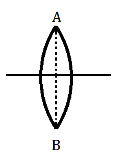 MHT CET 2020 Medium
 - A complex reaction takes place in 2 steps
(i) \(\mathrm{NO}_{2(\mathrm{~g})}+\mathrm{F}_{2(\mathrm{~g})} \rightarrow \mathrm{NO}_2 \mathrm{~F}_{(\mathrm{g})}+\mathrm{F}_{(\mathrm{g})}+\) (slow)
(ii) \(\mathrm{F}_{(\mathrm{g})}+\mathrm{NO}_{2(\mathrm{~g})} \rightarrow \mathrm{NO}_2 \mathrm{~F}_{(\mathrm{g})}(\) fast \()\)
Identify the reaction intermediate?MHT CET 2022 Easy - A cylindrical tube open at both ends, has a vibrating air column of fundamental frequency ' \(\mathrm{f}\) ' in air. The tube is dipped vertically in water so that half of its is in water. The fundamental frequency of the vibrating air column is nowMHT CET 2022 Easy
- Edward Jenner in 1796 produced the first vaccine against ___________ .MHT CET 2020 Easy