


MHT CET · Maths · Vector Algebra
Let \(P, Q, R\) and \(S\) be the points on the plane with position vectors \(-2 \hat{i}-\hat{j}, 4 \hat{i}, 3 \hat{i}+3 \hat{j}\) and \(-3 \hat{i}+2 \hat{j}\) respectively. Then the quadrilateral PQRS must be a
- A parallelogram, which is neither a rhombus nor a rectangle.
- B square.
- C rectangle, but not a square.
- D rhombus, but not a square.
Answer & Solution
Correct Answer
(A) parallelogram, which is neither a rhombus nor a rectangle.
Step-by-step Solution
Detailed explanation
\(\mathrm{m}_{\mathrm{PQ}}=\frac{1}{6}, \mathrm{~m}_{\mathrm{SR}}=\frac{1}{6}, \mathrm{~m}_{\mathrm{RQ}}=-3, \mathrm{~m}_{\mathrm{SP}}=-3\)
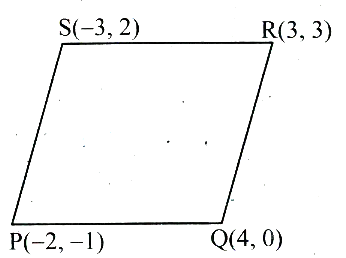
\(\square \mathrm{PQRS}\) is a parallelogram.
But neither \(\mathrm{PR}=\mathrm{SQ}\) nor \(\mathrm{PR}^{\prime} \perp \mathrm{SQ}\).
\(\therefore \quad\) Parallelogram, which is neither a rhombus nor a rectangle.
\(\square \mathrm{PQRS}\) is a parallelogram.
But neither \(\mathrm{PR}=\mathrm{SQ}\) nor \(\mathrm{PR}^{\prime} \perp \mathrm{SQ}\).
\(\therefore \quad\) Parallelogram, which is neither a rhombus nor a rectangle.
See the Complete Solution
Get step-by-step explanations for this and 2.5 Lakh+ more JEE, NEET & CET questions.
- Unlock all solutions
- Practice the full chapter
- Track accuracy across PYQs
4.8 rated on Google Play · 14,000+ reviews
More questions from Maths
- The principal solutions of \(\cos 2 x=\frac{-1}{2}\) areMHT CET 2020 Easy
- If two angles of \(\triangle \mathrm{ABC}\) are \(\frac{\pi}{4}\) and \(\frac{\pi}{3}\), then the ratio of the smallest and greatest side isMHT CET 2020 Easy
- \(\int \frac{x^4+x^2+1}{x^2-x+1} \mathrm{~d} x\) is equal toMHT CET 2024 Medium
- A box contains pens, of which are defective. Two pens are taken randomly from the box. If random variable Number of defective pens obtained, then standard deviation ofMHT CET 2017 Hard
- The cartesian equation of the curve \(x=3+5 \cos \theta, y=2+5 \sin \theta\) is
\((0 \leq \theta \leq 2 \pi)\)MHT CET 2020 Easy - \(\int \frac{x^3}{(x+1)^2} \mathrm{~d} x=\)MHT CET 2025 Medium
More PYQs from MHT CET
- Which from following elements belongs to group 17 of periodic table?MHT CET 2023 Easy
- Identify the compound \(A\) and \(B\) in following reaction.MHT CET 2020 Medium
- Two blocks \(A\) and \(B\) each of \(20 \mathrm{~kg}\) lying on a frictionless table are connected by a light string. The system is pulled horizontally with an acceleration of \(2 \mathrm{~ms}^{-2}\) by a force \(F\) on \(B\). The tension in the string will beMHT CET 2012 Medium
- The maximum area of the rectangle that can be inscribed in a circle of radius \(r\) isMHT CET 2021 Hard
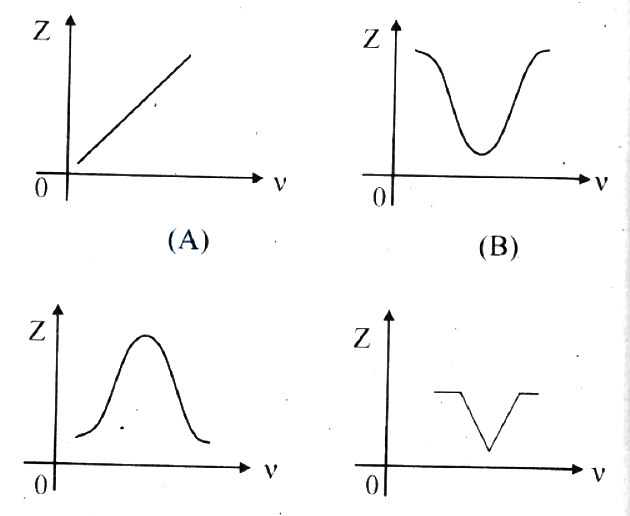
- Which one of the following graph represent correctly the variation of impedance (Z) of a series LCR circuit with the frequency ( \(v\) ) of applied a.c.?
 MHT CET 2024 Medium
 - A better conserver of water with respect to excretion of nitrogenous waste is _____.MHT CET 2020 Easy