


MHT CET · Maths · Mathematical Reasoning
Let A, B, C and D be four nonempty sets. The contrapositive of 'if \(A \subseteq B\) and \(B \subseteq D\) then \(A \subseteq C\) ' is
- A If \(A \subseteq C\), then \(A \subseteq B\) or \(B \nsubseteq D\)
- B If \(A \subset C\), then \(A \subseteq B\) and \(B \subseteq D\)
- C If \(A \subseteq C\), then \(A \subseteq B\) and \(B \subseteq D\)
- D If \(\mathrm{A} \subseteq C\), then \(\mathrm{B} \subset \mathrm{A}\) or \(\mathrm{D} \subset \mathrm{B}\)
Answer & Solution
Correct Answer
(A) If \(A \subseteq C\), then \(A \subseteq B\) or \(B \nsubseteq D\)
Step-by-step Solution
Detailed explanation
The contrapositive of \(p \rightarrow q\) is \(\sim q \rightarrow \sim p\)
so, the required contrapositive is
If \(A \nsubseteq C\), then \(A \nsubseteq B\) or \(B \nsubseteq D\)
so, the required contrapositive is
If \(A \nsubseteq C\), then \(A \nsubseteq B\) or \(B \nsubseteq D\)
See the Complete Solution
Get step-by-step explanations for this and 2.5 Lakh+ more JEE, NEET & CET questions.
- Unlock all solutions
- Practice the full chapter
- Track accuracy across PYQs
4.8 rated on Google Play · 14,000+ reviews
More questions from Maths
- If \(\bar{a}, \overline{\mathrm{~b}}, \overline{\mathrm{c}}\) are perpendicular to \(\overline{\mathrm{b}}+\overline{\mathrm{c}}, \quad \bar{c}+\bar{a}\) and \(\bar{a}+\overline{\mathrm{b}}\) respectively and \(|\bar{a}+\bar{b}|=2,|\bar{b}+\bar{c}|=6,|\bar{c}+\bar{a}|=4\), then \(|\bar{a}+\bar{b}+\bar{c}|=\)MHT CET 2025 Hard
- The volume of a ball is increasing at the rate of \(4 \pi \mathrm{cc} / \mathrm{sec}\). The rate of increase of the radius, when the volume is \(288 \pi \mathrm{cc}\), isMHT CET 2024 Easy
- If \(A=\left[\begin{array}{lll}1 & 0 & 1 \\ 0 & 2 & 3 \\ 1 & 2 & 1\end{array}\right]\), then the value of determinant of \(A^{-1}\) isMHT CET 2021 Easy
- \(\int(\sqrt{\tan x}+\sqrt{\cot x}) d x=\)MHT CET 2023 Medium
- The equation of the plane passing through \((-2,2,2)\) and \((2,-2,-2)\) and perpendicular to the plane \(9 x-13 y-3 z=0\) isMHT CET 2021 Medium
- \(\int \frac{\sin 2 x}{4 \sin ^2 x+9 \cos ^2 x} \mathrm{~d} x=\)
(Where \(C\) is a constant of integration).MHT CET 2022 Hard
More PYQs from MHT CET
- A certain system is exothermic by \(260 \mathrm{~kJ}\) and does \(10 \mathrm{~kJ}\) of work. What is the change in internal energy?MHT CET 2022 Medium
- Which of the following statements are corre regarding the conditions necessary for plant growth?
i. Microelements and macroelements are required for the proper growth of the plant.
ii. For proper growth of plant optimum temperature ranges between \(15^{\circ} \mathrm{C}-25^{\circ} \mathrm{C}\).
iii. In absence of oxygen, process of respiration and release of energy takes place in all plants.
iv. Gravitational force decides the direction of growth of the shoot and root.
v. Light is essential for germination of some seeds and photosynthesis.MHT CET 2024 Easy - \(\int \frac{x^{2}}{(x+1)(x+2)^{2}} d x=\)MHT CET 2020 Medium
- What is the current in the following junction diode circuit?
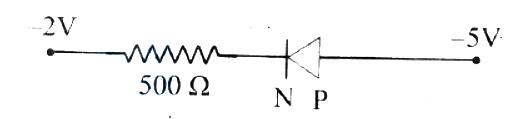 MHT CET 2024 Easy
 - \(\int \frac{\cos 2 x-\cos 2 \alpha}{\cos x-\cos \alpha} \mathrm{d} x=\)MHT CET 2025 Medium
- The equation of pair of lines \(y=\mathrm{p} x\) and \(y=\mathrm{q} x\) can be written as \((y-\mathrm{p} x)(y-\mathrm{q} x)=0\). Then the equation of the pair of the angle bisectors of the lines \(x^2-4 x y-5 y^2=0\) isMHT CET 2024 Hard