


MHT CET · Maths · Vector Algebra
Let \(\overline{\mathrm{a}}, \overline{\mathrm{b}}\) and \(\overline{\mathrm{c}}\) be three vectors having magnitude 1,1 and 2 respectively. If \(\overline{\mathrm{a}} \times(\overline{\mathrm{a}} \times \overline{\mathrm{c}})+\overline{\mathrm{b}}=\overline{0}\), then the acute angle between \(\overline{\mathrm{a}}\) and \(\overline{\mathrm{c}}\) is
- A \(\frac{\pi}{6}\)
- B \(\frac{\pi}{4}\)
- C \(\frac{\pi}{3}\)
- D \(\frac{\pi}{2}\)
Answer & Solution
Correct Answer
(A) \(\frac{\pi}{6}\)
Step-by-step Solution
Detailed explanation
Given, \(|\bar{a}|=1,|\bar{b}|=1\) and \(|\bar{c}|=2\)
\(\begin{aligned}
& \text { Also, } \overline{\mathrm{a}} \times(\overline{\mathrm{a}} \times \overline{\mathrm{c}})+\overline{\mathrm{b}}=\overline{0} \\
& \Rightarrow(\overline{\mathrm{a}} \cdot \overline{\mathrm{c}}) \overline{\mathrm{a}}-(\overline{\mathrm{a}} \cdot \overline{\mathrm{a}}) \overline{\mathrm{c}}+\overline{\mathrm{b}}=\overline{\mathrm{c}} \\
& \Rightarrow(\overline{\mathrm{a}} \cdot \overline{\mathrm{c}}) \overline{\mathrm{a}}-\overline{\mathrm{c}}+\overline{\mathrm{b}}=\overline{0} \quad \quad \ldots\left[\because \overline{\mathrm{a}} \cdot \overline{\mathrm{a}}=|\overline{\mathrm{a}}|^2=1\right] \\
& \Rightarrow(\overline{\mathrm{a}} \cdot \overline{\mathrm{c}}) \overline{\mathrm{a}}-\overline{\mathrm{c}}=-\overline{\mathrm{b}} \\
& \Rightarrow|(\overline{\mathrm{a}} \cdot \overline{\mathrm{c}}) \overline{\mathrm{a}}-\overline{\mathrm{c}}|=|-\overline{\mathrm{b}}| \\
& \Rightarrow\left|(\overline{\mathrm{a}} \cdot \overline{\mathrm{c}})^{\overline{\mathrm{a}}-\overline{\mathrm{c}}}\right|^2=|\overline{\mathrm{b}}|^2 \\
& \Rightarrow|(\overline{\mathrm{a}} \cdot \overline{\mathrm{c}}) \overline{\mathrm{a}}|^2+|\overline{\mathrm{c}}|^2-2\{(\overline{\mathrm{a}} \cdot \overline{\mathrm{c}}) \overline{\mathrm{a}} \cdot \overline{\mathrm{c}}\}=|\overline{\mathrm{b}}|^2 \\
& \Rightarrow(\overline{\mathrm{a}} \cdot \overline{\mathrm{c}})^2|\overline{\mathrm{a}}|^2+|\overline{\mathrm{c}}|^2-2(\overline{\mathrm{a}} \cdot \overline{\mathrm{c}})(\overline{\mathrm{a}} \cdot \overline{\mathrm{c}})=|\overline{\mathrm{b}}|^2 \\
& \Rightarrow(\overline{\mathrm{a}} \cdot \overline{\mathrm{c}})^2\left\{|\overline{\mathrm{a}}|^2-2\right\}+|\overline{\mathrm{c}}|^2=|\overline{\mathrm{b}}|^2
\end{aligned}\)
\(\begin{aligned}
& \Rightarrow-(\overline{\mathrm{a}} \cdot \overline{\mathrm{c}})^2+4=1 \quad \ldots\left[\because|\overline{\mathrm{~b}}|^2=1,|\overline{\mathrm{c}}|^2=4\right] \\
& \Rightarrow(\overline{\mathrm{a}} \cdot \overline{\mathrm{c}})^2=3 \\
& \Rightarrow \overline{\mathrm{a}} \cdot \overline{\mathrm{c}}= \pm \sqrt{3} \\
& \Rightarrow|\overline{\mathrm{a}}||\overline{\mathrm{c}}| \cos \theta=\sqrt{3}
\end{aligned}\)
where \(\theta\) is an acute angle between \(\overline{\mathrm{a}}\) and \(\overline{\mathrm{c}}\)
\(\Rightarrow \cos \theta=\frac{\sqrt{3}}{2} \Rightarrow \theta=\frac{\pi}{6}\)
\(\begin{aligned}
& \text { Also, } \overline{\mathrm{a}} \times(\overline{\mathrm{a}} \times \overline{\mathrm{c}})+\overline{\mathrm{b}}=\overline{0} \\
& \Rightarrow(\overline{\mathrm{a}} \cdot \overline{\mathrm{c}}) \overline{\mathrm{a}}-(\overline{\mathrm{a}} \cdot \overline{\mathrm{a}}) \overline{\mathrm{c}}+\overline{\mathrm{b}}=\overline{\mathrm{c}} \\
& \Rightarrow(\overline{\mathrm{a}} \cdot \overline{\mathrm{c}}) \overline{\mathrm{a}}-\overline{\mathrm{c}}+\overline{\mathrm{b}}=\overline{0} \quad \quad \ldots\left[\because \overline{\mathrm{a}} \cdot \overline{\mathrm{a}}=|\overline{\mathrm{a}}|^2=1\right] \\
& \Rightarrow(\overline{\mathrm{a}} \cdot \overline{\mathrm{c}}) \overline{\mathrm{a}}-\overline{\mathrm{c}}=-\overline{\mathrm{b}} \\
& \Rightarrow|(\overline{\mathrm{a}} \cdot \overline{\mathrm{c}}) \overline{\mathrm{a}}-\overline{\mathrm{c}}|=|-\overline{\mathrm{b}}| \\
& \Rightarrow\left|(\overline{\mathrm{a}} \cdot \overline{\mathrm{c}})^{\overline{\mathrm{a}}-\overline{\mathrm{c}}}\right|^2=|\overline{\mathrm{b}}|^2 \\
& \Rightarrow|(\overline{\mathrm{a}} \cdot \overline{\mathrm{c}}) \overline{\mathrm{a}}|^2+|\overline{\mathrm{c}}|^2-2\{(\overline{\mathrm{a}} \cdot \overline{\mathrm{c}}) \overline{\mathrm{a}} \cdot \overline{\mathrm{c}}\}=|\overline{\mathrm{b}}|^2 \\
& \Rightarrow(\overline{\mathrm{a}} \cdot \overline{\mathrm{c}})^2|\overline{\mathrm{a}}|^2+|\overline{\mathrm{c}}|^2-2(\overline{\mathrm{a}} \cdot \overline{\mathrm{c}})(\overline{\mathrm{a}} \cdot \overline{\mathrm{c}})=|\overline{\mathrm{b}}|^2 \\
& \Rightarrow(\overline{\mathrm{a}} \cdot \overline{\mathrm{c}})^2\left\{|\overline{\mathrm{a}}|^2-2\right\}+|\overline{\mathrm{c}}|^2=|\overline{\mathrm{b}}|^2
\end{aligned}\)
\(\begin{aligned}
& \Rightarrow-(\overline{\mathrm{a}} \cdot \overline{\mathrm{c}})^2+4=1 \quad \ldots\left[\because|\overline{\mathrm{~b}}|^2=1,|\overline{\mathrm{c}}|^2=4\right] \\
& \Rightarrow(\overline{\mathrm{a}} \cdot \overline{\mathrm{c}})^2=3 \\
& \Rightarrow \overline{\mathrm{a}} \cdot \overline{\mathrm{c}}= \pm \sqrt{3} \\
& \Rightarrow|\overline{\mathrm{a}}||\overline{\mathrm{c}}| \cos \theta=\sqrt{3}
\end{aligned}\)
where \(\theta\) is an acute angle between \(\overline{\mathrm{a}}\) and \(\overline{\mathrm{c}}\)
\(\Rightarrow \cos \theta=\frac{\sqrt{3}}{2} \Rightarrow \theta=\frac{\pi}{6}\)
See the Complete Solution
Get step-by-step explanations for this and 2.5 Lakh+ more JEE, NEET & CET questions.
- Unlock all solutions
- Practice the full chapter
- Track accuracy across PYQs
4.8 rated on Google Play · 14,000+ reviews
More questions from Maths
- If \(f(x)=\frac{4^{x-\pi}+4^{\pi-x}-2}{(x-\pi)^2}\) for \(\neq \pi\), is continuous at \(x=\pi\), then \(=\mathrm{k} \quad\) for \(=\pi\)
\(\mathrm{k}=\)MHT CET 2021 Hard - Let \(M\) and \(N\) be foots of the perpendiculars drawn from the point \(\mathrm{P}(a, a, a)\) on the lines \(x-\mathrm{y}=0, \mathrm{z}=1\) and \(x+\mathrm{y}=0, \mathrm{z}=-1\) respectively and if \(\angle \mathrm{MPN}=90^{\circ}\) then \(a^2=\)MHT CET 2025 Hard
- In a triangle \(\mathrm{ABC}\), with usual notations, if \(\mathrm{c}=4\), then value of \((a-b)^2 \cos ^2 \frac{C}{2}+(a+b)^2 \sin ^2 \frac{C}{2}\) isMHT CET 2023 Hard
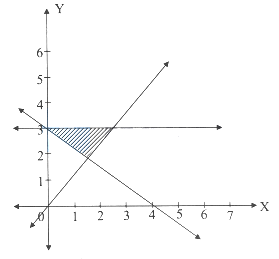
- If feasible region is as shown in the figure, then the related inequalities are
 MHT CET 2023 Easy
 - A spherical metal ball at \(80^{\circ} \mathrm{C}\) cools in 5 minutes to \(60^{\circ} \mathrm{C}\), in surrounding temperature of \(20^{\circ} \mathrm{C}\), then the temperature of the ball after 20 minutes is approximatelyMHT CET 2024 Medium
- The population of towns \(A\) and \(B\) increase at the rate proportional to their population present at that time. At the end of the year 1984, the population of both the towns was 20,000 . At the end of the year 1989, the population of town A was 25,000 and that of town B was 28,000. The difference of populations of towns A and B at the end of 1994 wasMHT CET 2025 Medium
More PYQs from MHT CET
- Which of the following interhalogen compounds in liquid state at room temperature?MHT CET 2025 Easy
- The order of the differential equation of all circles whose radius is is ________MHT CET 2019 Medium
- Calculate the molar mass of solute in a solution prepared by dissolving 1 gram in \(0.3 \mathrm{dm}^3\) solvent having osmotic pressure 0.2 atm at 300 K.
\(\left[\mathrm{R}=0.082 \mathrm{dm}^3 \mathrm{~atm} \mathrm{~K} \mathrm{~mol}^{-1}\right]\)MHT CET 2024 Easy - For the reaction
\(2 \mathrm{NO}_{(\mathrm{g})}+2 \mathrm{H}_{2(\mathrm{~g})} \longrightarrow \mathrm{N}_{2(\mathrm{~g})}+2 \mathrm{H}_2 \mathrm{O}_{(\mathrm{s})}\) \(\text {rate}=\mathrm{k}[\mathrm{NO}]^2\left[\mathrm{H}_2\right]\)
What is the order of reaction with respect to \(\mathrm{H}_2\) and overall order of reaction respectively?MHT CET 2024 Medium - Calculate the oxidation number of Cr in \(\mathrm{CrO}_4^{2-}\) ion and \(\mathrm{K}_2 \mathrm{Cr}_2 \mathrm{O}_7\) respectively.MHT CET 2024 Medium
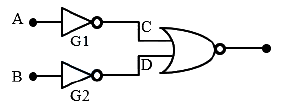
- The resultant gate and its Boolean expression in the given circuit is
 MHT CET 2021 Medium