


MHT CET · Maths · Quadratic Equation
In a \(\triangle \mathrm{PQR}, \mathrm{m} \angle \mathrm{R}=\frac{\pi}{2}\). If \(\tan \left(\frac{\mathrm{P}}{2}\right)\) and \(\tan \left(\frac{\mathrm{Q}}{2}\right)\) are the roots of the equation \(a x^2+b x+c=0(a \neq 0)\), then
- A \(\mathrm{a}+\mathrm{b}=\mathrm{c}\)
- B \(\mathrm{b}+\mathrm{c}=\mathrm{a}\)
- C \(\quad \mathrm{a}+\mathrm{c}=\mathrm{b}\)
- D \(\mathrm{b}=\mathrm{c}\)
Answer & Solution
Correct Answer
(A) \(\mathrm{a}+\mathrm{b}=\mathrm{c}\)
Step-by-step Solution
Detailed explanation
\(\text {In } \triangle \mathrm{PQR} \)
\( \angle \mathrm{P}+\angle \mathrm{Q}+\angle \mathrm{R}=180^{\circ} \)
\( \therefore \angle \mathrm{P}+\angle \mathrm{Q}+\frac{\pi}{2}=180^{\circ} \)
\( \therefore \angle \mathrm{P}+\angle \mathrm{Q}=\frac{\pi}{2} \)
\( \therefore \frac{\angle \mathrm{P}}{2}+\frac{\angle \mathrm{Q}}{2}=\frac{\pi}{4}\)
\(\tan \left(\frac{\mathrm{P}}{2}\right)\) and \(\tan \left(\frac{\mathrm{Q}}{2}\right)\) are roots of the equation
\(a x^2+b x+c=0\)...[Given]
\(\therefore\) Sum of roots \(=\frac{-b}{a}\)
\(\tan \left(\frac{\mathrm{P}}{2}\right)+\tan \left(\frac{\mathrm{Q}}{2}\right)=\frac{-\mathrm{b}}{\mathrm{a}}\)
Also, \(\tan \left(\frac{\mathrm{P}}{2}\right) \cdot \tan \left(\frac{\mathrm{Q}}{2}\right)=\frac{\mathrm{c}}{\mathrm{a}}\)
Using, \(\tan \left(\frac{P}{2}+\frac{Q}{2}\right)=\frac{\tan \frac{P}{2}+\tan \frac{Q}{2}}{1-\tan \frac{P}{2} \tan \frac{Q}{2}}\), we get
\(\Rightarrow \tan \left(\frac{\pi}{4}\right)=\frac{\frac{-b}{a}}{1-\frac{c}{a}} \)
\( \Rightarrow 1=\frac{-b}{a-c} \)
\( \Rightarrow \mathrm{a}-\mathrm{c}=-\mathrm{b} \)
\( \Rightarrow \mathrm{a}+\mathrm{b}=\mathrm{c}\)
\( \angle \mathrm{P}+\angle \mathrm{Q}+\angle \mathrm{R}=180^{\circ} \)
\( \therefore \angle \mathrm{P}+\angle \mathrm{Q}+\frac{\pi}{2}=180^{\circ} \)
\( \therefore \angle \mathrm{P}+\angle \mathrm{Q}=\frac{\pi}{2} \)
\( \therefore \frac{\angle \mathrm{P}}{2}+\frac{\angle \mathrm{Q}}{2}=\frac{\pi}{4}\)
\(\tan \left(\frac{\mathrm{P}}{2}\right)\) and \(\tan \left(\frac{\mathrm{Q}}{2}\right)\) are roots of the equation
\(a x^2+b x+c=0\)...[Given]
\(\therefore\) Sum of roots \(=\frac{-b}{a}\)
\(\tan \left(\frac{\mathrm{P}}{2}\right)+\tan \left(\frac{\mathrm{Q}}{2}\right)=\frac{-\mathrm{b}}{\mathrm{a}}\)
Also, \(\tan \left(\frac{\mathrm{P}}{2}\right) \cdot \tan \left(\frac{\mathrm{Q}}{2}\right)=\frac{\mathrm{c}}{\mathrm{a}}\)
Using, \(\tan \left(\frac{P}{2}+\frac{Q}{2}\right)=\frac{\tan \frac{P}{2}+\tan \frac{Q}{2}}{1-\tan \frac{P}{2} \tan \frac{Q}{2}}\), we get
\(\Rightarrow \tan \left(\frac{\pi}{4}\right)=\frac{\frac{-b}{a}}{1-\frac{c}{a}} \)
\( \Rightarrow 1=\frac{-b}{a-c} \)
\( \Rightarrow \mathrm{a}-\mathrm{c}=-\mathrm{b} \)
\( \Rightarrow \mathrm{a}+\mathrm{b}=\mathrm{c}\)
See the Complete Solution
Get step-by-step explanations for this and 2.5 Lakh+ more JEE, NEET & CET questions.
- Unlock all solutions
- Practice the full chapter
- Track accuracy across PYQs
4.8 rated on Google Play · 14,000+ reviews
More questions from Maths
- \( \sin ^{-1}\left[\sin \left(-600^{\circ}\right)\right]+\cot ^{-1}(-\sqrt{3})= \)MHT CET 2021 Medium
- If \(x^{2} y^{2}=\sin ^{-1} \sqrt{x^{2}+y^{2}}+\cos ^{-1} \sqrt{x^{2}+y^{2}}\), then \(\frac{d y}{d x}=\)MHT CET 2020 Easy
- If \(\overline{\mathrm{a}}=2 \hat{\imath}+3 \hat{\jmath}+\hat{\mathrm{k}}, \overline{\mathrm{b}}=4 \hat{\imath}+5 \hat{\jmath}+3 \hat{\mathrm{k}}\) and \(\overline{\mathrm{c}}=6 \hat{\imath}+\hat{\mathrm{j}}+5 \hat{\mathrm{k}}\) are the position vectors of the
vertices of a triangle ABC respectively, then the position vector of the intersection of the medians of the triangle \(\mathrm{ABC}\) isMHT CET 2020 Easy - Symbolic form of the given switching circuit is equivalent to ________
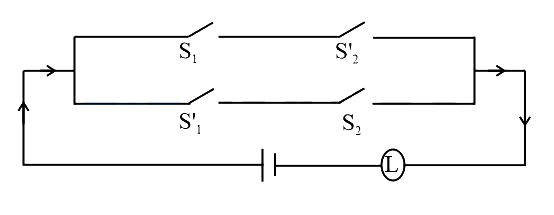 MHT CET 2016 Easy
 - The principal value of \(\cot ^{-1}\left(\frac{-1}{\sqrt{3}}\right)\) isMHT CET 2022 Easy
- A bag contains 5 red marbles, 4 black marbles and 3 white marbles. Then the number of ways in which 4 marbles can be drawn so that at most 2 of them are red isMHT CET 2022 Medium
More PYQs from MHT CET
- If \(y=\log \left[a^{3 x}\left(\frac{5-x}{x+4}\right)^{\frac{3}{4}}\right]\), then \(\frac{d y}{d x}=\)MHT CET 2020 Easy
- The maximum velocity of the photoelectrons emitted by a metal surface is \(9 \times 10^5 \mathrm{~m} / \mathrm{s}\). The value of ratio of charge (e) to mass (m) of the photoelectron is \(1.8 \times 10^{11} \mathrm{C} / \mathrm{kg}\). The value of stopping potential in volt isMHT CET 2025 Easy
- If \(\bar{a}\) and \(\bar{b}\) are vectors such that \(|\bar{a}|=3,|\bar{b}|=2\) and \(\bar{a} \cdot \bar{b}=5\), then \(=\) \(|\bar{a}-\bar{b}|=\)MHT CET 2022 Easy
- Which one of the following is a type of hyperploidy?MHT CET 2022 Medium
- The foot of the perpendicular drawn from the origin to the plane \(x+y+3 z-4=0\)
isMHT CET 2020 Easy - A weak monobasic acid is \(20 \%\) dissociated in it's \(0.01 \mathrm{M}\) solution. What is the dissociation constant of weak acid?MHT CET 2022 Medium